Author: RDN
ARE KOSOVO AND SERBIA IN A COLD WAR?
June 20, 2024
THE WAR-MONGERING AND VICTIM NARRATIVES LEAVE KOSOVO AND SERBIA BEHIND.
The 25th anniversary of the end of NATO’s bombing campaign against Serbian military, police and paramilitary forces, which marked the end of the 1998-1999 war in Kosovo, is approaching. Today, it seems that the citizens of Kosovo are experiencing a cold war with Serbia. The narratives used by Serbian and Kosovar officials cannot be compared; history has clearly marked who the aggressor was and who the victim was. However, any undiplomatic and divisive rhetoric, from either side, causes significant harm. Instead of moving forward these narratives cause both countries to stagnate.
The word “victim” is the one that most accurately describes the politics of the two leaders, Serbian President Aleksandar Vučić, and Kosovar Prime Minister Albin Kurti. By perpetuating this victim narrative, they mobilize their supporters by instilling the fear in citizens that “war is at our door” and could start at any moment.
The figure of the “enemy” is central to the narrative of these populist leaders. Rather than working to improve and ensure the well-being of their citizens, they involve them in an imaginary vicious cycle of insecurity. They nurture fear by claiming that imaginary enemies are constantly ready to attack and start a war. Both leaders intend to remain in power as long as possible by maintaining the status quo. They hope that, one day, history will remember them as nationalists or patriots who knew how to protect their country, its sovereignty and constitutional order.
Their goal requires four elements. First, they need people to believe that they are victims and to vote for them unequivocally in the elections, even if they are dissatisfied with the social situation in the country. Second, they must promote a persuasive narrative that they have long been victims of their neighbors or the international community. Third, they need a compelling narrative based on half-truths about the threat of occupation. Fourth, they must employ various methods and techniques to achieve their goal, the most effective being the use of hateful rhetoric and a refusal to compromise, which reinforce the deeply rooted status quo.
Dehumanization of Albanians and victimization of Serbs
A dehumanizing narrative towards Kosovar Albanians prevails among Serbian citizens today. This is not surprising when viewed through the lens of history, where Serbian politicians, writers and academics, have long attributed derogatory characteristics to Kosovar Albanians. Serbia’s denial of war crimes, including massacres and the denial of the existence of Kosovo, has been a permanent element in Serbian political discourse over the years.
In a 2018 United Nations Security Council meeting focused on Kosovo, Ivica Dačić, then Serbia’s foreign minister, stated that Vlora Çitaku, former ambassador of Kosovo to the US, “is not Kosovar, but Albanian and that the Kosovar nation does not exist.” Terms such as “self-proclaimed state of Kosovo,” “fake state of Kosovo” and “temporary institutions of Kosovo” are part of a wide vocabulary that has been used for the last 16 years, not only by Serbian officials but also by media outlets largely influenced by the Serbian government.
The dialogue in Brussels, launched with the aim to normalize relations between Kosovo and Serbia, has highlighted many instances of inappropriate language used by officials from both sides. These officials often receive applause from their supporters for their remarks. Statements made after each round of negotiations suggest a zero-sum outcome, where one side perceives itself as having won everything and the other has lost. This mindset contributes to the current low level of negotiations.
In the context of the ongoing crises in the Serb-majority municipalities in northern Kosovo, Vučić made one of his most serious statements. In December 2022, Kosovo Serbs employed in the public sector resigned, creating an institutional vacuum. In response to Kurti’s interventions — appointing Nenad Rašić as Minister for Communities and Returns and Rada Trajković as Rašić’s advisor — Vučić called Kurti “terrorist scum” and labeled Rašić and Trajković “the worst Serbian scum from the bottom of the barrel.”
Vučić went even further at the Security Council’s last meeting concerning the situation in Kosovo on April 22, 2024. He complained that the Kurti was not present because he was “busy undermining regional stability, personally leading his party’s campaign in the North Macedonian elections.” This remark was made during the election campaign for the new president of North Macedonia. Vučić added, “I want to send a message to the people of North Macedonia that meddling in their internal affairs is not Serbia’s policy, but the action of our irresponsible citizen, Albin Kurti.” These words will undoubtedly remain examples of harsh and hateful discourse in world diplomacy, as well as clear examples of fostering nationalism.
The pejorative term for Albanians, “shiptari,” was legalized by the Serbian courts in 2021 when the Court of Appeal dismissed a lawsuit filed by the National Council of Albanians in Serbia against the then Minister of Internal Affairs, Aleksandar Vulin, for his use of the term in 2019. This term is often used by Vulin, who is currently on the U.S. blacklist due to his involvement in corruption that has negatively impacted Balkan stability. The Belgrade-based organization Women in Black, a peaceful movement and feminist organization, condemned this decision. They stated that with this decision, “the court has given legal-institutional power to the language of hatred, intolerance, and xenophobia towards Albanians, especially those who live in Serbia.”
Meanwhile, for Serbian citizens who dare to acknowledge the crimes committed in Kosovo between 1998-1999, the Sandulović case gives a clear message. Nikola Sandulović, a pro-Western politician in Serbia, laid flowers on the grave of a child from the Jashari family, who was killed in 1998. Over 50 family members, including children of the Kosovo Liberation Army (KLA) commander, Adem Jashari, were killed in their house in Prekaz by Serbian forces.
Sandulović publicly apologized for the crimes committed by the Serbian state against civilians. After returning to Serbia, he was subjected to a severe beating which left him semi-paralyzed. According to him, he was tortured by the Serbian Secret Service. This case also serves as evidence for the international community that Serbia remains unwilling to acknowledge the crimes committed in Kosovo.
This year, Serbian politicians have revived the victim narrative by claiming that, through several decisions, the Kosovo government wants to expel local Kosovo Serbs. Igor Simić, vice-president of Srpska Lista, stated in an interview on TV Pink, a pro-government media outlet, that Kosovo Serbs are facing the most difficult times since 1999. Simić said this is due to the recent decisions made by the Kosovo government regarding establishing the euro as the main trading currency. In December 2023, the Central Bank of Kosovo decided that the euro would be the only trading currency, thereby prohibiting the use of the dinar in Serb-majority municipalities in Kosovo, where it is still used. This led to political tension.
“It is evident that the prime minister of the temporary institutions of Prishtina, Albin Kurti, wants to end the Serbian issue in Kosovo and Metohija at any cost,” said Simić, adding “His goal is to render life impossible for Serbs in both southern and northern Kosovo and Metohija, to disrupt their well-being, the payment of salaries and to prevent Serbs from surviving in their centuries-old hearths.”
Newly elected Serbian Prime Minister Miloš Vučević has continued the nationalist narrative against Kosovo and its government. In an interview, he claimed that the Serbian army “is the strongest in the region and can repel any potential aggressor and any attempt by Kurti to cause a new March pogrom or Storm.” Vučević referred to the March 2004 riots in Kosovo and the 1995 Croatian operation that recaptured territory in the Krajina region. According to the Croatian Helsinki Committee, the Croatian army killed 410 Serb civilians and displaced 200,000 people.
Freezing the status quo
On September 24, 2023, an armed Serb group led by Milan Radoičić, vice president of Srpska Lista and supported by Vučić, attacked a Kosovo Police unit in the village of Banjska in Zvečan, killing Sergeant Afrim Bunjaku.
Since then, Kurti and President of Kosovo Vjosa Osmani have frequently warned about the risk of an armed attack from Serbia during public appearances, international conferences and meetings with foreign diplomats.
The Kosovo government has repeatedly mentioned the risk of war, armed attack or invasion by Serbia, especially in interviews for international media outlets, even before the Banjska attack. Kurti has suggested that Kosovo is so threatened that citizens could wake up to a war at any moment. This focus has caused other pressing issues to become non priorities.
Kurti’s public language towards Vučić and the Serbian state only fosters this war narrative.
“Little Putin” is a term that Kurti uses to refer to Vučić.
In April 2022, Kurti wrote on Facebook: “With Putin’s friend in Republika Srpska [Milorad Dodik] and little Putin in Serbia [Aleksandar Vučić], peace and security in the Western Balkans have never been more endangered.” He further added that fascism is not reserved for Germany and Italy between the two world wars or for Pinochet’s Chile half a century ago. “Any nation or state can end up in fascism,” Prime Minister Kurti wrote, referring to Serbia. While Serbia assures the international community that it is a guardian of peace in the Balkans, it accuses Kurti of inciting war and persecuting Kosovo Serbs.
Both sides boast about the weaponry purchased and their military budgets. Kurti and his associates say they are ready for any attack from Serbia. On the other hand, Vučić indirectly doesn’t rule out the possibility of armed conflict, pledging to never abandon the Kosovo Serbs or leave them empty-handed. Recently, in the north of Kosovo, Kosovo Police have seized various weapons, ammunition and uniforms brought by Serbia.
In their political maneuvers, statements, verbal attacks and mutual accusations, both sides seem to exploit the armed conflicts in Ukraine and now in Gaza. They use these conflicts as opportunities to justify rattling their guns or accusing the other side of warmongering.
Kurti and Vučić also portray international officials as external enemies. Kurti has called United States Secretary of State Antony Blinken, “naive” for trusting Vučić. He has also called EU Special Representative for the Belgrade-Pristina Dialogue Miroslav Lajčak, and EU High Representative, Josep Borrell, “one-sided” as they favor Serbia.
Vučić stated that Kosovo is a child of the international community and that, whatever it does, the international community will protect it. “What do you want, to bomb us?” stated Vučić in a press conference, in the context of pressure from the international community for Serbia to recognize Kosovo. Of course, Vučić’s answer was: “No and never.”
Meanwhile, both sides face internal opposition. The opposition and individuals who criticize the stubborn and irrational policies of the current Serbian and Kosovar leaders. Vučić has stated that the Serbian opposition has the same goals as Kurti, his departure. Some of Kurti’s followers call anyone who dares to criticize him or his cabinet with the terms “shkije” — a pejorative term for Serbs — and Vučić’s spies.
Kosovar and Serbian officials share similar narratives with one goal — freezing the status quo. Why? Because they do not want to be remembered as key politicians who have made compromises. Serbian politicians do not want to go down in history as those who lost the “cradle of the Serbian people,” as they refer to Kosovo as. The current Kosovar government does not want to be remembered as the administration that accepted the creation of the Association of Serb-majority Municipalities, an initiative that, until recently, they denounced as a violation of Kosovo’s sovereignty.
They maintain the status quo by using daily populist rhetoric and spreading fear of potential conflict, influencing their citizens. This fear prevents people from speaking out about worsening socioeconomic conditions and increasing poverty. Consequently, hundreds of young people and professionals leave Kosovo and Serbia daily, seeking opportunities in Western European countries.
This populist rhetoric, often filled with hate speech, leads to mutual societal radicalization and a rise in nationalism. Nationalism, in turn, can escalate into violent extremism or various levels of armed conflicts.
Author: Violeta Oroshi Berishaj
Feature Image: K2.0
This article was originally produced for and published by Kosovo 2.0. It has been re-published here with permission.

Monthly Monitoring Highlights May: sexism and genocide denial
June 14, 2024
Throughout the month of May, the RDN monitoring team has detected a range of hateful narratives and discourse. This month, we have seen hatred based on gender, sexual orientation, genocide denial, and hatred against political opponents.
Sexism in Montenegro, North Macedonia and Kosovo.
In Montenegro, during the TV show “Some like it hot” on Adria TV, university professor Aleksandar Stamatović sexually harassed host Irena Tatar by commenting on her breasts. At the end of the show when the host was thanking her guests and wrapping up the programme, Stamatović said that during the entire show he was concentrating on the inscription on her T-shirt, around the area of her chest. He proceeded to imply that he could not take his eyes off her breasts, stating that he likes what is ‘underneath her T-shirt’.
In Montenegro, sexual harassment by men is so common that sometimes it is accepted as some minor inconvenience for a woman, and not treated as a type of gender-based discrimination and violence, that can be serious. Consequently, even somebody who should serve as a reputable figure – in this case a professor at the University of Montenegro, freely spreads sexist and misogynistic commentary on a TV show with little to no restraint.
This blatant case of sexism on public TV is extremely problematic. Despite the fact that TV Adria did come out to condemn the events which took place, Stamatović should still apologise and acknowledge the harm of his actions and words. Sexism should not be tolerated on any scale on any platform. Journalists and women in the media in Montenegro, and across the region often face sexism and discrimination while working.
In North Macedonia, an online portal published a story about a brother of the singer Adelina Tahiri who was getting married to a Macedonian woman. Adelina herself is of Albanian ethnicity which sparked various hateful comments from the Albanian population against Tahiri due to her affiliation with Macedonians.
North Macedonia is a diverse country with a significant Albanian minority alongside the Macedonian majority, reflecting its complex ethnic landscape. Historical tensions between these communities have been rooted in cultural, political, and social differences, often exacerbated by political leaders and members of society who emphasise such tensions and divisions.
Tensions and hate between ethnic groups in North Macedonia undermine national unity and social cohesion. This animosity fosters discrimination and exclusion, preventing the equitable participation of all communities in the political and social spheres. Hate and division overall undermine efforts towards peace and ethnic diversity within the country. Messages of hate such as these only further fuel narratives of divide and drive a wedge between various ethnic groups living within the same country.
In Kosovo, the “Albkings” group on the “Telegram” Messenger distributed intimate photos of women and girls, as well as their contact numbers. Explicit photos and other personal information were also shared on social media. The women and girls then received calls from unknown persons and were harassed with messages. Women and girls, including minors, have been the main victims of this group which has existed since November 2022. The media only started writing about the group, which numbers over 150,000 people, in 2023, upon discovering it.
The Kosovo police reacted and in two cases arrested members of the group. According to media reports, this group distributed pornographic and paedophilic materials and was involved in the sale of narcotics. Journalists from various newsrooms who reported on the group were targeted, receiving anonymous calls and messages. The police have arrested seven individuals, including the group’s main administrator and a woman (an individual who is part of the same group). Authorities have urged all individuals targeted by the group to come forward and testify, highlighting that the investigation is ongoing and exploring multiple leads. It is also worth noting that the police shut down this private group on two separate occasions; however, it quickly became operational again each time.
Online groups that share pornographic content of young girls and women pose a grave threat to the safety and well-being of minors. This case indicates the growing threat of image-based sexual abuse in the region, as this is not the first case of such group in the Western Balkans. Not only are such groups illegal, but furthermore, the proliferation of such content is extremely harmful to the victims who have been exploited by such groups. Indeed, one of the reasons why part of the media was persistent and continuously reported on this group (even if the police asked that it not be reported on for a while, so that it would be easier to investigate) is the risk of suicide of women and girls whose profiles were stolen and whose personal data and phone numbers were published.
The publishing of personal and sensitive content of anyone without their permission is illegal and unjustifiable. Moreover, the existence of these groups undermines societal values, erodes trust in digital platforms, and highlights the urgent need for more strict and effective regulations to protect vulnerable individuals and hold perpetrators accountable.
Hate against political opponents in Serbia.
In Serbia in May, campaigning for local elections, that took place in 89 cities and municipalities on June 3, ended. There was an increase in hate speech against political opponents both leading up to the vote, throughout the campaign and through media coverage of elections.
During an interview with the president of Serbia, Aleksandar Vučić, on TV Pink, a video aired targeting primarily opposition politician Savo Manojlović, but also young human rights activists and other public figures allegedly “connected” to him. This video was presented as “one of the most viral videos in Serbia” by host Jovana Jeremić, however we were unable to find it online. The video titled “Antisrpska prevara” (Anti-Serb fraud) does not involve direct hate speech, however, they all are targeted based on their political views that are considered “unacceptable” in Serbia, such as supporting the UN resolution on genocide in Srebrenica, and Kosovo independence. Names and pictures of young activists were shown and they were labeled as “anti-Serb”, insinuating they are traitors and are working against their country. This incident is part of a larger narrative surrounding not only the adopted resolution, but also an increasing negative and on occasion hateful election campaign against political opponents. Manojlović seems to be a common target of this campaign, as there was a similar incident on TV Pink just a few days earlier.
An AI-augmented video of opposition leader Savo Manojlović aired multiple times on TV Pink during the news. Pink presented the fake video of Manojlovic as “a joke made using AI technology”, however, did not explain that AI stands for artificial intelligence and what this means exactly, misleading the viewers. The Regulatory Body for Electronic Media (REM) initiated proceedings against TV Pink shortly after. Tabloid media published many texts calling opposition politicians, activists who are against the regime and even some journalists reporting live during the election day “criminals” and “violent”.
The Bureau for Social Research (BIRODI) stated that central news broadcasts on television channels with national coverage provided eight times more space for the representatives of the ruling party than the opposition throughout this month. The ruling party was also represented in an “extremely positive” manner, with zero “negative” seconds.
Ensuring a platform for diverse political opinions and parties leading up to elections is crucial for a healthy democracy, as it fosters informed decision-making, preventing the domination of certain political groups and opinions. Hatred towards political opponents is never justified on grounds of political difference or opposing opinions. Everyone should have their platform to voice their political views and for a healthy debate to take place without hate and discrimination.
Genocide denial in Bosnia and Herzegovina.
In May, the UN General Assembly adopted the resolution on the Srebrenica genocide, which proclaims 11 July as the ‘International Day of Reflection and Commemoration of the 1995 Srebrenica Genocide’. The resolution condemns ‘any denial of the genocide in Srebrenica as a historical event and actions that glorify those convicted by international courts of war crimes, crimes against humanity and genocide’.
Both before and after the announcement of the adoption of the resolution, there was a rise of genocide denial amongst prominent politician figures in the country including the president of the Bosnian entity Republika Srpska Milorad Dodik, who once again, on the day when the United Nations adopted the resolution, denied the genocide in Srebrenica. When asked by a Klix.ba reporter if he was aware that on that day he denied the genocide in Srebrenica several times even though it is punishable by the Criminal Code of Bosnia and Herzegovina, Dodik repeated his earlier claims without hesitation. “You don’t understand what I said. There was no genocide in Srebrenica. Do you want me to say it one more time? Are you recording me well, is it a close-up shot? There was no genocide in Srebrenica, because that’s what many authorities who deal with it say. I’m not the authority here, neither Lagumdžija or Bećirović, but people who invested their entire scientific lives to know what this qualification is,” said Dodik.
Furthermore, the Minister of Security of Bosnia and Herzegovina, whilst talking on the Serbian TV Happy, mocked and insulted the victims of the genocide in Srebrenica by telling a joke: “born in Sarajevo, buried in Srebrenica, lives in Germany”.
At the same time, some of the highest BiH military officials of Serb origin, wearing uniforms with state insignia, paid their respects to the convicted war criminal Ratko Mladić. The event took place in Kalinovik, the birthplace of Mladić.
From July 28, 2021, after changes to the Criminal Code of Bosnia and Herzegovina were imposed by the former high representative in Bosnia and Herzegovina, Valentin Inzko, the glorification of war crimes in BiH became punishable by imprisonment. Two and a half years after these changes were made and after dozens of rejected reports, the Prosecution of Bosnia and Herzegovina brought the first indictment in January of this year against the president of the “Eastern Alternative” association in Bratunac, for a poster congratulating Ratko Mladić on his birthday. Nevertheless, most politicians in Republika Srpska continue to undermine and deny the genocide which took place in Srebrenica whilst simultaneously glorifying war criminals. Indeed, Milorad Dodik is one of the biggest deniers of the Srebrenica genocide. According to research by the Srebrenica Memorial Centre, Dodik denied the Srebrenica genocide in various ways no less than 11 times in 2023.
Messages glorifying war criminals are harmful and insulting to the victims of the Srebrenica genocide and their families. Glorifying war criminals and denying genocide perpetuates a dangerous narrative that undermines justice and distorts historical truth, as well as further deepens divisions and slows down the necessary process of dealing with the past and peacebuilding in BiH and the whole region.
Hatred against the LGBTIQ+ community in Albania.
On the 19th of May on the terrace of the Tirana City Hall, same-sex couple Alba Ahmetaj and Edlira Mara held an unofficial wedding ceremony. It is important to note that same-sex marriage is not allowed in Albania, and their union will not be recognised by the state. However, the couple, who were married by two British pastors, wanted to send a message. They took the decision to go to court to be recognised as the joint parents of their daughters. If this fails, they plan to refer their case to the European Court of Human Rights in Strasbourg.
This news was widely reported by Albanian media, including different points of view, both for and against same-sex marriage. Various media outlets also presented the perspectives of religious communities, both Muslim and Christian, who oppose same-sex marriage. These outlets largely succeeded in providing objective and neutral coverage by including diverse viewpoints. However, despite this balanced reporting, social media platforms saw a significant surge in hate speech and negative comments directed at the LGBTIQ+ community, flooding every news portal on these platforms. Same-sex marriage represents a fundamental right to love and equality, affirming that all individuals, regardless of their sexual orientation, deserve the same legal and social recognition. Anti-LGBTIQ+ rhetoric undermines this principle, fostering discrimination, and perpetuating hate and inequality. Such rhetoric is unacceptable as it violates the core values of respect, dignity, and human rights that should be afforded to every person. Embracing diversity and promoting inclusivity is essential for building a fair and equitable society.
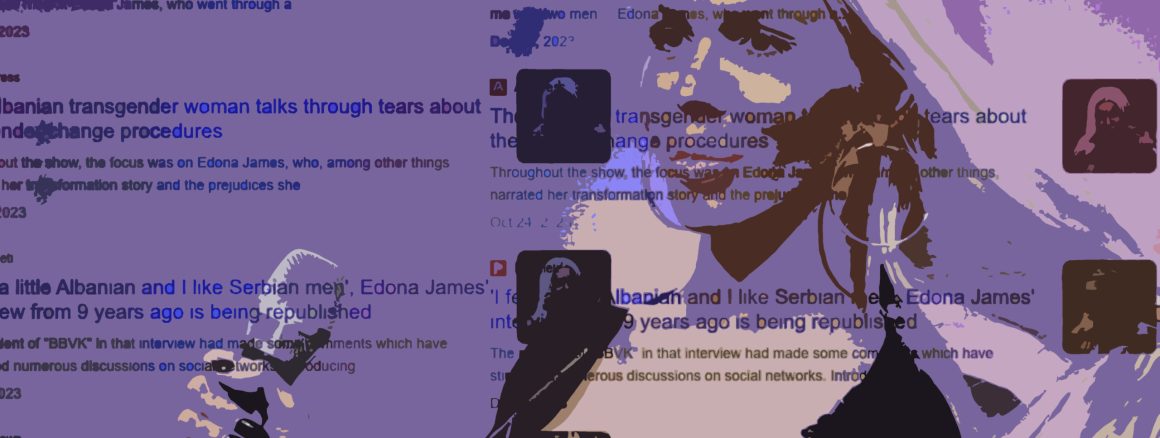
SENSATIONALIST MEDIA COVERAGE DEHUMANIZES EDONA JAMES
June 10, 2024
CLICKBAIT ARTICLES ARE UNETHICAL AND HARMFUL FOR THE LGBTQ+ COMMUNITY.
While sitting at a restaurant in Prishtina this past winter, I overheard a conversation between two waiters. Their discussion was difficult to ignore. “I understand that people are free to live however they want,” said one of the waiters, “but how should we explain it to our kids? On one hand, we can’t say it’s wrong, but we can’t tell them it’s right either.” The other waiter nodded in agreement.
The two waiters were discussing Edona James, the first trans woman to compete on Kosovo’s most-watched reality TV show, “Big Brother VIP.” While the show had only aired a few months prior, James had quickly become an audience favorite and topic of discussion far beyond that restaurant. Alongside her growing popularity, she disrupted the comfort of those who preferred to remain unaware of an openly trans Albanian woman.
ALONGSIDE HER GROWING POPULARITY, SHE DISRUPTED THE COMFORT OF THOSE WHO PREFERRED TO REMAIN UNAWARE OF AN OPENLY TRANS ALBANIAN WOMAN.
The broader societal conversation about James was marked by confusion, alarm and ultimately, fascination. Her representation in Kosovar media was informed by a state of societal shock, which has proven to be a profitable enterprise for reality television.
Media coverage on shows like “Big Brother” is inherently sensationalist and scandal-ridden, with reality stars often being reduced to clickbait headlines that spark controversy for views. However, this type of coverage becomes disturbing when media outlets use a trans woman’s identity to manufacture controversy. While other contestants on “Big Brother” were also subjected to sensationalist reporting, James was exploited by media outlets because of her gender identity. As such, she has become a tool for Kosovar media to construct a compelling scandal, further dehumanizing her.
James’ popularity before “Big Brother”
In order to fully understand James’ positionality in Kosovar media, it’s worth examining her very first interviews from 10 years ago, comparing them to the media coverage during “Big Brother.” James was introduced to the Kosovar public through an interview with Privé TV in 2014 titled “Edona James: the Albanian who Crossed the Rainbow,” echoing a recurring Albanian myth that “crossing the rainbow” changes one’s gender. A journalist who worked for Privé at the time, Vlorijan Halili, claimed that he discovered James through her appearances on RTL, a German TV program about show business. James emigrated to Germany during her childhood and established herself as a well-known figure in German media.
According to Halili, the fact that James was presented as both Albanian and trans intrigued him; he knew she would make a good story. “I thought to myself: there’s something here. It needs to be explored,” he said. After Halili reached out to her multiple times, James agreed to be interviewed and was apparently very open to sharing her experiences. Still, it’s evident Privé took advantage of her open personality to create a compelling story. “She became a sensation,” said Halili.
James was misgendered from the outset of the Privé interview; she was identified with the masculine form of the word “Albanian,” or “Shqiptari,” in the episode title. The interviewer revealed her deadname and used derogatory language to introduce her, painting a sensationalist narrative of James’ transition by claiming that she is “an Albanian man who no longer wanted to be the man of the house, so he decided to become a woman.” The interviewer further dehumanized her by mentioning that she now “has sex with men” and has “changed her organs.”
As the first Kosovar trans woman to come out on TV and reveal that she had undergone gender affirming surgery, James received hateful and negative backlash in the media after this interview. The hate speech against her was a reminder of the constant danger that trans women face in Kosovo. James has said that this experience deterred her from coming back to the country for a decade.
THE HATE SPEECH AGAINST HER WAS A REMINDER OF THE CONSTANT DANGER THAT TRANS WOMEN FACE IN KOSOVO.
James was also invited as a guest on the “Ami G Show” in Serbia, where the interviewer posed invasive questions about her transition, asking whether she has “operated on everything.” These interviews did not attempt to genuinely understand James on a personal level. Instead, they imposed a theatrical narrative on her to attract more viewers. She was stripped of her personhood because she was a trans woman, valued only for the sensationalist headlines that she could contribute to.
Recent online media coverage of James continues to perpetuate this dehumanizing narrative. In November 2023, Gazeta Express released an article claiming to reveal a photo of James pre-transition, when she was only six years old. The headline reads: “A small boy, this is what Edona James looked like at 6 years old.” Other articles written by Sot News and Pamfleti refer to her as “Transgender Edona James,” emphasizing the word transgender to maximize views and engagement. Pamfleti has also directly used James’ deadname for an eye-catching headline. Albeu published an article sharing alleged photos of her “before the surgeries,” with a headline that reads: “Are you curious? This is what Edona James looked like before her surgeries.”
Some articles even use derogatory language to refer to her identity. This demeaning media coverage only inflames existing prejudices against trans women and leads to their further marginalization. Instead of James being represented as a real person, her entire existence is reduced to a scandal.
THIS DEMEANING MEDIA COVERAGE ONLY INFLAMES EXISTING PREJUDICES AGAINST TRANS WOMEN AND LEADS TO THEIR FURTHER MARGINALIZATION.
Media companies should not promote disrespectful and discriminatory narratives about trans women for profit and should be held responsible for not abiding by ethical standards of reporting on LGBTQ+ issues. The language being spread by these articles only makes it more difficult for trans women to integrate into Kosovar society, as they are turned into caricatures and spectacles.
James as a positive and beneficial figure in Kosovar society
Although Kosovar media continues to sensationalize James’ experiences as a trans woman, participating in “Big Brother” has given her a chance to connect with audiences directly and express herself freely. Rather than having her presence moderated and filtered through an interviewer, as has been the case in her various TV interviews, James has used “Big Brother” to show viewers that she is a multi-faceted person. Her popularity and likeability lie in her humor, courage to speak her mind and honest personality. These qualities have made her go viral on TikTok and gain a loyal fanbase.
It seems that there is a discrepancy between public opinion on James, which is largely positive, and the damaging media coverage that uses her gender identity to generate profit. In fact, a report by Freedom House found that James has positively contributed to shifting public perceptions of transgender people in Kosovo. The support she received during her time on “Big Brother” has been instrumental in forging a more accepting society, but there is still a long way to go as far as media representation is concerned.
THE SUPPORT SHE RECEIVED DURING HER TIME ON “BIG BROTHER” HAS BEEN INSTRUMENTAL IN FORGING A MORE ACCEPTING SOCIETY, BUT THERE IS STILL A LONG WAY TO GO AS FAR AS MEDIA REPRESENTATION IS CONCERNED.
James was exploited by the media and turned into a face of controversy and scandal not because she was a reality TV contestant, but because she was a trans woman. If the rights of trans people are to be prioritized, the discrimination trans women face in Kosovar media is an issue that needs to be addressed. Most importantly, media outlets that perpetuate damaging narratives need to be held accountable and understand the consequences of reducing trans women to sensations.
Unethical and unprofessional reporting not only reinforces negative perceptions of LGBTQ+ people, but also leads to violence against them. James has recently shared many instances of the hateful or even threatening comments that she receives on a daily basis, and the articles mentioned in this story only fuel these harmful sentiments against her. In order to build a society that protects trans women, media companies must respect their agency and treat them as the humans and citizens they are instead of exploiting their experiences for views and profit.
Feature Image: Atdhe Mulla / K2.0
Author: Adora Limani
This article was originally produced for and published by Kosovo 2.0. It has been re-published here with permission.
WHO’S AFRAID OF UNMARRIED MOTHERS?
June 5, 2024
GENDERED DISINFORMATION HAS PLAGUED THE DEBATE ABOUT KOSOVO’S IVF DRAFT LAW.
In a TV debate in February 2024, Ferid Agani, Kosovo’s former health minister, declared that “A woman without a partner is mentally unstable.” Agani said this in reference to unmarried women who have a child through in vitro fertilization (IVF) with an unknown donor, as the Draft Law on Reproductive Health and Medically Assisted Conception currently proposes to allow. Agani, as a former minister, doesn’t hold political power, but his words reflect the broader toxic debate.
The draft law in question, which derives from the Administrative Instruction No. 06/2023 on Medically Assisted Conception, has repeatedly not been approved by the Kosovo Assembly over several rounds of voting, mainly due to opposition by assembly members in the ruling Vetëvendosje (VV) party. If passed, it would allow couples who cannot afford assisted fertility in private hospitals to receive IVF in public health institutions. Single women being able to receive IVF in public healthcare facilities would be an important step toward further securing women’s reproductive rights and women’s bodily autonomy. To this point, IVF has only been available in private hospitals, at high cost.
SINGLE WOMEN BEING ABLE TO RECEIVE IVF WOULD BE AN IMPORTANT STEP TOWARD FURTHER SECURING WOMEN’S REPRODUCTIVE RIGHTS AND WOMEN’S BODILY AUTONOMY.
The extensive debate about IVF in the assembly and on television centered on the supposed harm it brings to our society. The main source of grievance is article 15 of the draft law, which gives single women over the age of 18 access to IVF, allowing women to independently start and build families.
Several socially conservative MPs voiced concerns that the new draft law would allow unmarried women to become mothers through medically assisted conception. This, they argue, violates the institutions of marriage and family, but this argument is misguided because it rests on a conservative and outdated notion of what a family is.
The blatant misogyny of comments such as Agani’s corresponds with prevalent and traditional heteronormative thinking and living. Unless a woman fulfills the image of a sacrificial mother, is at the service of her husband and his family and helps further the bloodline, she is perceived as unnatural and alienated from other women.
Unmarried and alienated
Such misogyny — calling a single woman insane — has long been heard and fought against. This context led filmmaker Irina Dunn to coin the famous catchphrase “A woman without a man is like a fish without a bicycle.” This slogan was also later popularized by feminist activist and writer Gloria Steinem.
Unmarried women have historically been stigmatized by patriarchal families, seen as burdens or as pitiful creatures who didn’t live life to its fullest. Narratives like this reduce women’s worth to their marital status and draw upon traditional constructions of femininity. They use hyperbolic language and stereotypes to convey inaccurate and misleading claims aiming at polarizing public opinion. This is gendered disinformation, a form of gender-based violence and violence against women in particular that uses sexist and misogynistic narratives to maintain the patriarchal heteronormative status quo.
UNMARRIED WOMEN HAVE HISTORICALLY BEEN STIGMATIZED BY PATRIARCHAL FAMILIES, SEEN AS BURDENS OR AS PITIFUL CREATURES WHO DIDN’T LIVE LIFE TO ITS FULLEST.
One such narrative, fear-mongering about women’s rights to single motherhood through IVF, has been consistently reinforced by various MPs. These include Visar Korenica, Eman Rrahmani and Labinotë Murtezi-Demi from Vetëvendosje (VV), Albena Reshitaj from the Alliance for the Future of Kosovo (AAK) and Duda Balje, the chairperson of the Parliamentary Commission for Human Rights. Such voices have pushed sensationalist narratives about the destruction of traditional institutions of marriage and family, pregnancy without a father, a child without a father, a woman without a partner being insane, IVF through an unknown donor causing incest or compromising our national identity.
(The fear of) an end to fatherhood
Another key gendered disinformation narrative reinforced in Kosovo’s public discourse is that single motherhood through IVF makes fathers irrelevant. Social and religious groups insist that a child needs both a father and a mother. Others insist that the nuclear family is the so-called natural family model.
But the nuclear family has already reduced fathers to breadwinners and women to caregivers. It has tolerated and even enabled violent masculinity to flourish. A patriarchal family unit has produced a society where male violence is the norm, where violence against women is tradition and violence against children is discipline.
And who is in charge of maintaining the order and traditions within the nuclear family? Women, particularly mothers. More precisely, obedient ones, who have to perform their roles with a big smile on their faces and admit to the world that being a mother is the biggest honor and accomplishment of their lives.
Mothers are overloaded with unpaid care work, are often victims of domestic violence, largely unemployed and financially dependent, economically abused, even raped by their own husbands. But such lives, regardless of the brutal hardships, are deemed acceptable because a married woman’s marital status is considered a validation for her as a human being. Rarely have we heard from MPs that such violations of women’s bodies and their lives are detrimental to the institution of marriage or the traditional family.
Whether they provide financially or not, fathers in Kosovo generally seem happy with their biological contribution. Parental responsibility is typically not equally divided among married couples. The people who help mothers take care of their children are usually other women: their own mothers, mothers-in-law, sisters, aunts and so forth. We still don’t collectively demand qualitative contribution of men in family life, in equal partnership and more humane marital roles, as well as in the upbringing of children.
WHETHER THEY PROVIDE FINANCIALLY OR NOT, FATHERS IN KOSOVO GENERALLY SEEM HAPPY WITH THEIR BIOLOGICAL CONTRIBUTION.
Therefore, the polarization in Kosovo’s public discourse regarding reproductive rights and the accompanying health policies is about the autonomy that patriarchal societies and institutions despise so much in women — autonomy over their bodies, their lives and their definition of family. This autonomy gives women the vision, space and opportunity to lead their lives by their own informed choices.
Single and autonomous
All women are different, as are their motivations for motherhood. We might attribute it to the fiery desire and the fierce determination to act on hereditary maternal instincts that we may not even fully understand. It could be the need to fulfill one’s vision of womanhood or to respond to the internalized societal expectations for women’s gender roles. It could also simply be the joy of having a person who you will love fully and who will love you back.
Regardless of one’s motivation or decision to become a mother, it is important to acknowledge that going through IVF is physically and emotionally demanding. A woman who chooses this form of motherhood is already aware of the difficult path of parenthood and the commitment needed to dedicate her life to taking care of another human being.
IT IS THUS IMPORTANT THAT WE START DEMANDING HEALTHY MALE MODELS IN OUR HOMES AND IN OUR COMMUNITIES INSTEAD OF INSISTING ON BIOLOGICAL FATHERS’ SIGNIFICANCE.
A mark of political and social progress will be when people show less conflicting attitudes toward the image of a single mother who raises her child on her own by choice. It will come when people accept the fact that in some households, there may simply be no father or husband and when people know that this also constitutes a real family. It is thus important that we start demanding healthy male models in our homes and in our communities instead of insisting on biological fathers’ significance.
A single woman who chooses this path to motherhood will need the same services and resources to take care of herself and her child. Safe maternal care, breastfeeding support, and antenatal care apply the same to all women, regardless of their pregnancy background or marital status. Thus, the only thing that parliamentarians should panic about is whether women are being provided with high quality health care services.
Instead of contributing to disinformation and fearmongering, those holding public office should handle debates on sensitive issues with care. Details should be carefully discussed and clarified in respective parliamentary commissions, focus groups and other official meetings with key stakeholders, where civil society activists, particularly feminists, are an integral part of working groups.
Kosovo’s public is owed filtered and responsible information, but the information that it does receive breaks down trust, confuses people and diverts attention away from systemic solutions to problems that affect women, children and families. Holders of public office must communicate in ways that provide constructive education about responsible parenthood policies, family planning and that systemically uphold the rights of women, children and all humans.
Author: Shqipe Gjocaj
Feature Image: Majlinda Hoxha / K2.0
This article was originally produced for and published by Kosovo 2.0. It has been re-published here with permission.

TROLL OF THE MONTH: Journalist Darko Momić Čkalja
June 4, 2024
The Balkan Troll of the Month is an individual, group of individuals or media outlet that spreads hate based on gender, ethnicity, religion or other categories of diversity. The Balkan Troll is selected on the basis of hate speech incidents identified throughout the Western Balkans region.
In a column written by journalist Darko Momić Čkalja and published on the website of Nezavisne novine (Independent Newspapers), the author denied the genocide in Srebrenica and insulted the victims, in particular the Mothers of Srebrenica – mothers and relatives of the victims. The column had the mocking and insulting title “Fairly Tales of Srebrenica (Bajke Srebrenice)”, which sounds similar to Mothers of Srebrenica (Majke Srebrenice). The whole text conveys the message that the story behind the genocide in Srebrenica and the resolution on the genocide in Srebrenica is a fairy tale which, according to the author, is built on lies, manipulation and distortion of facts. He accuses the Mothers of Srebrenica, survivors and family members of those killed and missing in Srebrenica and Bratunac, of presenting even their stillborn babies as victims of genocide and of making themselves cry on command in front of TV stations, implying that it is all a show against the Serbs. He wrote that no one denies what happened in Srebrenica, but does not say what exactly, and that everyone with any sense justifies the pain of the survivors (as if such pain needs to be justified), but that no one can justify the behaviour of the Mothers of Srebrenica when they stand quietly in front of a cordon of peaceful policemen in Kravice ”until the cameras of Sarajevo’s television stations arrive, and then as if on command, they start crying and attacking the policemen”.
This column and discussion follows the recent adoption by the UN General Assembly of the resolution on the Srebrenica genocide, which proclaims 11 July as the ‘International Day of Reflection and Commemoration of the 1995 Srebrenica Genocide’. The resolution condemns ‘any denial of the genocide in Srebrenica as a historical event and actions that glorify those convicted by international courts of war crimes, crimes against humanity and genocide’. In addition, an outreach programme entitled “The Srebrenica Genocide and the United Nations” will be launched in 2025 on the thirtieth anniversary.
In response to the recently adopted resolution, there has been a rise in genocide denial. Political leaders from Republika Srpska have made numerous statements denying genocide, relativising war crimes, using offensive messages and spreading hate speech. According to the amendments to the Criminal Code of Bosnia and Herzegovina imposed by High Representative Valentin Inzko in 2021, it is a criminal offence to justify, trivialise and deny the crimes of genocide, war crimes and crimes against humanity in a way that could incite violence or hatred against a particular group of people. However, one of the prominent figures denying genocide is the President of the Bosnian entity Republika Srpska, Milorad Dodik. Dodik is one of the biggest deniers of the Srebrenica genocide, and according to research by the Srebrenica Memorial Centre last year, Dodik denied the genocide in various ways no less than 11 times in 2023.
In addition to genocide denial, political leaders from Republika Srpska and Serbia spread disinformation, relativising the nature of the genocide in Srebrenica and claiming that the UN resolution was a conspiracy of Western states against the Serbs with the aim of destroying the entity. Although the resolution reiterated that responsibility for genocide is individual, political leaders in the Republika and Serbia claimed that its intention was to portray the entire nation as genocidal and called for succession from BiH, creating a narrative of collective guilt. However, this resolution and international judgments only enforce individual responsibility.
The media often reported these statements without any critical approach, culminating in an organised marketing campaign in the week leading up to the UN General Assembly session, which was seen not only in traditional and social media, but also in public spaces. The main message was: “We are not a genocidal nation. We remember… Proud Serbia and (Republika) Srpska”. This message was plastered on billboards in cities throughout Serbia and Republika Srpska, including Srebrenica.
Darko Momić Čkalja’s column is another example of the response and reaction to the adopted UN resolution, published one day after its adoption. His entire journalistic column focuses on the idea that the Serbs were labelled a genocidal nation after the UN resolution on Srebrenica. He goes on to claim that all other past history and atrocities suffered by Serbs throughout history have been overtaken by this label. His entire piece is focused on the idea that the history of Srebrenica is fabricated and should therefore be called the Srebrenica Fairy Tale.
Genocide denial not only distorts the historical truth and dishonours the victims, it also perpetuates cycles of hatred and violence and undermines efforts towards justice and reconciliation. Recognising the genocide in Srebrenica is essential to honour the memory of the more than 8,000 men and boys who were systematically murdered, as well as the women and girls who were raped, sexually abused and subjected to other forms of torture. The Srebrenica genocide, adjudicated by two internationally recognised tribunals, the International Criminal Tribunal for the former Yugoslavia and the International Court of Justice, marks a horrific genocide and a period of history during the Bosnian war. Recognising and commemorating this event is extremely important, not only for reconciliation, but also as a means of moving forward to ensure that such acts never happen again in the future. Darko Momić Čkalja should be held accountable and recognise the harm of his words and denial of genocide, which is harmful not only to the victims and their families, but to all those who have had to bear the wounds of war.
WE ONLY HAVE EACH OTHER
May 24, 2024
THE POLICE PRESENCE ON MARCH 8 WAS AN ATTEMPT TO SUPPRESS FEMINIST PROTEST.
In early March 2024, the MARShojmë S’Festojmë collective announced that it would hold a protest on March 8, International Women’s Day. The organizers of the march, which has been organized annually since 2016, decided that this year they would march for each other.
This year’s march took place amid successive threats to our well-being as women. A few days before, the deputies of the Kosovar Assembly infringed upon our bodily autonomy by opposing the Draft Law on Reproductive Health and Medically Assisted Conception (MAC), often known as in-vitro fertilization (IVF). They mainly opposed article 15 of the draft law, which recognizes single women over the age of 18 as having the right to MAC.
“We have seen such processes that have destroyed the family,” Vetëvendosje (VV) deputy Eman Rrahmani said in a TV debate. Media outlets could not wait to give him the space to sensationalize the issue further and increase public polarization.
Meanwhile, the Islamic Community of Kosovo shared photos from a meeting with the head of the Parliamentary Commission for Human Rights, Duda Balje. The press release after the meeting states that there was a discussion about the Grand Mufti Naim Tërnava’s concern about the draft law on MAC. According to him, the draft law “contributes directly to the destruction of the institution of the family.” Ironically, Balje thanked Tërnava for his commitment to “the well-being of all.”
Around the same time, the Court of Appeal decided to retry the case concerning the murder of 18-year-old Marigona Osmani by Dardan Krivaqa in 2021. This decision was grounded in the notion that, during the initial trial, there had been “an essential violation of the provisions of the criminal procedure.” This has become a common justification used by the courts when dealing with cases of femicide in Kosovo. It serves as an indication of a justice system that does not take the (in)security of women in Kosovo seriously and hinders their access to justice.
Amid this challenging context, several actions preceded the march. Activists, appalled by the objectification and control of women’s bodies by men, took to the streets, using their bodies as a form of protest against the violence and reproductive regulation imposed upon them.
Police officers instead of fences
Due to these discussions about women’s reproductive rights and the imposition of limitations on when and under what conditions they are allowed to reproduce, activists felt compelled to speak out against this rhetoric before March 8, 2024. They couldn’t wait to highlight the presence of women in a society that requires them to diminish themselves daily: in the workplace, at home and on the streets.
So, on February 28, 2024, the Collective for Feminist Action and Thought, together with a number of activists, protested against the Court of Appeal’s decision to retry the case concerning Marigona Osmani’s murder.
The next day, a protest was held at the Assembly of Kosovo, under the slogan: “Deputies do not have a mandate to violate our bodies.” Then on March 6, 2024, in order to condemn the sexual harassment that threatens women daily on the streets they wrote “the streets are ours,” at George Bush square in Prishtina.
In all of these actions, the activists demanded justice and safety for women and girls. This has become necessary because it has become clear to us, as women, that the state does not prioritize justice or ensure our safety. Although deeply compromised and threatened by the way public discussions about women’s bodies — alive and dead — were being shaped, all of the actions before March 8 were symbolic and peaceful.
THE FINAL SPEECH OF THE MARCH, WHICH IS USUALLY READ IN THE GOVERNMENT BUILDING’S COURTYARD, WAS INSTEAD READ OUTSIDE THE BUILDING.
Since institutions did not condemn the language used by the deputies and did not make any serious commitment to join us in our efforts for justice, it became clear to us: we only have each other.
On March 8, the protest was organized for each other. The activists notified the police about the march and its route one day prior. The final stop in the route was the government building, which was highlighted in red.
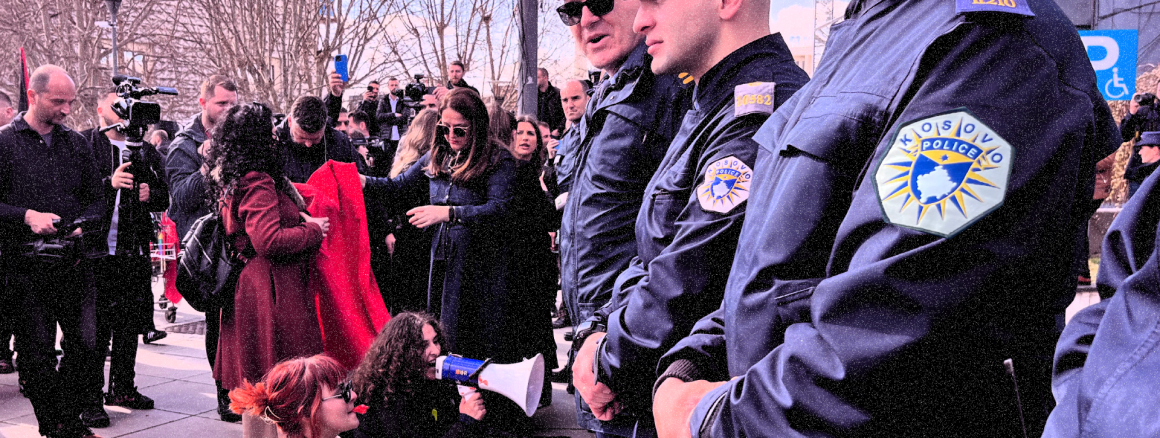
However, when the marchers arrived at the government building, they encountered a police cordon, which was then reinforced with members from the special unit of the Kosovo Police. The final speech of the march, which is usually read in the government building’s courtyard, was instead read outside the building.
The Kurti government, which four years ago removed the fences around some public institutions in the name of bringing citizens closer to the institutions, did not allow this year’s March 8 activists to approach the government building. Despite VV’s history as a movement largely shaped by protest and public action, it seems that after taking power, feminist protests have been disturbing to the government.
In these circumstances, police reducing access to public space can be read as an attempt to control criticism of the government. VV went from a political movement that saw the streets as a channel to articulate protest, to a government that wants to control protest by blocking access to the streets. What happened to the Kurti government’s approach and what does this approach mean for social activism?
“The streets are ours”
The events leading up to the march did not indicate that the activists would use violence during the march. Additionally, the protest on March 8 is not a new event — it has been happening for almost 10 years.
Attempts to control protests are also in danger of becoming commonplace. The police intervention targeting activists at the march was not only unjustified and unjustifiable, but also conveyed the message that feminist protest is not welcome.
There have been several instances where the police have fined or arrested feminist activists, primarily with the intention of publicly disciplining them and suppressing their inclination to protest.
But feminist activists are politically aware beings. They have learned to recognize the mechanisms and tools that the state uses against them. They have learned this because they face them every day and knowledge of these mechanisms has become a condition for survival. They know how to use these mechanisms to oppose efforts to reduce access to public spaces, which are often an extension of protest.
They know that gathering restrictions cannot happen at any time and cannot be allowed to happen at any time. The Law on Public Gatherings states that restrictions on gatherings must be legal, proportionate and necessary to ensure public order, public health, national security or the protection of the rights of others. The restrictions must also be timed and should be no later than 48 hours before the public gathering and not while the gathering is taking place.
THE GOVERNMENT SOUGHT TO PORTRAY THESE ACTIVISTS AS HOSTILE AND VIOLENT, AIMING TO ALIENATE THEM FROM THE BROADER PUBLIC.
Which of these is put at risk by reading a speech in front of a government building? Where is the explanation for the lack of proportionality in police control, which resulted in physical clashes between women attempting to exercise their right to protest and the police seeking to prevent it?
In the absence of an explanation from the authorities that limited the right to protest, this appears to be a warning measure about sanctions against criticism and opposing opinion, especially coming from women.
The government employed police control tactics to incite hatred and violence towards the feminist activists, They sought to portray these activists as hostile and violent, aiming to alienate them from the broader public. This alienation served as a means to legitimize the government’s ongoing attempts to discipline activists and to trivialize their causes.
The government is relying on its supporters to try to label feminist activists and protests as having specific agendas. This strategy aims to undermine the autonomy and collective solidarity of women’s organizations as a punishment for criticizing the government.
Activists cannot praise the government because they are busy doing the work that the government and institutions should be doing.
Feminist activists and women’s rights organizations are ensuring the survival of Kosovo’s women and girls. These activists and organizations are the first point of contact when women experience physical, sexual, psychological and economic violence.
Every year, women outside the government who work in shelters providing social services face the risk of closure. This is because the government fails to establish a stable budget allocation for them. At the same time, the government is allocating an unprecedented budget for “national security” to the Ministry of Defense. This indicates that, according to the government, women’s safety is not a national emergency.
In these circumstances, feminist activists still take to the streets and demand justice.
This type of activism diverges from the dominant ideology within VV and there also does not align with the views of the Kurti government. The government’s use of police control seemed to imply to its voters, “look at these hysterical women, needlessly raging, disturbing our priorities and our national agenda.” As a result, these voters were encouraged to attack the activists, bombarding them with hate messages, both virtually and physically. Men, who congratulated and celebrated the Kurti government for the police presence on March 8, even suggested that the protesters “deserve worse.”
THE GOVERNMENT’S PROCLAIMED COMMITMENT TO GENDER EQUALITY HAS BECOME MEANINGLESS.
The government is fully aligned with the masses that want to keep women obedient and oppressed. They don’t like the resistance of women in the street because it disrupts their ability to confine them inside the walls of the house, subject to constant control.
On March 8, 2024, the government tacitly encouraged those who flood the comment sections of online news articles about violence against women with the most inhumane remarks directed against us. The government secured voters, who support violence against women, in both public and private spaces, vocally and without reservations.
Therefore, the government’s proclaimed commitment to gender equality has become meaningless.
The commitment will make sense when the police, who were committed to suppress our gathering, redirect that commitment to protecting women when their well-being is threatened in public spaces. These spaces have become hotspots for harrassers and sexual abuse targetting girls and women. The police, who pushed us should be listening to women who report violence, have protection orders and end up killed; women who are raped. Police should work to restore the trust of those who are left alone to face their abusers.
Women, not government buildings, need police protection.
Until the government and the police realize this, feminist activists will continue to be deeply concerned about the pervasive social acceptance of gender-based violence, which on March 8 the government also contributed to.
We have no other choice but to stand together to first cultivate the imagining of a new reality for women and girls, without violence and oppression, no matter how difficult this sounds with all the current daily news. But only through imagining such a reality, we can work further towards changing it. For each other.
Author: Valmira Rashiti
Feature Image: Aulonë Kadriu / K2.0
This article was originally produced for and published by Kosovo 2.0. It has been re-published here with permission.

Monthly Monitoring Highlights April: femicides, genocide denials and hatred aimed towards journalists
May 16, 2024
Throughout the month of April, the RDN monitoring team has detected a range of hateful narratives and discourse. This month, we have seen hatred based on gender, ethnicity, and hatred against journalists.
Femicide in Kosovo
In Kosovo, two femicides took place in the month of April over a period of less than a week. At the premises of the Social Work Center in Ferizaj, a 21-year-old woman was murdered, and her 15-year-old brother was shot and injured, allegedly by her ex-husband. He was remanded in custody shortly after. Only four days later another femicide occurred in Peja where a man was arrested under suspicion of murdering his wife. According to the Basic Prosecutor’s Office in Peja, two years ago he was found guilty of domestic violence and charged with a fine and three months in prison, which he avoided by paying the fine.
In response, protests were organised in Ferizaj and Pristina. The demonstrations, organised by the Collective for Feminist Thought and Action, underscored demands for increased safety measures for women, condemning the patriarchal structures contributing to such tragedies. Participants could be seen carrying banners with the messages: “Safety for girls and women” and “Our enemy is the patriarchy”.
Kosovo’s officials and political leaders condemned the murder. Minister of Justice Albulena Haxhiu convened a meeting with key officials, acknowledging the gravity of the situation. “Despite the dedication, the measures undertaken, the campaigns initiated with the aim of gender equality, murders against women continue,” Haxhiu stated. “Violators have often become murderers precisely because of the lack of adequate punishment by the relevant institutions.” President Vjosa Osmani echoed these sentiments, emphasising the urgent need to halt femicide. The Collective for Feminist Thought and Action (Kolektivi për Mendim dhe Veprim Feminist) issued a statement, highlighting the systemic failures that leave women vulnerable to violence and advocating for a unified societal effort to combat the pervasive influence of patriarchy. They urged the government to prioritise the issue of femicide as a national emergency, emphasising the urgent need for systemic change to ensure the safety and security of all women in Kosovo.
Amidst these developments, the International Forum for Women Peace and Security commenced in Pristina. However, outside the venue, protesters voiced frustration, urging immediate action rather than conferences to take place. Activists from the Collective for Feminist Thought and Action claim to have been denied entry, with police citing their presence posed “a security risk” and could harm Kosovo’s image.
President Vjosa Osmani declared April 17 as a National Day of Mourning, saying “our society will mourn every day as long as our women and girls are being murdered”.
Some media published sensationalist headlines and information that was not in the interest of the public. On the social networks of these media, one could read comments using misogynistic narratives that blame the victims. It is important to note that the media violated the code of ethics less in the case of the murder in Ferizaj, because the close relatives refused to give statements to the media.
Nevertheless, instead of delving deeply into all the details of a specific case of gender-based violence, the media must focus on institutional responses or lack thereof. An important role of the media lies not only in holding relevant institutions accountable, but also in ethical and professional reporting on cases of femicide as well as educating the public about the broader underlying societal issues around gender-based violence.
Between 2010 and April 2024, 57 women were killed in Kosovo. Within five years (2019-2023), the number of women victims of domestic violence increased by 33.1%. In 2023, 2,375 out of 2,749 perpetrators of domestic violence in Kosovo were men.
Hatred aimed towards journalists in Albania
In Albania, a coordinated cyber-attack on the nonprofit and independent media outlet, Citizens Channel, by unknown perpetrators raised fresh concerns about media freedom and access to independent information. Citizens Channel is financed by donors with no ties to local businesses. It is widely regarded as reputable, with reporting mostly focused on human rights, public spaces, environmental issues, and the use of public funds.
Following the removal of its posts on Facebook as “spam content” in what was allegedly a coordinated effort, Citizens Channel experienced a cyber-attack on its website, suspected to be a Distributed Denial-of-Service (DDoS) attack. Lorin Kadiu, the director of Citizens Channel, reported that, “The first 10 posts were removed from the Facebook platform on Tuesday evening…and [then] some articles about the occupation of public space by construction companies, etc.” He continued, “The next day, this escalated with the removal of hundreds of posts, which practically removed about 80-90 percent of the content we have on Facebook, leaving very little behind. In addition, we faced an intensified attack on the web, leading us to believe that the attack was coordinated.”
The Safe Journalists Network emphasised that these attacks not only infringe upon Citizens Channel’s rights to report and inform but also instil fear among other media outlets and journalists, potentially stifling investigative journalism and critical reporting in Albania.
Since March 2024 the website of Citizens Channel, as the outlet reports, has been a target of attempted distributed denial-of-service (DDoS) attacks. These attacks resulted from Citizens Channel’s reporting on issues of public interest, including the construction of the National Theater and the granting of permits for skyscraper constructions by the municipality of Tirana. The articles highlighted how construction companies are occupying public land without proper authorisation or taxes. Other content included reports on the abuse of natural resources and the resistance of communities in Thirre (Mirdita) and Zall Gjocaj (Mat) against the destruction of nature.
It’s deeply concerning to witness a “digital army” spearheading a concerted campaign against Citizens Channel, specifically targeting articles dating back to 2021. This calculated effort aims to dismantle their platform, directly eroding their digital presence, outreach efforts, and rapport with their audience.
Ethnic discrimination and denial of genocide in Bosnia and Herzegovina
An announcement that the draft Resolution on the genocide committed in Srebrenica would be on the agenda of the United Nations General Assembly on May 2 resulted in various statement by officials from Republika Srpska, denying the genocide that took place and spreading hatred.
The proposed UN Resolution on Srebrenica advocates for designating July 11 as the International Day of Remembrance of the genocide in this city. It calls for unequivocal condemnation of any denial of the genocide and urges UN member states to safeguard established facts through their educational systems. Additionally, the resolution encourages the development of programmes aimed at preventing revisionism and future genocides. Notably, the document does not directly address the Serbian people or emphasise collective responsibility.
In response to this, on April 18, the National Assembly of Republika Srpska (NSRS) unanimously adopted the Final Report of the Independent Commission of Inquiry on the Suffering of All Peoples in the Srebrenica Region between 1992-1995, which was formed by the government of Republika Srpska. The report included 12 conclusions which outlined that the term genocide is incorrect and unacceptable.
Around the same time, Republika Srpska President Milorad Dodik denied the genocide in Srebrenica for two days in a row. “The genocide in Srebrenica did not happen, and if it had happened, this story would not have been imposed so much,” Dodik said, among other things, in a statement dated April 15. That statement came after he announced a “Srpska calls you” rally in Banja Luka on Thursday, April 18, in response to the announcement of the adoption of the Resolution on Srebrenica in the UN General Assembly. The rally was organised by the ruling SNSD party in Republika Srpska (Alliance of Independent Social Democrats) and partner parties. Tens of thousands of people attended the rally including party and state officials of Republika Srpska and Serbia. This event was broadcast live for several hours on national frequency channels in Serbia and Republika Srpska, including public service channels. Many speakers used harmful language, including inflammatory speech and harmful narratives. Several weeks of discussion and media reporting on the UN resolution on the genocide in Srebrenica included constant genocide denial, historical revisionism, and harmful narratives claiming that this resolution aims to label the Serbian people as a genocidal nation.
Dodik also denied genocide on April 16, saying that “in order for someone to commit genocide, there must be an intention to biologically destroy an ethnic group. And that did not happen in Srebrenica”. The mayor of Banja Luka, Draško Stanivuković, in a separate statement from April 16, denied the genocide and announced his arrival at the “big meeting”. “I am sure and I know that the representatives of the PDP (Party of Democratic Progress) will support this report, which is true, that a genocide did not happen in Srebrenica and that we are not the people they want to label us as and that we will all respond to a large gathering of support”, Stanivuković said.
Former High Representative in Bosnia and Herzegovina Valentin Inzko, using the Bonn powers, imposed changes to the Criminal Code in July 2021. Denial of genocide and glorification of war criminals is prohibited in Bosnia and Herzegovina. This criminal offense carries a sentence of six months to five years in prison. The biggest denier of the genocide in Srebrenica, according to research by the Srebrenica Memorial Center from last year, is Milorad Dodik, who denied the genocide 11 times in different ways during the past year.
Sexism and undermining of gender equality efforts in Montenegro and North Macedonia
In Montenegro, artistic director of the Nikšić Theater Janko Jelić recently refused to allow a play called “IzloŽene” (Exposed) by the independent theatre group BUNT scena (Rebellion) to be performed at the theatre. The play focuses on gender inequality and violence against women.
Jelić’s justification for refusing the play was that the topic to be discussed is “worn out” and represents “engaged propaganda”. He claimed to believe that “women are the ones who discriminate”. The decision was condemned in Montenegro by numerous people including Sandra Vujović, founder of BUNT scena and leading author of the play, who labelled the decision as a “scandal”. Minister of Culture Tamara Vujović expressed her surprise at Jelić’s decision. Furthermore, the government’s Operational team for the fight against domestic violence and violence against women commented that this decision was indeed a ‘slap’ for victims of domestic violence. Additionally, the Royal Theater “Zetski dom” from Cetinje cancelled its cooperation with the theater.
The president of the local government, Marko Kovačević, later announced that the Municipality of Nikšić will facilitate and sponsor the performance of the play in the Nikšić Theater. He said that the public controversy that has arisen on this issue, regardless of different attitudes, is useful for the problem as it raises awareness. “And the play itself will now get publicity that it might not have had if things had gone differently,” Kovačević added.
Gender inequality and violence against women is unfortunately a reality across the world. Addressing these issues requires unwavering commitment to education and information dissemination, empowering individuals with the knowledge and awareness necessary to challenge discriminatory norms and advocate for change. By shedding light on the pervasive nature of gender-based violence and inequality, we can bring much-needed attention to these societal issues and commit to fighting such inequality whilst holding those accountable to react and respond appropriately to instances of gender violence. Jelić’s dismissal of this important topic and furthermore his comment regarding women being those that discriminate undermines the fight for equality and victims of gender violence.
In North Macedonia, Aleksandar Nikoloski, the vice-president of the VMRO-DPMNE party (The Internal Macedonian Revolutionary Organization – Democratic Party for Macedonian National Unity), and a member of parliament, made a discriminatory remark in a meeting in the municipality of Strumica, within the framework of the presidential elections. He said that for his party “men are men, women are women, boys are boys, girls are girls, and it is healthy for them to live in decent families, and not to conduct any kind of gender politics. Because what nature has given, no foundation, no money, no sold souls can change it”.
VMRO-DPMNE party has been spreading harmful narratives and conservative rhetoric for a long time now. They opposed the law on gender equality and connected it with transgender policies. They also share the same stance as the Macedonian Orthodox Church that is advocating against the LGBTIQ+ community. This connection and alignment between the political party that has been in opposition for seven years (one of the two major parties) with organisations and church representatives granted them voters. Due to this, they continue to spread harmful narratives among the population. This party won the general elections held in North Macedonia on May 8 and will most likely be constituting the government, as the State Election Commission published the first results indicating the convincing victory brought the party 59 MPs in the Parliament out of 120 seats total.
Comments and rhetoric like these are extremely hateful towards women and trans people. Members of political parties who have a platform should not be using it to spread hate and discriminatory rhetoric. When politicians propagate sexism, they reinforce harmful stereotypes, undermine gender equality efforts, and perpetuate discrimination, ultimately eroding trust in democratic institutions and hindering progress towards a more inclusive society.
Unethical and unprofessional reporting on a missing girl in Serbia
In Serbia, a two-year-old girl disappeared on March 26 in Banjsko Polje near Bor. After a ten-day search by the police, two employees of the public water supply company were arrested on suspicion of having murdered her. Following the news of the alleged murder of the missing girl and amid ongoing efforts to locate her body, mainstream media in Serbia sensationalised the case by unethically and unprofessionally reporting on it. This included publishing misinformation, disinformation, and purported leaked information from the ongoing investigation during the time she was missing and later when news of her murder broke.
National media outlets, tabloids, and TV channels published content created as if they were “conducting” their own unofficial investigations. The media also interviewed relatives and neighbours of the victim, publishing explicit details of the case. Reporting on the family members bordered on abuse in some cases, as was a news segment for Informer TV in front of the house of the uncle of the (at the time missing) child where journalist Jelena Rafailović was reporting. When the man said he did not want them filming his house, as it was a live programme, from the studio someone was saying “Hit him Rafa, hit him… It will be good for the share when Rafa hits him, you’ll see”.
For several days, many media outlets presented inaccurate information, guesses, misinformation, personal comments, and theories against the girl’s mother, blaming her for her child’s disappearance, saying she sold her. This indicates a harmful patriarchal pattern in which the mother is always responsible for the family and the woman is the one to blame. The media invaded the privacy of the entire family, especially of the child during the search for her, and after the news of her murder. Unethical and unprofessional reporting on the disappearance and alleged murder of the child was also on social media, with users sharing their opinions on “what happened” with the girl during an ongoing investigation.
The whole coverage and reporting of the incident in traditional and social media was completely insensitive and unprofessional. Journalists should adhere to the Code of Journalists of Serbia and report in a professional and ethical manner especially when covering and tackling topics as sensitive as a missing minor, presumed to be dead. It is not the role or job of the media to make assumptions, conduct investigations, or confront people in a violent manner for a headline or story. It is the role of the media to disseminate information to the public based on fact rather than to take it upon themselves to get involved in private matters which is the role of the police and relevant institutions to tackle.
TROLL OF THE MONTH: Ninoslav Cmolić, Head of the Criminal Police Directorate, Serbia
May 10, 2024
The Balkan Troll of the Month is an individual, a group of individuals or a media outlet that spreads hate based on gender, ethnicity, religion, or other diversity categories. The Balkan Troll is selected based on hate speech incidents identified across the Western Balkans region.
Ninoslav Cmolić, the Head of the Criminal Police Directorate, was interviewed on TV Informer regarding the suspects in the case of Danka Ilić, a two-year-old girl who went missing in Serbia. During the interview, Cmolić revealed that the individuals implicated in her disappearance were two employees of the water supply company in Bor, Serbia, who have been accused of her murder.
In the segment, talking about the accused offenders, Cmolić proceeded to comment on the ethnicity of the two individuals, saying that “it is such a personality profile, there is no empathy, the IQ is very low. Again, that area itself is strange to us, the dialect, the speech, they are Vlachs.” The Vlachs are a Romanian-speaking ethnic group living in eastern Serbia, mainly within the Timok Valley.
With this one statement, Cmolić made swooping generalisations about the ethnic group of the two accused. In this way he insulted a whole ethnic group in Serbia and other people living in Bor and eastern Serbia, calling them stupid, strange, and insinuating they are violent and not to be trusted.
In response to this, the Commissioner for the Protection of Equality reacted, criticising Cmolić’s statement, saying that “emphasising the national and ethnic affiliation of the accused for the death of a two-year-old girl, as well as attributing negative characteristics and propensity to illegal behavior to all Vlachs, is prohibited by law and stigmatising for all members of the Vlach national minority”. Alongside this, several civil society organisations reacted as well.
Highlighting the ethnicity of those accused of murder and furthermore, making generalisations about ethnic groups is extremely harmful and discriminatory.
Commenting on someone’s ethnicity in relation to a crime risks perpetuating harmful stereotypes and prejudices. Generalising and linking such acts to an entire ethnic group further fuels intolerance and division in society. Exactly for that reason, revealing the ethnicity of perpetrators of criminal acts is also forbidden by the Serbian Code of Journalism Ethics.
A head of a criminal police directorate should uphold the highest standards of professionalism and objectivity, avoiding generalised statements about ethnicity that can fuel discrimination and undermine trust in law enforcement. Such actions not only perpetuate harmful stereotypes but also erode the integrity of the justice system. Ninoslav Cmolić should issue an apology and retract his discriminatory remarks, acknowledging the harm inflicted upon the Vlachs community.

WHEN MEDICAL STUDENTS APOLOGISE – THE IMPACT OF THE ANTI-GENDER MOVEMENT IN THE PUBLIC SPHERE
May 8, 2024
How the anti-gender movement, supported by American and Russian Christian organisations, incite fear and hatred in the public discourse under the pretense of defending “family values”
In April 2024, the Macedonian Medical Student Association (MMSA) announced on Facebook that the Faculty of Medicine of the Ss. Cyril and Methodius University (UKIM) in Skopje will host a lecture titled “The Path of Transitioning”. According to the post, the lecture was supposed to cover various aspects of gender-affirming care and medical services. The two speakers at the lecture were set to be a plastic surgeon and an activist who would share her experiences with gender-affirming care in North Macedonia.
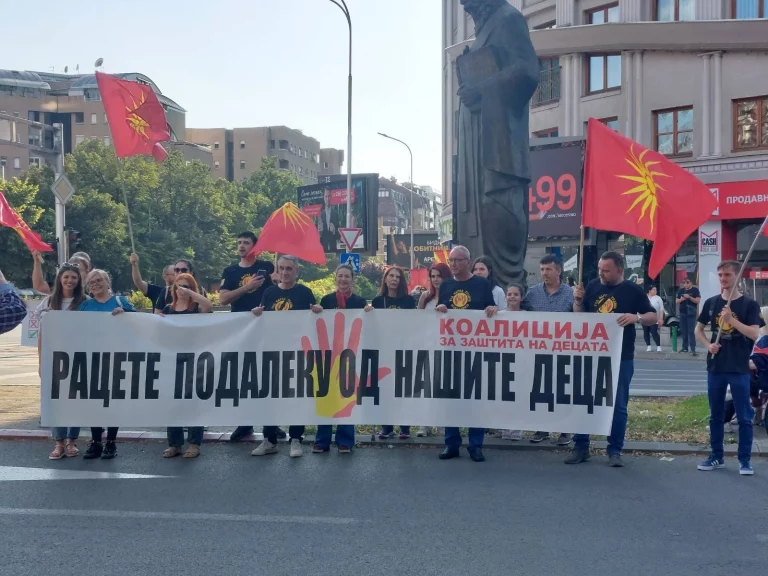
“Keep your hands away from our children.” From the protest organized by the Macedonian Orthodox Church, protesting the new law on gender equality, and the amendments to the law for civil registration, 29 June 2024. Photo: Bojan Blazhevski / Meta.mk
However, the lecture never took place.
The lecture was cancelled after the group “Coalition for the Protection of Children” (KZD), whose relation to the Faculty of Medicine is unclear, publicly criticised the student organisation MMSA. KZD claimed that the Dean’s Office was notified of the lecture, but that the students said the lecture had a different name. KZD implied that student organisation was trying to “sneak in” the lecture. After this post, MMSA cancelled the event and publicly apologised several times to the Dean’s Office.
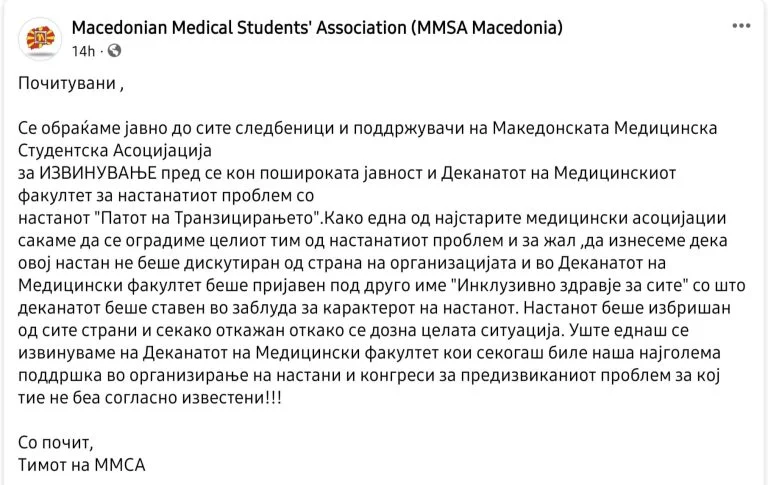
Screen-shot of MMSA’s apology. The screenshot was shared by the Coalition for the Protection of Children.
Coalition Margins, a local organisation that, among other things, fights for LGBTQ rights, responded by stressing the fact that gender affirming medical procedures are supported by decades worth of research and are not merely “experimental”.
“The decision to cancel the lecture was the result of the panic, hatred, manipulation and hysteria spread by several anti-democratic and discriminatory persons, groups and coalitions, known as the anti-gender movement,” say Coalition Margins in their response.
The anti-gender movement is the key to understanding how this fiasco could have occurred. The “Coalition for the Protection of Children” (KZD) is one of few accounts with a significant online presence on Facebook which is part of the so-called anti-gender movement. Representatives of this movement oppose “transgender” or “gender ideology”, as they believe that the normalisation of LGBTQ people in society is part of a Western conspiracy to destroy the family unit. Their posts are full of hate speech and are frequently directed to specific members of the LGBTQ community.
A cursory browse through KZD or other similar pages like “From Us for Us” or “Take Responsibility” immediately reveals a few facts.
First, the pages sharing inflammatory content are not just a few isolated personal accounts that are merely expressing their opinions. Rather, there is a network of many Facebook profiles with thousands of followers.
Second, there is a staggeringly large volume of fairly well-written content posted every day, which does not look like the work of amateurs. The posts are even frequently accompanied by sources. All of which is to say that behind these profiles is not merely a “concerned group of parents”, as these pages often present themselves, but some larger structure.
In fact, the anti-gender movement is an international phenomenon backed by American organisations, supported by Russian and American Christian oligarchs, for the purpose of spreading traditional values worldwide, from Uganda to Hungary.
It is exactly this structure that enables associations like KZD to mobilise quickly and have influence beyond their online space. Their influence can be seen in the cancellation of MMSA’s lecture, as well as the protests organised by the Macedonian Orthodox Church against the draft laws on gender equality and civil registration (which would expedite bureaucratic process for transgender people), and most generally in the adoption of their rhetoric by political parties.
The anti-gender movement’s methods and rhetoric (in North Macedonia and beyond)
The rhetoric of the anti-gender movement, in North Macedonia or otherwise, is essentially the same.
“The anti-gender movement uses disinformation and fearmongering and promotes intolerance, especially through social media, but also through local action and mobilisation,” says Sara Milenkovska, a feminist researcher and co-founder of the Stella Network.
Not only do the anti-gender Facebook pages share “imported” disinformation narratives, but they also produce local ones – a perfect example of this is the controversy stirred up around the novel The End of Eddy by the French author Édouard Louis. The novel was translated into Macedonian last and published by the publishing house ’Polica’.
The End of Eddy by Edouard, published by Polica. Photo: Polica
The novel portrays the experiences of a gay child whose life is full of sexual trauma. The anti-gender Facebook pages claimed that Polica was marketing the book to children; their evidence for this claim was the fact that the book’s cover had a photo of a child. As a result, KZD claimed that Polica “promoted” such traumatic experience as being normal for children. Polica publicly refuted this claim, or that they intended to sell the book to children in any manner. But Polica’s statement did not stop an avalanche of negative messages and allegations that they intend to “corrupt our children”.
This example illustrated one of the anti-gender movement’s favorite strategies – fearmongering by using the idea of an innocent child “destroyed” by those who hate the family and Christian values.
Apart from fearmongering, Milenkovska emphasises that the anti-gender movement often hides behind anonymity, save for a few public faces. One of those faces in North Macedonia is the famous anti-vaxxer Gordana Godjo. Through the group “From Us for Us”, she spread disinformation about comprehensive sexual education and advocated against vaccination during the pandemic, firmly planting the anti-gender movement on the side of disinformation.
“The ideology of anti-democratic movements, as demonstrated by anti-gender and anti-feminist actors, aims at creating resistance against progress, equality, human rights and dignity,” says feminist researcher Milenkovska.
The organisations behind the local anti-gender movement
A question then emerges: who exactly is funding and supporting these alleged protectors of children? If you look at KZD’s website, you will find a list of partner organisations. All of the aforementioned Facebook pages such as “Take Responsibility” and “From Us for Us” are all there, but so is Family Watch International, described as a “key partner”.
Family Watch International (FWI) is an American conservative lobbying organisation established in 1999 which promotes pro-family, traditional, anti-LGBTQ values worldwide. It was founded by Sharon Slater, the daughter of Howard Raff, well-known businessman and author.
Family Watch International is known for its work in Africa and is often accused of advocating anti-LGBT policies on the continent. Slater has even had a meeting with one of Uganda’s presidents. Uganda was recently in the news because it had passed one of the most vicious anti-LGBTQ laws of the century. It included life sentences and capital punishment for homosexuals in certain cases. Family Watch International denies it has supported any efforts in Africa to promote anti-homosexual bills and says it is opposed to the Uganda Anti-Homosexuality Act 2023.
It probably should not come as a surprise that FWI and their partner-organisations are funded by conservative Christian groups.
FWI is linked to the Church of Jesus Christ of Latter-day Saints. More commonly known as the Mormon Church, it is known for its adherence to traditional values. Although Family Watch International denies any connection with the Mormon Church, according to a research paper by the international organisation Ipas, the link is obvious if one looks at the history of the “parent” organisation of Family Watch International and the main donors, who are primarily Mormon organisations and wealthy members of the church.
Additionally, FWI is supported by a conservative advocacy umbrella organisation, World Congress of Families, also known as the International Organization for the Family. It influenced the adoption of the comprehensive homophobic 2013 law in Russia, which bans public presentation of any LGBTQ-related content. Conservative Americans and Russians established the organisation and it receives donations from Russian oligarchs who also support initiatives of the Russian Orthodox Church.
Roots of the anti-gender movement
It is important to note that all the funding in the world could not support dissemination of “pro-family” propaganda if societal and material conditions were not such so that people are ready to internalise said propaganda. Namely, according to the United Nations Research Institute for Social Development, the anti-gender movement found fertile ground in people’s anxiety after the financial crisis in 2008.
“More recently, anti-genderism has been attributed to the rise of new illiberal populist right-wing movements that have emerged after the 2008 global economic recession. Feeding upon ‘anxieties produced by neoliberal reforms,’ anti-gender ideology demonises gender equality, gender and sexuality diversity, and sexual rights movements as the cause of unwanted economic and social change, positioning a return to heteropatriarchy as a “common sense” solution that will restore order and certainty,” states the research paper led by Haley McEwen and Lata Narayanaswamy.
“The notion that economic and national crises can be ‘solved’ through a closing down of gender mainstreaming and LGBTIQ+ rights has become a platform for organising and for recruiting massive support amongst right-wing activists from otherwise distant walks of life, including believers and nonbelievers, nationalists, and universalists, populists who demonise global capital and traditional Reagan/Thatcher-style conservatives with a neocon love for the market,” state McEwen and Narayanaswamy.
“The anti-gender movement is an opportunistic illness that capitalises from the political and economic insecurity in vulnerable societies. Their policy aims to create resistance against progress, equality, human rights, and dignity”, says Sara Milenkovska.
The anti-gender movement almost always sees the West (acting as a kind of surrogate of all progressive ideas) as the ultimate enemy that aims to erode traditions. North Macedonia, where a large proportion of the population is disillusioned by the European Union accession process and the seemingly endless obstacles on the path towards the Union, is especially susceptible to anti-Western rhetoric.
How anti-gender influences – and will influence – Macedonia
North Macedonia has already witnessed how anti-gender rhetoric is employed by Eurosceptic and conservative political actors. In addition, such actors are often supporters of authoritarian regimes, such as for Putin’s Russia.
For example, the party “Rodina Makedonija” stands firmly “against sexist and transgender ideology”. Rodina, along with the parties Integra and MAAK can be found on the list of partners on the website of the Coalition for the Protection of Children.
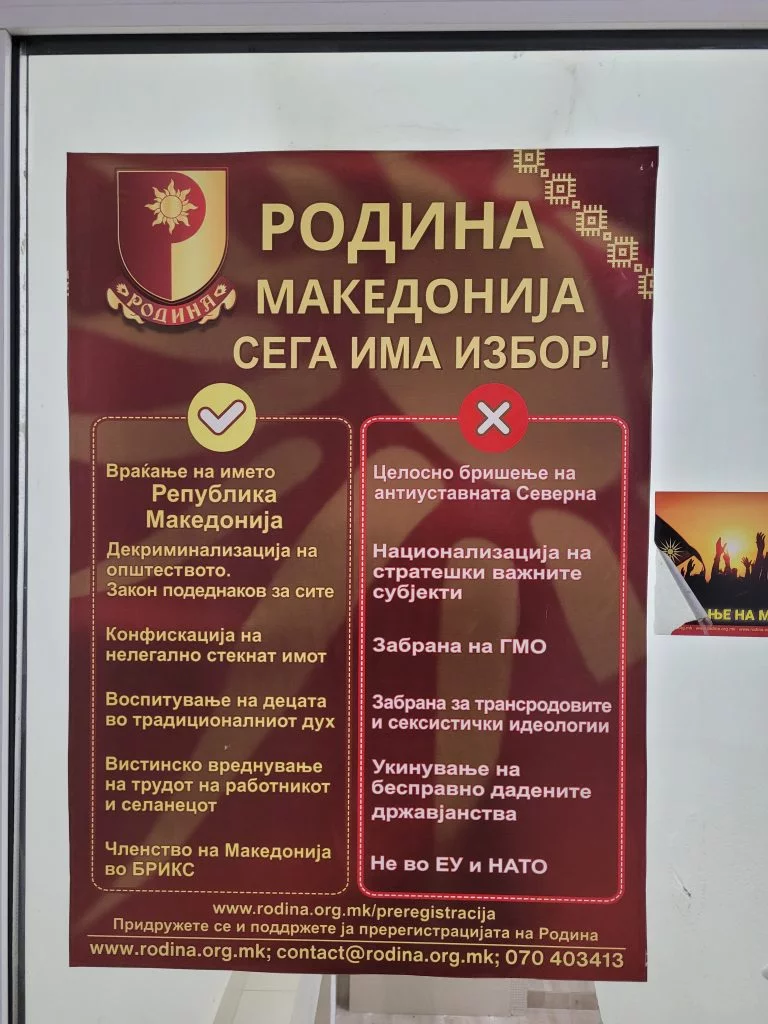
Poster of the party Rodina Makedonija. Photo: Meta.mk
Anti-gender rhetoric is already present in mainstream parties, as can be seen by the statements of VMRO-DPMNE’s lead candidate in the fourth electoral unit Aleksandar Nikoloski. During the campaign for the upcoming parliamentary elections, he stated that his party believes only in a “mother” and a “father”, not in “parent 1” and “parent 2” – a statement that seems to borrow directly from the “Coalition for the Protection of Children” playbook. In fact, this is an old disinformation narrative that the terms Parent 1 and Parent 2 will be used in the pilot-curriculum for sexual education.
The anti-gender movement has also successfully brought together all sorts of conservative spheres from the conservative world – even the Macedonian Orthodox Church (MOC) came out with a public statement and a clear political position against the laws on gender equality and civil registration.
In the summer of 2023, MOC organised and promoted the protests against said laws, claiming that they were sent to the Parliament in a fast-track procedure. That turned out to be untrue – the Law on Gender Equality is still “stuck” in the Ministry of Labour and Social Policy, while the amendments to the Law on Civil Registration were read in the Parliament in a regular procedure.
From the protest organised by the MOC against the amendments of the Law on Gender Equality, 29 June 2024 | Photo: Bojan Blazevski, Meta.mk
Jakov Stobiski, the person behind MOC’s political activism, regularly spreads disinformation on the topic, alongside other popular global conspiracy theories. For example, he has talked about the “incredible connection between the progression of gender ideology and the liberalisation of pedophilia on a global level”. One should not be surprised that his article on the topic can be found on KZD’s website.
The danger and the future of the anti-gender movement
Anti-gender rhetoric and “activism” can only cause additional difficulties in the lives of transgender people; they will certainly not lead to the “protection of children”.
Research shows that there is a correlation between US states passing laws limiting transgender rights and increased violence towards trans children. Most alarmingly, this correlation exists even when such laws are merely read in local councils.
The rollback of transgender rights is just one piece of the puzzle of the consequences of these movements. They allow the validity of the progress of the rights of women and sexual minorities to be brought back on the table again. For example, KZD regularly shares disinformation in relations to abortion.
This regression in values caused by the anti-gender movement can be easily seen in the case of a gymnasium in Strumica that introduced a restrictive dress code which banned shorts, leggings and long fingernails. This policy came only a few days after a similar policy was implemented in Prilep. It is no coincidence that such rules were enforced in Strumica, the city that became a hot spot of the anti-gender movement, after “Parents’ Front” organised a protest in the town against the implementation of “gender ideology” in schools.
According to Lila Milikj, the transgender activist who was supposed to talk about her experience with trans medical care in the lecture cancelled at the Faculty of Medicine, the anti-gender movement has led to less space for trans lives to be publicly discussed.
“What the ‘Coalition for the Protection of Children’ did, hurt me personally. The cancellation of the lecture affected me since my right to explain my transition process was taken away from me. It was direct interference in the students’ learning process – students who one day will be doctors. The students were deprived of dialogue and insight into the problems and needs of trans people going through gender affirming medical care. It seems that the dean, or the student organisation under pressure, can cancel other events opposed by the anti-gender movement. The mere cancellation is a sign of high-level discrimination and stigma towards transgender people by institutions,” said Milikj.
Researcher Milenkovska agrees that dialogue remains the last resort for overcoming the damage and the pain caused by the anti-gender movement.
“I honestly believe that we should create space for dialogue, errors, but also for learning. That said however, it is still not clear how to initiate dialogue with a people who believe that queer and transgender people should not exist or that reproductive freedom should not be a right. How can one create a space for understanding if that person is not interested in your side of the story – especially the lives of marginalised groups. Nevertheless, we should address those who lack support and solidarity and create coalitions of care instead of coalitions of fear and violence,” concludes Milenkovska.
Author: Borjan Gagovski
This article was originally produced for and published by Meta.Mk. It has been re-published here with permission.