Author: RDN

The daughter belongs to someone else’s family
December 11, 2025
Stories behind the disparity in property ownership at the expense of women
Inheritance of property by women in North Macedonia is so rare that over time it has become a customary practice that is seldom questioned. Like many traditions, this one too is rooted in inequality, upheld only by our socially constrained perceptions of what women “deserve” from their families and communities. Beyond it being blatant discrimination, the issue of women’s property rights cuts deep into gender inequality, both personally and politically.
After reading the statistics on the huge discrepancy in property ownership at the expense of women, we decided to look into the stories behind the numbers. Starting from 2023, available data highlights significant gender gaps, showing that men account for 71% of registered property, compared to only 29% owned by women – a consistent trend across different regions. Additionally, according to research by the National Federation of Farmers, “in rural areas, only 4% of women hold ownership rights, usually after becoming widows.” Research by Reactor — “Is There Land for Women? Gender Analysis of Property Ownership” also reveals a gender pattern in declarations of waiver, where women more often give up their inheritance in favor of a brother.
This is a result of a patriarchal and traditional culture, in which during inheritance distribution, property most often goes to the son, or daughters renounce what legally belongs to them during probate procedures. For this purpose, we conducted a survey and spoke with women of different ages, ethnic communities, and social backgrounds who shared their stories with us.
Methodologically, our goal was to listen to their voices, the voices behind the disturbing statistics.
Their testimonies, the similarities in their stories, and the unravelling of toxic family dynamics that they have carried on their shoulders, sacrificing their own futures, reveal a culture, politics, and ideology that resist equality, democratic values, and basic common sense.
These dynamics also show the urgent need for the state to recognise the importance of this issue to include it as an essential topic in education and to address it through special campaigns and programs led by the Ministry of Labour and Social Policy.
Only a son can inherit a land
A dominant narrative we observed is that inheritance is given to the son, with the assumption that he will start a family, while the daughter “does not need” property because she will become part of another man’s family. Numerous testimonies reveal the different treatment women received compared to their brothers, and the most painful example was one woman being told: “A girl (a daughter) is a part of another family.”
“My father wanted me to inherit something as well, but after his death my mother completely succumbed to my brother’s pressure, who manipulated and convinced her that ‘a girl child belongs to another family.’ I want my experience to show that such abuse and manipulation of elderly parents must not be tolerated, because they have the right to their own will and dignity. A whole life of working and saving is in vain if, in the end, the son becomes a despot and dictates the lives of frail parents.”
“My brother pressured my parents terribly, telling them that a girl shouldn’t take property. Today, it seems that this pressure shortened their lives.”
“My father told me that only men are given inheritance – you’re a woman, your husband should take care of you.”
“Everything was transferred to my brother, with the reasoning that everything remains with the son. It’s not about money. It never was. I just wanted to be treated like a human being, a daughter of equal worth not a burden. I forgave them once, when they said: ‘Leave, your brother is getting married, you’re in the way.’ I didn’t forgive the second time. Something died inside me then. I’m his only sister and he hasn’t contacted me in years. The hardest part is that I never asked for anything material, only love. Equality. Because of that pain, I spent so much money on therapy. But finally, I’m done. Everything I have, I earned myself. And even if they offer me something now, I’ll throw it back in their faces. I don’t need it.”
“I come from a family of four – my parents, my brother and me. After studying in Skopje, I married into a village near Valandovo. That’s where my hell began, years of domestic violence. My brother got married and moved to Italy. He helped me secretly, afraid of my mother’s reaction. One night, my abusive husband attacked me. The neighbors saved my life. I fled with my children to my parents’ home, but there a new torment awaited. I was forbidden to use the boiler; there were insults and threats. After a fierce conflict, I ended up on the street. I moved to Skopje, found work at a real estate agency, rented an apartment, and started a new life with my children. My parents didn’t call for a whole year to check if we were alive. Years later, I found out that my mother had transferred all the property to my brother. Then my brother died in Italy, and I remained the one caring for my parents. My mother was bedridden for a year; I left my job to take care of her, despite the continued insults. I spent my whole life trying to earn her love but never received it. I’m still here, caring, even though there is neither gratitude nor support from the other side.”
“Before my father died, my mother secretly brought a notary to sign that the apartment would be left to my brother. He was the MAN; I was the girl – expected to marry and leave the house.”
“What hurts isn’t that I received nothing material, but that my ‘exclusion’ from inheritance was equal to psychological, emotional, and physical abandonment by my parents – no empathy for my situation (divorced, living alone under rent), while my brother received property worth over 1 million euros. It left anger, grief, frustration, permanently damaged the family relationships. They told me simply: ‘Girls don’t get property.’”
“For my family, the house was ‘for the boy,’ and the occasional help was ‘enough’ for me. I regret one sentence the most: ‘Don’t take anything from your brother.’ I realised too late, I wasn’t taking his property, but the inheritance of my parents – I am also their child.”
“Because I’m a woman, I was expected to find a husband and another roof over my head.”
I gave it up to keep the peace in the family
The research shows that more than half of the women gave up most or all their property so their brother(s) can inherit it. Yet some do not feel discriminated against, believing they freely chose to renounce their inheritance.
This is the result of systemic discrimination and injustice woven into upbringing – where sons and daughters are treated differently, shaping expectations that a daughter should voluntarily give up what “rightfully” belongs to the brother, most often to “keep peace in the home” and preserve family harmony. The reasons for renunciation vary among women, but the essence remains the same: behind these decisions lies a deeply internalized tradition and social norm that sons should receive the property, while daughters will “find their roof” with a husband or elsewhere.
A crucial question emerges from many responses: How free is a woman to choose, when that “choice” is conditioned by expectation and pressure from her family and the wider community?
Part of the testimonies come from women who voluntarily, fully aware of the consequences, renounced their property and, de facto, demonstrate freedom of choice. And essentially, we would never question that freedom – after all, everyone has the right to give something away. But what made us reflect were the subtle and delicate pressures of the political and social context, so deeply internalized that they result in a significant statistical discrepancy.
Namely, what kind of system teaches a woman that her peace and tranquillity correlate with her renouncing what legally belongs to her? On which sociopolitical, familial, and intimate pillars is this peace built, and ultimately, what does it camouflage? What sort of system reduces one’s own so-called self-sacrifice to a feeling of moral obligation, even to a sense of self-satisfaction in fulfilling that obligation?
This subtly led us to the thesis of the influential American philosopher and feminist theorist Sandra Lee Bartky, who writes that those who claim that women can simply reprogram their consciousness if they are determined enough have a shallow perspective of the nature of patriarchal oppression. (…) One of the evils of the system of oppression is that it can cause harm that cannot always be undone. Patriarchy attacks the intimate cracks of one’s personality, where it can creep in and permanently cripple the spirit.
The following testimonies illustrate this:
“I am 37 years old, a mother, a wife, and a sister. My mother died when I was 12. That’s when we started taking care of each other – my father, my brother, and I. At age 26, I lost my father as well. After his death, I moved in with my boyfriend (now husband). My brother and sister-in-law sent me money until I became independent. Then came the time for the inheritance. I still didn’t have a family of my own, but I was certain I didn’t need property – not a land, nor a house in my name. I needed family, I needed people. All I wanted was to go to my father’s house, still cozy and warm. And that’s how it is – I go when I can to see the people I love immensely. After my father’s death, we went to a notary and, consciously and willingly, I asked for nothing. Still, I often wonder if the relationship between my brother and me would have been different had I kept my share, and honestly, I think the answer is yes.”
“I renounced my share at the notary; I fulfilled my mother’s wish for everything to be left to the sons.”
“I agreed with my parents that, for the sake of peace in the household, the larger portion should go to him. I don’t feel discriminated against – I simply didn’t want to spend my whole life in court, nor burden my children with problems. At the end of the day, we must earn and create something of our own. That is part of maturity.”
“I voluntarily left all the property to him. I don’t want to interfere in my brother’s household. This way, I know I always have a place to return to and that I have his support. What matters most to me is having a brother with whom I can share both sadness and joy. That is worth more to me than any property.”
“Together with my sisters and our one brother, we began the division of our parents’ property while my mother was still alive. In court, we, the sisters, voluntarily gave our share to our brother; it was our wish.”
“We are three sisters and one brother. When our father died, we – the three sisters – voluntarily renounced the inheritance, entirely by our own initiative, because we were raised from a young age to believe that the greater share should go to the brother. We went even further and renounced our entire portion. We ourselves suggested that the entire property be transferred to our brother’s name, so there was no situation in which we would question why we didn’t receive our share.”
A paradigmatic case – one that has repeatedly reaffirmed the thesis that the personal is political – is that of Arta Mero, an Associate Professor of Family and Inheritance Law at the Faculty of Law at the South East European University, who shared her testimony. Despite the fact that in her family the property had been divided equally and fairly, pressures unexpectedly came from those who had nothing to do with the family’s property – from relatives, friends, and the wider community. According to her:
“After the division of my parents’ property, I faced numerous criticisms and insults from relatives, colleagues, friends, and even my own students. The accusations were degrading: ‘If my sister did this to me, I would close the door on her’; ‘You turned out to be a spiteful sister’; ‘How did your brother accept this – are you still on good terms?’; ‘You will never enjoy that property’; ‘Does your brother even speak to you?’; ‘I would never do this to my brother’; ‘Let’s see how you’ll feel when your husband’s sister takes her share’; ‘Aren’t you ashamed before your brother?’; ‘I would never allow my mother to do that to my uncles’; ‘A daughter who takes her share deserves to be thrown out like a dog.’ And even: ‘I would rip the hair out of my sister’s head.’”
My brother sold the house, and with nine children I ended up in Vizbegovo
Several testimonies showed that it is often impossible to maintain full control over real estate and the way it is transferred, especially when the property is unregistered or illegal, which is common among socially marginalized communities. Among many such cases, one stands out—resulting in homelessness due to an illegal property sale:
“We lived – two sisters and one brother – with our parents. After our parents died, my brother, who was married and had children, decided to sell the house and move with his family to Germany. My sister and I were left with nothing, and although I opposed the sale, I didn’t even know when he sold it or anything about it. At the time, my sister and I were married and living with our husbands and children. Then my husband died and I was left alone with nine children in the homeless shelter in Vizbegovo. Had I inherited my parents’ property – had my brother not sold it – I would have a house today and wouldn’t be homeless. My parents’ house had no property papers, and the whole sale was suspicious.”
***********************************************************************************************
The above twenty or so testimonies, grouped into three basic thematic lines, are only the tip of the iceberg we have been investigating these past months. What became clear in the research process is that women, even if mostly anonymously, are finally more open to thinking and talking about this issue. Additionally, the testimonies raise the question of economic violence, directly linked to women’s financial powerlessness and dependence on their partners – made worse by not owning property in their own name. In fact, the control and denial of inheritance rights, the pressure and manipulation from families for daughters to renounce property in favor of sons, is itself a form of economic violence.
In a society where violence is normalized, how can a woman leave an abusive environment if she has nowhere to go? Economic dependence is one of the reasons why women remain in violent relationships or marriages, and being excluded from inheritance, which legally belongs to them, can contribute to ongoing abuse or the need to endure an abusive partner just for a roof over their head. When women do not inherit property equally to their brothers, they face structural discrimination – an added burden that directly affects the quality of their lives.
This momentum shifts the focus onto state institutions, which are obliged to respond to the needs of those citizens who feel oppressed and deprived of their rights, and which – through media, education, free legal aid, and similar mechanisms – must commit to ensuring that this injustice does not become the fate of their daughters as well.
_________________________________________________________________________________________
Authors: Marta Stevkovska and Leni Frckoska
This story inspired a cross-border collaboration with the Meduza platform. As part of this collaboration, we will publish stories of women’s experiences with inheritance from Western Balkan countries.
Featured photo: Meduza platform

From Belgrade to Prishtina: Women Who Refused to Be Silent
December 10, 2025
On August 14, 2025, after one of many student protests in Belgrade, a group of students was attacked by the police while heading home and taken to a nearby garage. Among them was Nikolina Sinđelić, a survivor of police brutality.
“As we were walking down Nemanjina Street, we encountered members of the JZO (Unit for Protection of Certain Persons and Facilities), police officers, and several masked men whose identities were unknown to us,” Sinđelić said inan interview for N1.
According to her, men in plain clothes and balaclavas rushed out of a government building and began beating protesters with batons. The students claim they were forced to kneel with their hands behind their backs as the JZO commander, Marko Kričak, arrived. When he noticed a red light on Nikolina’s camera, he accused her of recording the violence, even though the camera had no batteries. All students had their phones immediately smashed, except Nikolina, whose phone was first confiscated and later returned completely destroyed. Her camera was seized as well.
Sinđelić spoke publicly about how Kričak physically assaulted her, threatening to strip and rape her in front of others. After the ordeal, all detained students were taken to the police station. Unfortunately, this was only the beginning of her story.
Less than four days after Sinđelić spoke publicly about police brutality and the actions of Marko Kričak, former State Secretary Dijana Hrkalović, convicted earlier this year for influence peddling, and the pro-government TV channel Informer published her intimate photos. The images were likely taken from her destroyed phone, in an attempt to discredit her. With REM (Regulatory Authority for Electronic Media) inactive and prosecutors silent, Nikolina’s only legal option was to file a private lawsuit.
A month later, the government introduced a draft law criminalising the misuse of intimate photos, videos, and recordings. Under current Serbian law, such cases are not prosecuted ex officio, forcing victims to initiate private lawsuits.
However, questions remain about how the new offence will be applied, given the judiciary’s dependence on the ruling party. Human rights organisations warn that women’s rights could once again be used for political gain rather than genuine protection.
Milena Vasić, attorney-at-law and program director at the Lawyers’ Committee for Human Rights (YUCOM), emphasised that introducing a new offence is meaningless without institutional capacity. “The capacities of the Office of the Prosecutor for High-Tech Crime, which should deal with it, also need to be strengthened. We have a very small number of prosecutors currently dealing with this specific type of criminal offence that falls under high-tech crime,“ she said.
Vasić added that the government is using women’s rights for populist purposes, while serious issues in the draft law remain unresolved.
Ana Zdravković from the organisation Osnažene told Zoomer.rs that one of the key issues with the draft law is the lack of clear definitions, particularly of what constitutes “sexually explicit content”, leaving room for inconsistent interpretations by courts. She also noted the absence of legal mechanisms for removing leaked content from the internet, meaning victims may remain exposed to violence even after court proceedings.
In the same Zoomer.rs interview, Vanja Macanović from the Autonomous Women’s Centre added that similar international acts, such as the UK’s Online Safety Act or the US Take It Down Act, often fail in practice because lawmakers do not understand how digital platforms function and rarely consult civil society experts.
Ultimately, Nikolina’s story reveals more than one case of police brutality. It exposes a system where perpetrators act with impunity, and victims are left to seek justice on their own. Without independent institutions and political will, the new law risks becoming another example of performative justice.
Her story is not an isolated incident but part of a broader regional pattern where speaking out, especially against gender-based violence, often comes at a cost. The mechanisms of impunity that protect perpetrators in Serbia are mirrored elsewhere in the Balkans, revealing a shared culture of silencing and intimidation. If you travel south from Belgrade to Prishtina, you’ll find a journalist who faced a strikingly similar fate for raising her voice, Ardiana Thaçi Mehmeti.
On the morning of Monday, May 7, 2024, Klan Kosova journalist Ardiana Thaçi Mehmeti faced a day unlike any other. Her phone flooded with messages and calls from unknown numbers, men demanding sexual favours, commenting on her appearance, asking her rates, and even sending nude photos.
This harassment began after her number was shared in the infamous AlbKings group, a notorious online community in Kosovo that circulated private information and targeted women with threats, blackmail, and exposure.
Only weeks earlier, Thaçi Mehmeti had reported on the group in her investigative show Kiks Kosova.
“The difference between this case and the other threats I have received is that this time I did not know who was behind it. In other cases of harassment and threats, I usually knew the person responsible and that it was connected to my work,” Thaçi Mehmeti explained.
“This time, there were around seventy thousand people involved, and when you go out on the street, you cannot identify who they are. That made it much more dangerous, especially because it was the first time someone attacked me based on gender and in a sexual way.”
The scale of the group’s reach was massive. According to a report by Balkan Insight in September of this year, the AlbKings group on Telegram had 120,000 members at its peak.
In response to the incident, the Association of Journalists of Kosovo (AJK) condemned the sharing of her phone number and the insulting messages and calls she received, stating that these actions aimed to damage her reputation.
“The publication of journalist Thaçi Mehmeti’s personal phone number as an act of revenge by AlbKings not only endangers her personal safety but also serves as an attempt to intimidate and silence her,” the AJK stated.
Despite public condemnation, the harassment against Thaçi Mehmeti escalated when group members sought contact information for her family.
For the first time, she questioned whether continuing her work was worth it, as the situation affected not only her but also her children, husband, and parents, especially her mother, who had undergone a mastectomy that January due to breast cancer.
“When my case happened, my mother saw it on television. The police, who had offered me close protection, were already at her house before I arrived. Seeing them and learning I was being targeted again, she feared I had been killed and had a panic attack that took two to three hours to calm.” she vividly remembers.
A nonchalant response leaves the victim without proper support
By February 9, 2024, Albkings had accumulated 20,993 photos and 19,516 videos. Shortly after that date, it switched to private mode. In May 2024, prosecutor Elza Bajrami explained that the group had previously been shut down but was later reopened on two separate occasions.
Ariana points out that public figures and ordinary women face very different experiences in seeking justice for harassment or abuse.
“When I went to report the case, the first thing a police officer told me was, “Just change your phone number.” I asked him, “Why should I? We live in the age of technology. If I change my number, everyone gets notified automatically.” – Thaçi Mehmeti explains.
“Besides, why should I give up something that belongs to me just because someone decided to harass me? If a police officer can say that to a journalist like me, what do they say to women who do not have a public voice?” she adds.
Another aspect of the issue appears to lie within Kosovo’s legal system.
In the second Albkings case, the prosecution removed Thaçi Mehmeti from the indictment, saying that she had not continued to communicate with the harassers.
“It felt strange to me because they were the ones harassing me. I had taken screenshots, blocked their numbers, and reported them. Even though two admitted to sending nude photos and asking for sexual favours, the prosecution argued the crime was not completed since I did not respond.” she says.
She adds that prosecutors often struggle to classify these cases and to apply the right punishments.
According to Thaçi Mehmeti, public trials, harsher punishments, and better-trained police are crucial to prevent harassment and ensure real accountability.
“The penalties are far too light. I wanted the trial to be public because I believed that when justice is transparent, others will think twice before committing the same acts. We fought for months to find and arrest those people.” she explains.
Once they were caught, I wanted them to face real punishment, not two months in prison or a fine of two thousand five hundred euros. When offenders are hidden or lightly punished, nothing changes.”
“Always report it. Reporting is power.”
Despite being targeted, insulted, and constantly subjected to intimidation and denigrating comments, Ardiana became the voice for many women who drew strength from her courage.
“Today, one of them has been convicted, while two others were released by the prosecution. I am happy that I became a voice for many women. When I went to court, I saw around twenty other women who had also been harassed by the same people, but they did not want their names revealed or their families to know.” she explains, adding that in the Balkans, traditional attitudes still treat women as shameful victims, even when they are the targets.
At the end of 2024, Ardiana Thaçi Mehmeti was awarded the Journalist of the Year 2024 by the Association of Journalists of Kosovo.
“By coincidence, I was added to a group called Albkings, and I dedicate this award to all those women who didn’t have other women to stand by them, who were forced to change their lives, their phone numbers, to stay silent, and not even tell their own families,” she said while receiving the award.
She also thanked the team of journalists from KIKS Kosova and expressed gratitude to her teenage children, who had a difficult time during this period due to bullying at school.
Today, looking back at the fear many women endure when their intimate photos are shared, Thaçi Mehmeti urges every woman to report such cases and not feel ashamed.
“You are not guilty because someone decided to harass or humiliate you because of your gender.” she says.
“Healing takes time, and I know how difficult it is, especially in a society where victims are often blamed. But we must keep our heads up and say, yes, this happened to me. We should not keep it a secret, and we should not isolate ourselves, because silence allows worse things to happen.” she concludes.
In both Belgrade and Prishtina, two women who dared to tell the truth found themselves punished for it. Their experiences reveal not only the gaps in the legal systems of these two societies but also the deep-rooted mindset that has cultivated a culture of silence, one where speaking up against injustice often comes at a cost, and where a woman’s morality is placed under scrutiny by the very society that claims to define what is moral and what is not.
Yet, the stories of these two women carry a glimmer of hope, showing that resistance begins when someone dares to speak, and that change, however slow, is born from that first act of defiance. Nikolina and Ardiana remind us that raising one’s voice is not only an act of courage but also a way of reclaiming dignity, truth, and the right to be heard.
Authors: Bubulina Peni & Ana Adžić

Troll of the Month: TV Klan Kosova
December 5, 2025
The Balkan Troll of the Month is an individual, a group of individuals or a media outlet that spreads hate based on gender, ethnicity, religion, or other diversity categories. The Balkan Troll is selected based on hate speech incidents identified across the Western Balkan region.
On the evening of November 5, 25-year-old Daorsa Spahija from Kosovo was found dead below the balcony of her apartment building in Tetovo, North Macedonia. Initial reports suggested that she had fallen from her balcony. The Macedonian Prosecutor’s Office later stated that her death was not the result of a crime. Investigations are ongoing, and authorities have not released detailed information.
Family members and friends of the victim claim that Spahija’s death is linked to H.S. (30) from Kumanovo, with whom she had been in a relationship. H.S. is reportedly known to law enforcement authorities in North Macedonia. However, the family of H.S. has denied any involvement, stating that attempts are being made to tarnish their name.
Seven days later, the case has exposed failures by both institutions and society. Neighbours reportedly ignored repeated cries for help, normalising violence, while authorities have remained largely silent, fuelling misinformation and conspiracy theories. The alleged perpetrator, H. S., remains free despite public outcry.
During the ongoing media coverage of the incident, journalist Nevri Ademi from North Macedonia, appeared on the programme Kosova Shtatë on TV Klan Kosova, where he made unverified claims about the victim’s behaviour prior to her death, attributing them to unnamed sources. Here he stated, among other things, that he had information suggesting that Doarsa Spahija had recently been ‘very restless’ and that allegedly some of her colleagues told him that it could not be ruled out that she was using narcotics. These statements were not supported by evidence. Following public criticism, Ademi visited the victim’s family to apologise for the remarks.
Despite the controversy, Ademi was later invited again to speak on TV Klan Kosova’s Kosova Today, prompting further concern from civil society groups. The NGO “Qika” publicly criticised the broadcaster for giving airtime to a journalist who had shared unverified and potentially harmful claims, stating that doing so contributes to the sensationalising of cases involving women and reflects broader gender-based biases in media representation.
Media in North Macedonia and Kosovo reported the same no matter the language, raising wider questions about media responsibility in reporting sensitive cases. Furthermore, the Macedonian Association of Journalists has remained silent, drawing criticism for complicity. According to journalism standards, media outlets should avoid airing unverified allegations, particularly in cases under active investigation, and should ensure that reporting does not lead to victim-blaming or misinformation. Ethical guidelines emphasise verifying information, relying on official sources, and exercising caution when reporting on victims and their families.
Given its large audience, TV Klan Kosova holds significant influence in shaping public understanding of sensitive events. The broadcaster, and the media sector more broadly, must prioritise accuracy, verification, and responsible coverage, especially when reporting on ongoing investigations or sensitive cases.

THE “UNALTERED” LITERATURE OF KOSOVAR SCHOOLS
November 14, 2025
LITERATURE IN SCHOOLS REPRODUCES DEROGATORY AND RACIST LANGUAGE WITHOUT CRITICAL EXAMINATION.
The teacher reads aloud: “I thought I had come to the door of the magjyp” (a derogatory term for the Egyptian, Roma, and Ashkali communities), while the class listens in silence. Somewhere in the penultimate row, an Ashkali boy lowers his gaze. After this sentence, the lesson continues as if nothing happened. This is what lessons, where school readings are read aloud, look like: a sentence with racist content is read out by the teacher, who assumes a position of authority; the child targeted by the racism internalises the stigmatisation, while the other children learn that discriminating against others is acceptable — and carries no consequences.
In the book Old Albanian Tales, written by Mitrush Kuteli in 1965, the phrase “I thought I had come to the door of the magjyp” is contrasted with the expression “I thought I had come to the door of my brother,” positioning the use of the term “magjyp” as the antithesis of Albanian tribal ties and trustworthiness.
The term “magjyp”, used as a synonym for malevolent tendencies, also appears in Malësorja, a work by Nazmi Rrahmani published in 1965. In a passage where the protagonist declares their personal integrity, this statement ironically relies on a derogatory term traditionally used to denigrate minority communities: “My integrity is not a thing to be messed with, by anyone, like a gypsy!”
In some of the most recommended readings for fifth to ninth graders, offensive, racist and discriminatory expressions directed at certain literary characters are based on terms that have historically been used to denigrate the identities of three minority groups in Kosovo — particularly the Roma, Ashkali and Egyptian communities.
What is most concerning is not simply the presence of these expressions in school readings, but their inclusion in children’s reading lists, without offering anything critical alongside them, from the teacher’s end, which explains the historical and cultural context in which the book was written, comparing the text to today’s reality.
The reading lists given to lower secondary school students play an indisputable role in developing literary knowledge and cultivating the habit of reading. If, for each school month, students are required to read a book, and by the end of the year they have completed around 12 titles, this regular and repetitive structure can help turn reading into a lifelong habit. It is therefore reasonable to assume that one of the main causes behind the worrying statistics of non-reading in Kosovo lies precisely in the content of school readings and the lack of pedagogical effort to make reading attractive and meaningful.
STUDENT READING STATISTICS
According to ETEA reports, 53.8% of primary school students, 73.3% of lower secondary school students and 55.7% of upper secondary school students hardly interact with literary books at all, neither with “mandatory” nor free reading. In addition, 54.2% of all Kosovo citizens cannot name three books they have read in their entire lives.
In Kosovo, the importance of developing children’s reading habits through school is even greater, given the lack of parental modelling in fostering such habits, the high cost of books, the absence of functional public libraries and the rapid pace of technological advancement. As a result, the list of reading materials assigned in schools represents the most systematic, stable and institutionalised link that children have with literature.
Recognising this importance, in April of this year, the organization ETEA — dedicated to advancing the quality of pre-university education — published the research study “Critical Review of School Textbooks.” This research was guided by a question that has long been ignored in Kosovo’s education system: Are the language and content of school textbook texts appropriate for the age of the students who are required to read them, often individually and without further instruction?
To identify the ways in which language constructs and maintains social hierarchies, the research drew on reading lists from 10 lower secondary schools across Kosovo to examine how these texts — and the linguistic expressions they use — can influence children’s perceptions of themselves and others: the societies they live in.
Literary texts that reproduce racist and oppressive language
Reading lists are not issued as official documents by the Ministry of Education, Science, Technology and Innovation (MESTI) or the Municipal Directorates of Education (MDE). In practice, they circulate informally within schools and are passed down from generation to generation among teachers, remaining an unexamined and unaltered “tradition.”
Without clear guidelines, systematic teacher training or periodic review, outdated lists continue to be recycled for decades, even when they are no longer appropriate for the age, language or present reality of the students. In schools, these lists are often treated as “showcases” of national and historical importance — and are considered unalterable from a critical perspective.
Approaching it from a more critical angle, ETEA’s research shifted the discussion about textbooks beyond the role they have in the nation-building identity process. Precisely because of this perspective, the publication of the findings sparked wide debate — both among those who had read the report and those who had not. In some circles, the report was even considered an act of betrayal against national heritage, in a context where Albanian literature is regarded as sacred and untouchable.
The report’s findings highlighted several issues: outdated textbook lists, the derogatory, racist, and contemptuous language that continues to circulate across generations, and the teachers’ lack of a critical pedagogical approach.
Not only do current school textbooks reinforce the use of ethnically discriminatory language, many of the works recommended for reading also rely on narratives, which restrict the role of women, glorifying beauty and morality as their only “values.” These texts preserve outdated gender norms and stereotypes and, at times — read between the lines — contribute to the normalization of violence against women. Because these textbooks have long been outdated, the language they use continues to perpetuate both gender oppression and ethnic discrimination across generations. This dynamic is further reinforced by the fact that none of the authors recommended in these reading lists are women.
For example, the protagonist in the book Verorja is defined almost entirely by her appearance and moral “purity,” being described as the personification of “the two highest qualities of a woman, beauty and virtue.” This fixation on virtue and appearance is repeated in many of the literary texts on these school reading lists. In this book, Verorja, 15, is kidnapped and raped by her husband, in a forced marriage, the result of which she becomes pregnant.
In the play Nita, written by Josip Rela in 1954, the protagonist takes on a role that was considered masculine for the time, a role with which she defies tradition, in order to avoid the arranged marriage planned by her family and tribe. Nita represents sacrifice in the face of patriarchal norms. After her morality is questioned by the elders of the tribe, she faces social exclusion, ultimately ending her life.
The book Malësorja is another typical example of literature that, in its message, normalizes violence against women. In this work, Hajrija’s mother addresses her in these words after she refuses to return to her husband: “[…] I, too, have given birth to a bad offspring, what a pity! But I never gave birth to a bastard […], where have you been for two nights, where did you wander? Are you with someone?!”
After being forced to return to her husband, Hajrija again faces severe verbal abuse and physical violence from Neziri: “…he then rushed at her, grabbed her by the hair, and threw her to the ground. He punched her several times in the back… He also punched her several times in the body while still holding her hair with his other hand.”
These are the readings assigned to 12-year-old students, readings that contain ethnic and gender insults as well as scenes of domestic violence, without any critical reflection, contextualization or condemnation.
The reproduction of racist insults and gender norms in these literary texts sustains structures of inequality and creates models through which children might imagine themselves in the future, models that reproduce patriarchal hierarchies and ethnic differences.
This situation raises an inevitable question: Given that the texts contain such problematic language, should we rely solely on the hope that teachers will provide the necessary critical perspective, or should the relevant institutions, at both central and local levels, ensure that the curriculum is updated with alternative readings that reflect the current temporal and cultural reality?
Although lacking a clear plan, Kurti’s outgoing government took two promising steps related to the issues highlighted in the report. At the end of 2023, MESTI included the subject “Reading Comprehension and the Development of Critical Thinking” in the list of elective subjects. At the beginning of 2024, it created a working group to establish criteria for selecting readings aligned with human rights, initiating the drafting of a recommended reading list. However, this subject was introduced into the curriculum without supporting materials or teacher training, rendering the reform largely a formal change on paper rather than a practice in the classroom.
The working group for the selection of readings began with great promises but was followed by institutional silence. Attempts to obtain information about the progress of this process yielded unclear answers or indifference from the MESTI administration, while an unofficial communication stated that “the process has been stopped from above” — a phrase that, in our administration, usually means: it was blocked by politics.
Without a mechanism ensuring a critical approach by teachers to such texts, entire generations of children risk learning that ethnic and gender contempt are not only permissible but also natural. In each of the texts designated for reading that contain such insults, there is no note or reference to provide a critical explanation of the particular time or context in which such language was once acceptable. This was one of the recommendations ETEA made in its report, but it was neither understood nor implemented; in fact, it was misinterpreted and deemed inappropriate for school readings that are of historical and national value.
During a roundtable organized by ETEA after the report’s publication, a teacher from the Roma community asked: “Do you know what it means for us that we are forced to teach these words to our children?”
Public debate between criticism and so-called patriotism
The publication of the ETEA report sparked a public debate, accompanied by a wide range of reactions. On one hand, there were constructive responses that welcomed the report as a necessary effort to address long-standing concerns in public discourse regarding the linguistic inappropriateness of school readings, their misalignment with students’ ages, their perpetuation of gender and ethnic stereotypes and prejudices, and their outdated topics, which are disconnected from students’ experiences. On the other hand, critical reactions did not engage with the report’s findings but attacked its very existence, with terms such as “criminal tendency,” “made-to-order report,” “ideological from beginning to end,” “orchestrated attempt,” “cancel culture,” and “attempt to censor classical literature.” Some went further, describing the report as “an agentic attempt with roots somewhere else, further away that have aims to tear apart the national fabric.”
Despite the unfounded criticism and absurd claims, ETEA sought to foster democratic dialogue by creating opportunities for public discussion. However, as is often the case with online commentary, critics primarily chose to express their opinions through social media, without directly engaging in the debate.
This situation makes it difficult to determine whether these reactions reflect rational critical reflection or a climate in which emotions replace facts and myths dominate arguments. In his book Post-Truth, Matthew d’Ancona describes our era as one in which personal feelings are valued more than verified facts, and emotional narratives prevail over scientific analysis.
SCHOOL IS NOT A MUSEUM, AND TEXTBOOKS AND SCHOOL READINGS ARE NOT ARTIFACTS FROZEN IN TIME OR UNTOUCHED BY INTERPRETATION.
The fact that necessary questions cannot be raised about the literary canon — because doing so is considered an act of betrayal of the nation’s heritage — poses a serious danger. What kind of education can be provided if it is not subjected to critical analysis and if questions that challenge the status quo are discouraged? How can free and critical thinking develop when debates about book selection, age-appropriateness and didactic approaches in the classroom are shut down with hysterical labels?
At the heart of this clash lies a deep-rooted misunderstanding: literature in schools is treated as “national heritage,” sacred and untouchable. But, as disappointing as it may sound to some, we must accept a simple fact: schools are not museums, nor should they serve as sacred spaces where textbooks and readings are preserved as artifacts, untouched by time and interpretation.
On the contrary, literature should serve as a means to open the mind, stimulate sensitivity and imagination and connect students with the world — not only with the past, but also with the present and the future. School literature should foster reading habits in individuals, enabling meaningful engagement with the works of Gjergj Fishta, Fan Noli and Ismail Kadare.
Otherwise, we risk producing the same outcome indefinitely: children who do not understand the books, much less the temporal and cultural contexts in which they were written; teachers who do not take the time to explain these contexts, instead reproduce grand national narratives at the expense of minority communities and women; all in the echo of a public debate confused by so-called patriotism.
Authors: Uranela Demaj and Agon Ahmeti
Feature image: K2.0
This article was originally produced for and published by Kosovo2.0 It has been re-published here with permission.
Monthly Highlights October: ethnic hatred, sensationalism, unprofessional reporting, sexism, and political motivations
November 14, 2025
During October, the RDN monitoring team identified a range of hateful narratives and discourse driven by ethnic hatred, sensationalism, unprofessional reporting, sexism, and political motivations.
Ethnic hatred and violence in Montenegro
Between 25 and 28 October 2025, a series of violent and xenophobic incidents unfolded in Montenegro following an attack in Podgorica’s Zabjelo neighborhood.
Late on 25 October, 25-year-old Montenegrin M.J. was attacked allegedly by Turkish citizens outside kafana Komanka in Zabjelo. The attack, captured on camera, triggered widespread outrage after being shared on social media.
Following this, on 26 October, groups of citizens gathered in Zabjelo, chanting anti-Turkish slogans (“Turks out,” “Kill the Turk”) and attacking a vehicle with Turkish license plates. Three Turkish nationals sought refuge in a nearby casino before being detained by police. Simultaneously, Prime Minister Milojko Spajić announced the temporary suspension of Montenegro’s visa-free regime for Turkish citizens.
The police proceeded to arrest one Turkish and one Azerbaijani citizen suspected of the attack and began checking the legal status of dozens of Turkish and Azerbaijani residents.
As online hate spread, fuelled by some media outlets, by 28 October, the police had detained eight individuals for violence and incitement of national and religious hatred. That same day, attacks on property intensified with a Turkish-owned venue in Podgorica being destroyed, venues in Bar damaged, and Turkish-owned vehicles and shops set on fire across several cities.
The nationalist fan group “Varvari” organised a protest in front of the Montenegrin Government building, joined by several local councillors and political figures. They shouted xenophobic slogans such as “No Turk will walk through the city,” while police did not intervene to disperse the unregistered gathering. Some politicians publicly supported the protest or further fuelled the hateful narratives, including several councillors from the Podgorica local government Goran Milić (NSD), Milivoje Brković (Ujedinjena Crna Gora), and Boban Radević (Slobodna Crna Gora). Very few called for the de-escalation of the situation.
Police Director Lazar Šćepanović later clarified that three Azerbaijanis and one Turk were involved in the initial attack, that the victim’s injuries were not life-threatening, and that prosecutors did not classify the act as attempted murder.
Subsequently, the court stated that the investigation placed the two men as having been in their accommodation during the time of the attack therefore, there is no longer reasonable suspicion they were involved in the crime. Their detention was therefore lifted due to the lack of evidence linking them to the attack.
Throughout the crisis, inflammatory media coverage, disinformation, and anti-immigrant rhetoric on social media fuelled public anger. False claims circulated about a “Turkish occupation” of Montenegro, alleged child abductions, and exaggerated numbers of Turkish residents.
The events illustrate how a single violent incident, amplified by misinformation and political opportunism, can quickly escalate into widespread hate speech, vandalism, and societal polarisation. In the end, it came to light that the two suspected individuals were, in fact, not involved in the crime, although it is important to highlight that even if they were involved in the attack, it is never a justification to use the ethnicity of a perpetrator to commit violence and hatred towards members of that same ethnic community. The media must uphold their moral duty to disseminate factual information and put a stop to the spread of misinformation and hate online which translates into real life violence and consequences.
Ethnic hatred and sensationalistic reporting in North Macedonia
In North Macedonia, following Albania’s football team win against Serbia in Belgrade, the Shkendija fan group “‘Ballistët,” in Tetovo gathered in the city centre chanting chauvinistic and ethnic offensive slogans.
Videos were shared online, causing public concern. In response, Skopje1 portal reported on the “atmosphere” with the title “Gunshots in Prishtina after the victory”. Underneath the post was a wave of hateful comments made by Macedonians towards Albanians.
Furthermore, portal Телевизија 24 (Television 24) reported on the groups in the city of Tetovo that screamed offensive words on an ethnic basis. The headline read “Chauvinistic chants late last night disturbed the residents of Tetovo. The supporter group of Shkëndija, ‘Ballistët,’ celebrated the victory of Albania’s national football team against Serbia in the city centre with offensive, ethnically based messages.”
Sensationalist reporting on such cases and unfiltered hate in the comment section only serve to fuel further division between ethnic groups while escalating tensions in an already delicate environment. The media should use their platform to dilute the pre-existing tensions rather than add further fuel to the fire. Furthermore, they should not provide the platform for ethnic hate to be directed from one group to another.
Sexism and discrimination in Albania
On 27 October 2025, Brazilian volleyball player Nayara Ferreira, who plays for Dinamo Volley Tirana, became the centre of an intense and discriminatory controversy in Albania.
Following a request by rival teams Vllaznia and Pogradeci, the Albanian Volleyball Federation (FSHV) suspended Ferreira and demanded that she undergo a “gender verification test.”
The move was triggered based solely on unverified rumours and “corridor talk” regarding her appearance and physique, with no official evidence provided by the complaining clubs.
The suspension led Ferreira to miss two league matches, costing her valuable opportunities in her professional career, all stemming from baseless insinuations.
The case provoked widespread debate over discrimination and the absence of gender sensitivity in Albanian sports institutions with the Albanian Volleyball Federation being accused of discrimination and prejudice over its decision. Albania’s Commissioner for Protection from Discrimination, Robert Gajda, said the case was based on prejudice and the decision to suspend Ferreira was discriminatory. Ferreira in response reported the case to women’s rights organizations and the Brazilian Embassy in Tirana, calling it a “humiliation that destroyed my career and life.”
In its official response, the FSHV framed the incident as a “sporting matter,” claiming that it had acted “with full transparency.” However, the federation failed to address the discriminatory dimension of the decision or the breach of the player’s privacy, focusing instead on procedural justifications.
Likewise, the media took no responsibility in amplifying the hateful narratives. Many online portals reproduced and amplified the hateful narratives circulating on social media, where the case fueled a wave of sexist, xenophobic, and transphobic commentary. Ferreira’s identity and dignity were publicly questioned, and her photos were shared without consent.
Some outlets even published sensationalist headlines such as: “Female or male? Photos of the Brazilian volleyball player are published…”
Rather than using their platform to call out a case of discrimination and sexism on the account of rumours, the media once again played on the sensationalistic nature of the case, to garner further reach and engagement for their audiences.
Politically motivated hate speech in Kosovo
The local elections in Kosovo were held on October 12, with special attention focused on the municipality of South Mitrovica, which is separated from North Mitrovica (and three other municipalities). South Mitrovica is predominantly inhabited by ethnic Albanians, administered by the Republic of Kosovo’s institutions, meanwhile North Mitrovica is predominantly inhabited by ethnic Serbs and is administered by Serb-majority local institutions.
According to the Exit Poll results, a significant lead was given to the rival candidate from the Democratic Party of Kosovo. However, after the Central Election Commission counted the votes, the difference between the candidates was only symbolic. Both candidates will compete again in the second round of elections.
Berat Buzhala, founder of Media Nacionale, on his Facebook page, published two indecent photos alluding to the voting results for Faton Peci, a candidate for the mayor of the municipality of South Mitrovica, supported by Vetëvendosje. The first photo referred to the Exit Poll results, while the second one referred to the preliminary results from the Central Election Commission. A large number of citizens reacted to his posts, mostly mocking and ridiculing the candidate Faton Peci. One of the two posts also alluded to the candidate’s surname – Peci (in colloquial speech, this word is a slang term used for the male genital organ in baby boys or small children.) As a result, the post received ironic, offensive, and mocking comments.
Regardless of political stances and opinion, there is no justification for hate to be directed towards a political figure especially on social media by a prominent figure such as the founder of a media outlet. The founder of a media outlet should stand by journalistic standards of truthful, fair, and accurate reporting. Using images that mock or humiliate individuals violates a journalist’s duty to inform responsibly. Journalists and media actors should not use their platforms to spread hate or incite hostility.
Unprofessional media reporting in Bosnia and Herzegovina
In the last week of October, in Bosnia and Herzegovina, news broke that eight people had been arrested in the Tuzla Canton on suspicion of involvement in the sexual exploitation of two 15-year-old girls. Among those detained were four officers of the Tuzla Canton Police Administration.
Several online outlets in BiH followed their ongoing practice of violating professional principles and journalistic codes concerning the protection and dignity of minors. Portals such as Avaz, Radiosarajevo and Ekskluziva shared an interview published on the YouTube channel Defter Press, hosted by Fatmir Alispahić, a journalist who regularly posts on his Facebook page Defter Hefte. Alispahić conducted the interview in question with the grandfather of the abused girls in Tuzla.
Media outlets in BiH published the grandfather’s full name and photograph, referring to the piece as a “shocking confession” of the grandfather of the abused girls. Some even disclosed the name of the school the girls attended.
None of this serves the public interest. On the contrary, according to the Code of the Press and Online Media Council in BiH, journalists and editors are obliged to protect the identity of children involved in proceedings from which the public is excluded. Journalists and editors must not, either directly or indirectly, identify children under the age of 18 in cases where they are victims, witnesses, or defendants in criminal proceedings.
UNICEF’s Principles for Ethical Reporting on Children also emphasises to ‘not further stigmatize any child; avoid categorisation or descriptions that expose a child to retaliation — including additional physical or psychological suffering, or lifelong abuse, discrimination, or rejection by their community’.
Similarly, the association Journalists Against Violence in its Guidelines for Media Reporting on Violence Against Women highlights that ‘during ongoing legal proceedings, the identity of the survivor/victim and members of her family should not be disclosed in media reports.’
It is also important to note that violating a child’s privacy constitutes a criminal offense under Article 219a of the Criminal Code of the Federation of Bosnia and Herzegovina.
The media should adhere to laws and regulations surrounding the reporting on criminal offenses involving minors as well as journalistic code of ethics. The media should not disclose personal information regarding minors or disclose any other information related to their private life such as the school they attend, as this could put both the victim and their family in further danger.
Ethnic and religious hate used as a political tool in Serbia
Ahead of the November 1st one-year commemoration for the 16 victims of the train station canopy collapse in Novi Sad, several thousand students marched from Belgrade and other cities to Novi Sad. One group of students from Novi Pazar symbolically walked 16 days for the 16 victims, crossing almost 400km on foot. Novi Pazar is one of the biggest cities in the Raška or Sandžak region, mainly populated by Bosniak Muslims.
While many professional media outlets reported extensively on their endeavour, so did some of the pro-regime media. The editor-in-chief of Informer TV, Dragan J. Vučićević, called them ‘Islamists’ and ‘zabrađeni hamasovci‘ during a live programme (roughly translated to veiled Hamas members). This is also an offensive word used in Serbian to describe women wearing hijabs.
As the students were carrying the Serbian, Palestinian and the flag of Bosniaks (in Serbia), TV Pink falsely labelled the flag of Bosniaks as the flag of Sandžak during a news programme. The fact that students were carrying it was used to claim they were calling for the separatism of this region of Serbia.
Similar hateful narratives were found on tabloid portals. Citizens gathered to welcome students from Novi Pazar in cities and villages they walked through. In Kraljevo, they were welcomed with fireworks, which pro-regime media outlets also reported on. Portal Informer ran a headline saying “Fireworks for the blockaders from Novi Pazar, who would attribute the alleged genocide to Serbia: We are delighted”. As the last RDN report on hate speech in Serbia extensively noted, the narrative of those perceived as political opponents allegedly claiming that Serbs are a “genocidal nation”, was heavily used against students, activists and citizens participating in the protests since the protests ignited.
Pro-regime media in Serbia have yet to face legal consequences due to the continuous violations of media laws and professional standards.
Troll of the Month: Media platforms across Albania
November 3, 2025
The Balkan Troll of the Month is an individual, a group of individuals or a media outlet that spreads hate based on gender, ethnicity, religion, or other diversity categories. The Balkan Troll is selected based on hate speech incidents identified across the Western Balkan region.
On 6 October 2025, Judge Astrit Kalaja was shot and killed inside the Tirana Court of Appeal during a property dispute hearing. The perpetrator was named as Elvis Shkambi. Four days later, on October 10, 2025, another person threatened a security employee at the Court of Appeal of General Jurisdiction, saying, “You all deserve to be killed.” He was escorted to the Police station for further interrogation.
The murder of the judge occurred amid widespread public distrust in Albania’s judicial institutions, especially regarding property disputes and perceived corruption within the justice system. As a result, following the murder, several actors including journalists, politicians and family members of the perpetrator publicly issued statements that either justified or normalised the violence.
Amongst these narratives were direct threats made against judges including comments claiming they “will face bullets”, with media platforms amplifying these narratives. Gjovalin Shkambi, the uncle of the perpetrator Elvis Shkambi, openly stated that any judge who convicts his nephew “will face bullets.”
Online users turned to glorifying the murder, framing it as an act of ‘justice’ against a corrupt system, an act of righteousness. One example was an investigative journalist working at Stop, a show produced by TV Klan who turned to frame the incident to be a direct consequence of systemic failures that have “exhausted citizens,” emphasising the perceived injustice and frustration of the public. Furthermore, posts and coverage by JOQ, an online media platform, featured dramatised portrayals of the event that framed the perpetrator sympathetically while underscoring systemic injustice. The narrative presented Elvis Shkambi’s actions as a reaction to long-standing grievances, thereby indirectly normalising and justifying violence.
Alongside this, a GoFundMe campaign was launched by a person named Francesk Shkambi, who claimed to be a relative of Elvis Shkambi, to help cover the legal expenses of the latter. In the GoFundMe description, it was stated that the murder occurred because of the judicial system, and they expressed hope that “the Albanian government will carefully review this case and ensure that no one else suffers the consequences of the actions and mistakes made during this conflict.”
The GoFundMe has now been closed, but within two days it managed to raise $14,000 out of the $20,000 goal.
The overall media reporting on the case, mixing details of the event with emotive commentary, reinforcing the anti-judiciary sentiments, was both unprofessional and incorrect. The discourse surrounding the killing and its ‘so-called justifiability’ blurred the lines between institutional accountability and criminal violence, implying that such behaviours are acceptable if defined as a reaction to injustice. This rhetoric created a dangerous climate of hostility toward judicial actors, increasing the risk of copycat behaviour and further attacks.
Murder and violence cannot be justified under any circumstances, nor should it be glorified. The media has a role and responsibility to report the news without amplifying hateful, harmful narratives.
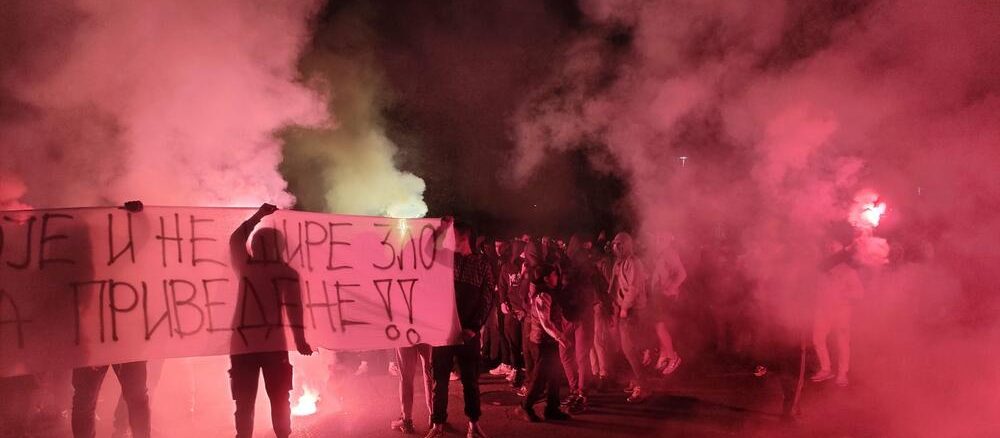
OUTBREAK OF XENOPHOBIA AGAINST TURKISH CITIZENS: A prepared hate campaign
October 31, 2025
Nothing came as a surprise, the violence against Turkish citizens in Montenegro had been prepared for weeks in the media, on social media, and by certain politicians spreading false claims that more than one hundred thousand Turks are living in Montenegro and are “ready for anything.”
“Kill the Turk” echoed through the streets of Podgorica as citizens stepped aside before the mobs of young men, football fans, and so-called “people’s patrols” intent on taking “justice” into their own hands.
In the night between Saturday and Sunday, shortly after midnight, a fight broke out in front of kafana Komanka in Zabjelo. According to official police data, 25-year-old M.J. was injured in the incident. At first, the media reported he suffered seven stab wounds, later Police Director Lazar Šćepanović said he suffered several minor injuries, cuts and one stab wound.
News of the attack spread quickly on social media, fueling hatred and inflaming tensions with mad ideas on organising “people’s patrols.” By the next evening, hundreds had gathered in Zabjelo, demanding that “the Turks be banished.” “Kill the Turk,” “This is Montenegro,” and “We don’t want foreigners in our neighbourhood” were some of the chants heard as police tried to calm the crowd. Dozens attacked a vehicle with Turkish license plates, while three Turkish citizens had to seek shelter in a casino after the crowd tried to assault them. Police escorted them out of the casino and detained them, as the crowd shouted and called for the death of Turks.
Police officially addressed the incident late that night, around 22:20, announcing the arrest of Azerbaijani citizen Y.G. (31) and Turkish citizen N.D. (54), suspected of injuring M.J. They are accused of violent behaviour, a criminal act. The police reported that 45 Turkish and Azerbaijani citizens were brought in for questioning that evening, both for criminal processing and verification of their legal status in Montenegro. Eight will be deported, while seven received fines.
Member of Parliament and senior Democrat official Boris Bogdanović posted a photo of Turkish citizens lined up against a wall with their legs spread, claiming that 40 Turks had been arrested and that “they are protecting every home,” promising “no compromise” in defending citizens’ safety.
While the tense situation in Zabjelo continued, Minister of Internal Affairs Danilo Šaranović addressed the gathered citizens. He said that claims of 100,000 Turkish citizens in Montenegro were false. “There are currently 13,000 Turkish citizens in Montenegro, of which only 80 have permanent residency. We prepared a new law on foreigners seven or eight months ago. Next week, we will introduce a more restrictive law to Parliament, and we will solve this like a serious state,” he said.
According to police data as of September 30, 2025, 13,308 Turkish citizens hold temporary or work residence permits, while 87 have permanent residency in Montenegro.
While the gathering in Zabjelo was still underway, Prime Minister Milojko Spajić announced on X that Montenegro would, through urgent procedure, temporarily suspend the visa-free regime for Turkish citizens the following day. The next day, the promise was fulfilled.
The overnight visa regime for Turkish citizens will be effective on Thursday. How this campaign and the new restrictive measures will affect relations with the country that is one of the top foreign investors, after Serbia and Russia, is to be seen. Problems may escalate if Turkey responds with reciprocal measures, given the large number of Montenegrin citizens who study, trade and receive medical treatment in Turkey or travel via Istanbul.
That same night, chants turned into action. After midnight, a car belonging to a Turkish citizen was set on fire at the car park Zeren Motors in Zabjelo, while in downtown Podgorica, on Ivan Crnojević Boulevard, a restaurant leased by a Turkish citizen was destroyed. Windows shattered, the place set on fire, and the kitchen demolished. On social media, some users shared lists of businesses cancelling Glovo deliveries because many Turks work there, alongside videos showing two Turkish men being harassed.
On Tuesday, police arrested eight people for crimes and misdemeanours motivated by national and religious hatred. A man identified as P.M. from Podgorica was detained for spreading hate speech against Turks online. Three young men were arrested for attacking three Turkish citizens in Zabjelo with fists, kicks, and baseball bats.
The Higher State Prosecutor’s Office (VDT) in Podgorica initiated an investigation into the October 26 incidents, when a group in Zabjelo chanted “Kill, kill, kill the Turk.” The VDT stated that investigations were also opened regarding damage to two vehicles and property owned by Turkish citizens, “to determine whether any of the actions constitute incitement of national, racial, or religious hatred.”
The next day, the crowd with the same hate in their voices, escorted by police, marched toward City Kvart, an apartment complex, “to look for Turks.” There were no physical clashes, but the tension was palpable as anti-Turkish chants filled the streets. Before the march to City Kvart, police detained several Montenegrin citizens after finding multiple baseball bats prepared for attacks on Turks near the so-called Komanka building in Zabjelo. Police stated the arrests were part of intensified activities following online calls for violence and hate speech, warning that “there is no place for self-initiated actions or hate speech” and that all those spreading national intolerance would be prosecuted.
“We are defending ourselves from further migration, stabbings, rapes, and occupation,” read one banner at a protest outside the Government on Tuesday, October 28. The protest, initially planned in front of the Turkish Embassy, was held under the slogan “For a normal life for us and our children! We want to live safely!” and followed the established narrative of “protecting” women, children and others from Turks.
Before the protest, police detained 11 people, including nine minors, who were found with balaclavas, flares, and marijuana, allegedly planning to attend the protest.
The wave of hatred spread beyond Podgorica. In Bar, two Turkish-owned businesses were demolished, and one was nearly set on fire. The following night, a Turkish-owned shop in central Herceg Novi burned down completely.
Three days after the initial incident that triggered this wave of violence, in which a young Montenegrin man was injured, Police Director Lazar Šćepanović stated that three Azerbaijanis and one Turk had taken part in the attack. “The injuries were minor, cuts and one stab wound, and the prosecutor determined this was not attempted murder, a conclusion confirmed by medical experts,” Šćepanović said.
Following these events, hate exploded across social media and comments on news portals, with open calls for Montenegrins and Serbs to unite against, as they say, the eternal enemy. Posts and comments dehumanising Turks and calling for lynching spread unchecked.
Saturday’s fight was merely a trigger, as the hate campaign had been brewing for months through statements from politicians, activists, influencers, and hate on social media. Institutions were slow to refute the false claim that a part of citizens accepted as credible, promoted by Nebojša Medojević, Milan Knežević, and Vladislav Dajković, that over 100,000 Turkish citizens lived in Montenegro. There was little to no response to rumours about Turks allegedly raping, kidnapping, or intimidating locals.
At the beginning of the month, anti-Turkish sentiment intensified after social media was flooded with videos of a kidnapping in Budva involving Turkish nationals. Police reacted quickly, arresting all those involved.
The fear and anger deepened further when fake news circulated that a child had been kidnapped in a Podgorica shopping mall. Posts claimed the child was taken from their mother in broad daylight and later found in a bathroom with their hair cut and mouth taped. All spiced up with the information that it was a group of Turks. Police confirmed that no such report had been filed, and the mall stated that it had not been closed, calling the story false. “Turks kidnap children”, “they steal food from Glovo orders”, “they kill, beat, and rape…”, these were some of the comments circulating online.
As the story grew, new rumours appeared: that “strange men” were photographing children on playgrounds or lurking in neighbourhoods to “record” them. UNICEF and Montenegro’s Statistical Office (Monstat) reacted, explaining that they were conducting a preparatory phase of a research. In vain, as the fan group Varvari issued their last statement, saying “they rape our women, kidnap and film our children, rob in the streets, and walk Podgorica armed.”
Even after the false claim about 100,000 Turks in Montenegro was debunked, some politicians justified it by saying there was a “subjective feeling that there are that many.”
It is worth recalling the shameful 1995 incident in Danilovgrad, when, after the rape of a girl, a mob took justice into their own hands and burned down an entire Roma neighbourhood. Police did not intervene.
This will not stop on its own. A part of the citizens has finally found someone to unleash its anger upon for all the problems that trouble us all. The problem is that for now, they are mostly getting away with it, so they might go even further in the future.
Author: Predrag Nikolić
Photo: Aljoša Turović
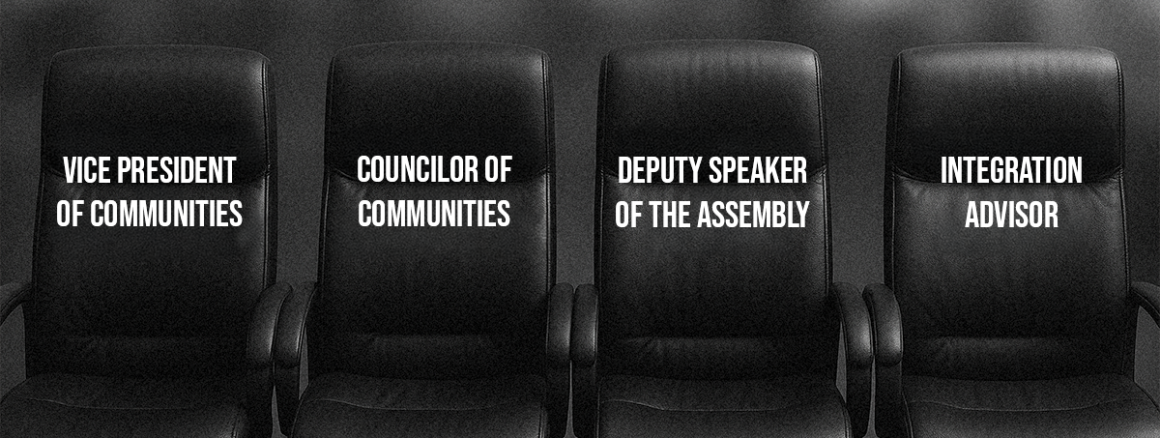
ARE WE READY FOR A LEADER WHO DOESN’T LOOK LIKE OUR MAJORITY?
October 15, 2025
The absence of Roma, Ashkali and Egyptians in state-building positions.
After months of political deadlock, on August 26, Dimal Basha was elected Speaker of the Kosovo Assembly. This followed nearly 60 failed attempts, until a Constitutional Court ruling on August 8 limited Vetëvendosje (VV) to prosposing each candidate only three times. After none of the three ministers proposed by VV secured enough votes, and following the Democratic Party of Kosovo’s (PDK) request that an MP outside the resigning Government be nominated, VV put forward Basha. He was elected on the second attempt with PDK’s support.
Since this impasse has wasted Kosovo more than half a year, it was expected that with the election of the Speaker of the Assembly, public opinion would shift to the next step in forming the Government and state institutions. But that did not happen. Social networks were flooded with insults against Basha — insults that took a racist turn, making the color of his skin the main topic, accompanied by derogatory comments. The irony is that Basha does not belong to any of the Roma, Ashkali or Egyptian communities; he is Albanian.
In fact, he was not immune from these derogatory expressions, such as “magjup,” “gabel,” or “gypsy” despite being part of the Albanian ethnic group, to which it is known he belongs. The color of his skin alone was enough for public opinion to strip him of his political responsibility, burdening him with the weight of racism that the Roma, Ashkali and Egyptian communities endure every day. This is not the case, for example, with state representatives from the Bosniak community. They are identified by their ethnic origin, but because they are white — and white state representatives represent the norm — their skin color is never questioned. This shows that appearance and skin color, regardless of ethnicity, can serve as a basis for institutionalized contempt and racialization, often even disguised as collective “criticism.”
The use of racist insults, however, is not “criticism” of an individual; rather, it denigrates the identity of entire communities that have historically been oppressed. Such insults send a message to thousands of citizens from the Roma, Ashkali and Egyptian communities. It is as if they are being told that no matter how much they work, study, or contribute to this country, you will always remain “the other” – unworthy of leading it.
In Kosovo, the president or prime minister usually represents the majority and comes from the ranks of the Albanian community, while non-majority communities, according to the Constitution, have guaranteed seats in the Assembly and Government. For example, for the first time since Kosovo’s declaration of independence in 2008, between 2021 and 2023, Bekim Arifi from the Ashkali community served as Deputy Speaker of the Assembly.
In addition to the positions guaranteed for communities in the Assembly, every government mandate has included deputy ministers, advisors to the Prime Minister, and ministers who have represented the voices of these communities and worked for their integration into society. In the Kurti Government (2020–2024), for the first time, there was a minister from the Egyptian community, Elbert Krasniqi, who continues to serve as acting Minister of Administration and Local Government (MLGA). However, even this representation — having a minister from a non-majority community in government — is a constitutional requirement.
The Constitution does not make provisions based on ethnicity. Any citizen of the Republic of Kosovo over the age of 35 is eligible to be elected President.
However, although the Constitution of Kosovo guarantees seats for representatives of non-majority communities, it does not prohibit members of these communities from holding higher representative positions, whether as president or mayor. According to the Constitution, every citizen of the Republic of Kosovo has the right to be nominated and the right to be elected. For example, the President of the Republic of Kosovo can be any citizen of the Republic who has reached the age of 35. There are no conditions or ethnic affiliation requirements for exercising this position.
But the question arises: what would happen if one day a Roma, Ashkali or Egyptian were to lead the state – not as a deputy for non-majority communities, nor as an advisor for their “integration,” but as Speaker of the Assembly or President of Kosovo? Are we ready to imagine such a reality, and then create it? Or does this persistent framing of the “other” as less valuable ultimately undermine the very democracy in which we claim to live?
“Present” in symbolic activities, but without executive power
The local elections of October 12, 2025, in Kosovo are a good opportunity to reflect on the representation of the Roma, Ashkali and Egyptian communities in decision-making structures. According to data published by the Central Election Commission (CEC), a total of 93 political entities have been certified for this year’s local elections: 32 parties, two coalitions, 32 citizens’ initiatives and 27 independent candidates, with 5,626 candidates running for local positions. Of these, 206 are running for mayor, while 5,420 are running for Municipal Assemblies.
However, not a single candidate for mayor comes from the Roma, Ashkali or Egyptian communities. One of the main reasons is the limited real chance of winning for people in these communities. They are well aware that, due to prejudice against them and ethnically driven voting, the likelihood of an Ashkali, Egyptian or Roma candidate securing a municipality is very low.
In the Municipal Assemblies, members of the Roma, Ashkali and Egyptian communities do participate, but their representation is ensured mainly through community-based parties and initiatives rather than through the major political parties. According to the CEC, a total of 129 candidates from these communities are running in this year’s elections, spread across eight municipalities — even though these communities live in 26 municipalities of the Republic of Kosovo. Specifically, the candidates represent two Egyptian parties, two Roma parties, one Ashkali party and one Ashkali community initiative.
None of the major parties has included a representative from the Roma, Ashkali or Egyptian communities as a candidate for the assembly. This absence is not due to a lack of capacity, but is clear evidence of the ethnic division of parties at the local level, as if each community is forced to be represented only by its own party.
Community representatives convey their needs only to Albanian leaders but have no real influence over addressing them.
In some municipalities, according to the Law on Local Self-Government, specifically Articles 54 and 56, communities are entitled to the positions of deputy chair of the municipal assembly and vice-chair for communities, in municipalities where at least 10% of citizens belong to non-majority communities. In certain cases, even when the percentage of non-majority communities in a municipality has not reached the 10% threshold, municipal mayors have nevertheless appointed vice-chairs from among these communities.
However, most of the time, these positions have been more “decorative” than executive. They are described as decorative because the responsibilities attached to them are often limited to symbolic activities and protocol meetings, keeping community representatives “present” at the municipal level but without tangible political influence.
Even civil society representatives from the Roma, Ashkali and Egyptian communities often describe these roles as limited, emphasizing that representatives of non-majority communities primarily collect information about the demands and needs of their communities and convey it to their Albanian leaders — without holding any executive power or direct influence over decision-making regarding those needs.
The Law on Local Self-Government also reinforces the distinction between the roles of deputy mayors of municipalities and deputy mayors for communities: the deputy mayor has executive powers and can act in the mayor’s absence, while the deputy mayor for communities remains mainly advisory. The latter only offers suggestions on issues affecting non-majority communities, without any decision-making responsibilities or executive authority.
The lack of real powers for representatives of the Roma, Ashkali and Egyptian communities has profound structural consequences, turning representation into an illusion that creates the appearance of inclusion while effectively reproducing political marginalization. This means that the needs of these communities are addressed indirectly, often filtered and diluted by the interests of the majority, instead of the communities themselves articulating and advancing solutions. The long-term consequences of this practice include a lack of trust in institutions, the perpetuation of inequalities and the risk that these communities will remain dependent on the “mercy” or will of the majority. Such a system not only undermines social cohesion but also contradicts the principles of inclusive democracy, because political equality cannot be reduced to mere physical presence in institutions without real power to influence decision-making.
Democracy is measured not only by elections and rotations of power, but also by the ability to vote for someone with a program and vision — someone who sees beyond color, surname, or background. In the United States, the election of Barack Obama as President twice, between 2009 and 2017, did not eliminate racism, but it showed the world that democracy can prevail over prejudice. A similar example occurred in London, when Sadiq Khan, the son of immigrants from Pakistan, became mayor of a metropolis of over nine million inhabitants.
For many, especially those from stigmatized communities, these moments represent recognition and hope for a more just and representative future. When Kosovo reaches the point where Roma, Ashkali or Egyptians have greater political and public representation, it will not be a victory for individuals from non-majority communities alone, but a victory for Kosovo itself — in the battle against racism.
Feature image: K2.0
Author: Bajram Ilazi
This article was originally produced for and published by Kosovo 2.0. It has been re-published here with permission.
Monthly Highlights September: glorification of war criminals, ethnic hatred, misinformation and anti-LGBTQI+ rhetoric
October 13, 2025
During the month of September, the RDN monitoring team detected a range of hateful narratives and discourse fuelled by sexism and glorification of war criminals alongside anti-LGBTQI+ rhetoric, misinformation and ethnic hate speech.
Sexism and glorification of war criminals in Bosnia and Herzegovina
The cultural event “Kočićev zbor” (Kočić’s Assembly), held on August 29, 30, and 31, 2025, in Banja Luka and Zmijanje, was organized by the Ministry of Education and Culture of Republika Srpska.
Kočićev zbor, an annual cultural and literary event in Republika Srpska, is dedicated to celebrating the legacy of Petar Kočić, a renowned Bosnian writer and activist. Local officials, cultural figures, and the public attended the event.
During the event, a shameful incident was recorded involving top ruling party officials Vlado Đajić, Savo Minić, and Milorad Dodik from The Alliance of Independent Social Democrats (SNSD). As reported by the media in Bosnia and Herzegovina on September 3, they were dancing and laughing to the lyrics: “Oh doctor, check my wife, last night I beat her spleen”.
The video, according to posts, was shared by the mayor of Bijeljina, who called on women’s associations and NGOs to react, warning that “otherwise, any further fight against violence would be meaningless.”
Furthermore, during the last day of the cultural manifestation, a journalist team from the Balkan Investigative Network of Bosnia and Herzegovina (Detektor.ba) recorded stands with T-shirts featuring the image of convicted war criminal Ratko Mladić. The T-shirt being sold features Mladić’s image and the inscription “General, are you afraid of anyone? Only God and no one else”.
The ban on glorifying war criminals or denying war crimes was introduced through amendments to the Criminal Code of Bosnia and Herzegovina, imposed by High Representative Valentin Inzko in July 2021. Mladić, the former commander of the Army of Republika Srpska, was sentenced to life imprisonment by the International Criminal Tribunal for the former Yugoslavia in June 2021 for genocide in Srebrenica, persecution of Bosniaks and Croats, terrorising the citizens of Sarajevo, and taking UNPROFOR members hostage. Promoting his image and thereby invertedly glorifying a war criminal, is highly insensitive and indeed harmful and upsetting to all those families and victims of the horrors imposed by Mladić and his army. Such scenes should not take place at any events, especially those organised by institutions, nor should they be justified.
Anti-LGBTQI+ rhetoric in Albania
During the month of September in Albania, a public debate was held over the Draft Law on Gender Equality, which aimed to align national legislation with international human rights standards.
The debate took place within a culturally conservative society where traditional family values and religious norms remain highly influential. Political actors, religious institutions (such as the Muslim Community of Albania – KMSH), and some civil society groups leveraged these cultural sensitivities to frame the draft law as a threat to family, education, language, and national identity.
In addition, media outlets amplified these narratives, often without contextualising the legal provisions, contributing to public confusion and alarm. These often-misleading narratives, portraying LGBTQI+ individuals and gender equality advocates as a moral threat to society served to foster stigmatisation, panic and hostility towards the targeted groups. The misrepresentation of the intent of the law led to hateful narratives and anti-LGBTQI+ rhetoric.
This environment reflects the broader challenge of implementing progressive gender equality reforms in a socially and politically conservative context, where misrepresentation and moralistic framing can easily influence public perception and foster hostility toward marginalised groups. The media, acting as messengers to society, should not be the catalyst of misrepresentation and hate towards marginalised groups in society. On the contrary, they should provide facts and truth allowing members of society to make their own opinions whilst also protecting marginalised groups from harm.
Misinformation and fake news in Montenegro
On one early September morning, on social media, claims began circulating that a mother’s child was abducted from her arms in a shopping mall (Big Fashion) in Podgorica. According to the post, the shopping mall was allegedly closed instantly, and the child was found with tape over their mouth and their hair cut. Some posts claimed the child was then found in a restroom and that foreign nationals (according to the allegations, “Turks”) were responsible. There was also an emphasis on this not being the first of such an event.
In response to the posts circulating social media, parents and concerned citizens exchanged messages, especially in Viber groups, about the supposed event. As a result, there was widespread fear and questions about child safety. In Montenegro, as in many places, stories about child safety are particularly sensitive and parents are especially worried about abductions, trafficking and safety in public spaces. When an event involves children, conversations on social media spreads very quickly.
Following havoc and panic, it then came out that the initial post regarding the child abduction was fake and the information not true. The alleged involvement of “Turks” fed into broader narratives and fears about migration, or so called “outsiders,” and national security. One article reporting on the incident noted that the “anti-Turkish” narrative was a strong component of the panic resulting in fearmongering and pointing of fingers at communities living in Montenegro. Moreover, as institutions in Montenegro (e.g. police, statistical offices, NGOs) are sometimes mistrusted or not immediately believed, false claims can persist even after official denial of the claims, as in this case. Regardless of no evidence of the abduction taking place nor holding any truth to the matter, no accountability has been held. This highlighting the dangers of disinformation being spread like wildfire on social media with little to no accountability or responsibility. It is the role of the media to inform their public of the truth and to debunk any disinformation circulating whilst social media companies themselves should use their agency to take down fake news and not permit hate and division to be spread based on disinformation.
Ethnic hate in Kosovo and North Macedonia
In Kosovo, after dozens of attempts to elect the Speaker of the Assembly, the majority of deputies finally gave the green light and elected Dimal Basha from the “Vetëvendosje” party to this position. Public opinion was divided in its reactions to Basha’s election. He received support from his party’s sympathizers, but not from those of other parties or from the majority of citizens who are not politically engaged. This dissatisfaction, among a considerable number of commentators, turned into racist remarks on social media because of his darker skin colour — even though it is well known that Basha is Albanian and does not belong to the Roma, Ashkali, or Egyptian communities.
This reaction can be explained by the considerable portion of citizens in Kosovo who do not accept diversity and oppose granting greater rights to people with different sexual orientations, ethnic minorities, or to individuals with a different skin colour. In this particular case, because of Basha’s darker skin colour, a significant number of social media commentators did not hesitate to use hate speech and to cynically remark that the institutions have “fallen into the hands” of minorities or Ashkali (Roma who speak the Albanian language). According to Kosovo’s laws, all communities have equal rights, and each of their representatives can be elected to head Kosovo’s institutions.
News on the Ashkali community is often accompanied by hate speech and language in the comment sections of the articles. Such is the case with online media outlet Nacionale where one of their journalists visited an Ashkali family that had been living for some time in the basement of a building. The husband, his pregnant wife, and their seven children, who were evicted from their rented home, had been unable to find shelter for two weeks, despite seeking help from both the municipality and the police.
The journalist contacted the head of the municipality and the official responsible for social issues and community rights and then revisited the family. Temporary accommodation was provided, and the wife and children were placed in a women’s shelter, while the husband was given temporary lodging in a hotel.
If it is confirmed that this family is from Prizren, and not from Gjakova as stated in the video recording, the municipality has promised to resolve their permanent housing issue.
Following this, there was a surge of hateful speech on social media including hate and insults directed at the family based on their ethnicity. It is the role and responsibility of the media to ensure that hate does not flourish in the comment sections of their articles but rather to provide a healthy space to talk about important issues such as that of the unequal treatment of different minority groups in the country.
In North Macedonia, Ali Ahmeti is the longtime leader of the Democratic Union for Integration (DUI), the dominant ethnic Albanian party in North Macedonia and a key player in almost every governing coalition since 2002. DUI has positioned itself as both the political representative of Albanians in the country and a strong pro-European force, often framing EU integration as the only realistic path for stability and coexistence.
In a recent exchange, Ali Ahmeti reportedly sent a message to Prime Minister Hristijan Mickoski, according to 4NEWS.mk, warning that if North Macedonia does not continue its path toward EU integration, citizens might feel compelled to seek unification with Albania or, in some cases, Bulgaria. He added, however, that hatred should not be spread among citizens, emphasizing that it is neither Albanians, Albania, nor Bulgaria that are taking over the country, noting that Bulgaria is in the EU and questioning North Macedonia’s place if it falls behind. The Facebook page Dissident View published the news, generating over 500 comments. Many of the comments contained hate speech and harmful narratives, with users debating historical grievances and ethnic origins from both Albanian and Macedonian perspectives.
Furthermore, during the election campaign, Ali Ahmeti also used a metaphor in his rally speech directed at Prime Minister Hristijan Mickoski. He said that “you cannot go hunting eagles with hunting dogs, because eagles fly high,” implying that Albanian representatives in the government are treated like “hunting dogs,” while Albanians themselves are “eagles” who cannot be controlled.
Prime Minister Mickoski quickly replied, saying that Ahmeti is “not an eagle, but just a bird,” dismissing his metaphor and undermining his self-description as a leader representing strength and dignity.
The exchange was widely discussed online and in the media, with interpretations split along political and ethnic lines. For some, Ahmeti’s words highlighted the mistreatment of Albanians in government, while Mickoski’s response was seen as an insult toward Albanians more broadly. Others, however, saw both leaders as using divisive language to mobilize voters during the campaign.
The exchange of hateful speech between Ali Ahmeti and the Prime Minister can be seen has hateful and unprofessional. Regardless of political stance and methods used to garner votes, such campaigning should not rest upon personal insults and especially not those along ethnic lines. North Macedonia is a multi-ethnic country where there remain division and tension amongst ethnic groups. Political leaders should not use this division to further their agenda regardless of their stance and politics – rather than seeking division, those in power should use their platform to promote inclusivity and respect.
Hate speech in Serbia
The second season of the children’s show Važne stvari (Important Matters) on the Radio Television of Serbia (RTS) began with an episode in which a twelve-year-old boy talked about how he temporarily did not have classes at school, explaining that it was because of the student blockades and protests “because the students are fighting for justice and for our future”. The concept of the show is that children are getting their hair cut, while the hairdresser asks simple questions about them, their families, school and daily life. Children then talk about things that are important to them.
The boy’s statement went viral on social media, with the original Instagram reel featuring the excerpt from the show reaching over 2.7 million views. This was followed by many messages of support. Still, it also caused negative reactions in pro-regime media, which described this show as a “shameful abuse of children” for political propaganda.
This caused a chain reaction, starting with the cancellation of the replay of the show the very next day, the episode being removed from the show’s official YouTube account, and the RTS Board of Directors reporting the show to the Regulatory Body for Electronic Media for violating the rights of minors.
Pro-regime media outlets reported not only exposed the child to hate but also targeted anyone involved with the show both on RTS and the production team behind it. This reporting suggested that children should not have an opinion about the world around them, presented the childs statement and the show as “propaganda” and abused the boy’s statement as collateral damage in targeting RTS and N1, whereby the pro-regime media do what they accuse others of. For instance, television channel and online portal Informer, targeted the owners of the production company behind the show, characterising them as “supporters of blockaders”.
RTS workers’ collective Naš proTeSt called on the management to protect the editor of the Children’s program at RTS, Jelena Popadić Sumić, who was also targeted in Informer and Alo. The production team of the show stated that the concept they are working on “explicitly defines how children are treated and communicated with, from casting to recording to the broadcast of the show. Children talk about topics that are important to them, any instruction from the author or presenter is not allowed and is not practiced.” Children and young people are not isolated from reality. They live in a society where protests, blockades and political tensions affect their daily life, and they have the right to think and speak about it.