Why women in Bosnia and Herzegovina are still afraid of having property in their name
May 7, 2026
In Bosnia and Herzegovina, women have equal rights to property, at least on paper. In practice, many renounce it. Not because they must, but because they believe they should.
This is confirmed by the long-term experience of Lana Jajčević, a legal advisor at the United Women’s Foundation from Banja Luka, who has been working with women victims of domestic violence for decades.
More than 10,000 women have passed through the counseling center of this foundation.
“Women seem to be afraid of owning property in their name” says Jajčević.
Although she advises that it would be good for them to accept the property during the divorce and the one they inherit from their parents, because it can be crucial for their protection and security, many women refuse to do so. Therefore, they immediately transfer the property to their children or refuse to register it in their name at all.
Jajčević cites the example of a woman who experienced a severe case of domestic violence but did not change her attitude towards property.
“As soon as there was talk that she would inherit property from her parents, even before she inherited the property, she asked how she would leave it to her children.”
She survived a severe case of domestic violence but still thinks the same.
“Her husband brutally beat her up in public, but when she inherited property from her parents, she immediately passed it on to her children, and she has two children from that marriage,” says Jajčević.
“She acts as if she doesn’t need anything, and she lives as a tenant in Banja Luka.”
According to Jajcevic, women often leave property to their brothers or other family members, even when they are in a worse financial situation.
The prevailing attitude among women, Jajcevic observes, is that “property should not be in their name”.
“The most common question is: what will people say?! These traditional values that are wrongly nurtured still show our women that they should not own property,” she points out.
It is particularly worrying that, as she says, even younger women in urban areas are not immune to these types of behavior. The exception are mostly more educated women.
All goes to the brother, because a daughter belongs to “another household”
In a survey on the topic of family inheritance, from their personal experience, women across Bosnia and Herzegovina confirmed that they gave up property because of tradition and family expectations.
“In our country, men are more respected and they say: you should give everything to your brother, but not to women because they will marry into someone else’s house”, Merka Mustafić from Srebrenica points out the customs.
She points out that now, after dividing the property, she would act differently.
“Now I would take it, even just to have a room of my own, instead of giving everything to my brothers,” says Mustafić.
Mevlida Jašarević, a forty-seven-year-old woman from the vicinity of Srebrenica, pointed to her specific family situation. She and her sisters renounced their property in favour of a male family member.
“We gave everything to our cousin, because he was the only one who inherited our last name. He was the only one left of the men, the only one with a last name.”
For some, the renunciation did not go without consequences. Amina Buljubašić from Zenica describes the damaged family relationships due to the unresolved inheritance.
“The process was never finished, and my brother and sister blocked me and we don’t talk, and they look away when we meet. It’s horrible,” Amina wrote in the survey.
Sajma Mehmedović’s brother inherited everything after the death of their parents.
“My brother inherited everything after my mother died because we lost our father in ’95, and the four of us, sisters, gave the property to our brother as a gift.”
They, says Sajma, already had stability in their new families:
“Our brother offered it, but we didn’t want it, because, thank God, all of us have families and a home,” wrote Sajma.
In Srebrenica, in eastern Bosnia and Herzegovina, it’s tradition, says Muhiba Hadžibulić.
“It’s our tradition, in order not to ruin the relationship between us”, she points out the reason why property is left to male family members.
For most women, giving up the right of inheritance is primarily a moral obligation towards the family, the desire to preserve good family relations, not to divide the property into several parts, and avoid family pressure.
‘Women who ask for their share are often stigmatised as greedy’
Only 34 percent of women in Bosnia and Herzegovina own immovable property, says the data from the CILAP immovable property records, carried out with the geodetic administrations of the Republic of Srpska and the Federation of Bosnia and Herzegovina.
Mirjana Miškić, a professor at the Faculty of Law at the University of Banja Luka, states this data in the analysis “Common property and inheritance in Bosnia and Herzegovina”.
The reasons lie in a deep-rooted tradition according to which family property is viewed as “men’s”, answers Miškić when asked why this is so.
Daughters often give up their inheritance in favor of their brothers, she continues, in order to preserve good relations in the primary family.
“There is a belief that by going to another house (marriage), the daughter is taken care of, while the son stays to maintain the family estate and surname and is considered the legitimate successor of the family name,” she explains.
Patriarchal patterns in BiH society operate through stereotypical gender roles and are the result of the historical development of the legal position of women, says Miškić.
“The pattern in which the male descendant inherits everything dates back to customary law and the first living communities, and it has remained until today as an unwritten rule that often overrides modern legal solutions,” says the professor at the Faculty of Law in Banja Luka.
Although renunciation is voluntary, it is very often the result of concealed social pressure, warns Miškić.
“Women who ask for their share are often stigmatized as greedy or face a break in contact with their family. The fear of judgment from the environment and loss of emotional support from the family makes this renunciation only conditionally ‘voluntary'”.
This renunciation also has its economic consequences, because as professor Miškić says, “renunciation directly threatens economic independence”.
“Without assets in their name, women do not have assets that serve (as collateral) to obtain bank loans to start independent entrepreneurship. They depend on the goodwill of their husbands or male relatives. They are left without ‘security in case of divorce or death of their spouse'”.
The choice is often not really free
Professor Miškić explains that customs are still extremely strong in Bosnia and Herzegovina. Although the laws on inheritance in both BiH entities are gender neutral and guarantee equal rights to sons and daughters, she says, in practice the institute of renunciation of inheritance is used massively, and the role of the family and the community are always primary sources of pressure.
“The family teaches female children from an early age that property belongs to the brothers. Throughout history, religious laws (such as Sharia law or church rules in the past) have treated male and female heirs differently, which left a deep mark on the collective consciousness of the people of BiH,” Miškić points to the essence of the problem and adds that the local community maintains the norm “through gossip and condemnation of women who take their brother’s share”.
And Amila Zdralović, a professor at the Faculty of Law at the University of Sarajevo, believes that women give up property under the influence of society and patriarchal norms.
“Individuals are taught patriarchal values through entire processes – not through one act, but through entire processes of socialization. And then we actually adopt those values as if they were our own. Even when at first it may seem to us that it is voluntary, in principle it is not,” she points out.
Equal rights on paper, not in life
The question that arises is how to empower a woman to claim her legal right, because laws in Bosnia and Herzegovina treat heirs equally, regardless of gender.
“In principle, the question is how we will dismantle this socio-cultural context”, says Zdralović.
There is no direct connection, she explains, between gender-sensitive language and women in politics, for example, but all this”, Zdralović continues, “contributes to the breakdown and deconstruction of patriarchal sociocultural patterns”.
The law is clear: in Bosnia and Herzegovina, women and men have equal rights to property and inheritance, but there is a deep gap between the law and real life.
In the name of “keeping the peace at home”, women give up their rights and from generation to generation remain without property and their economic security and independence.
This story inspired a cross-border collaboration with the Meduza platform. As part of this collaboration, we will publish stories of women’s experiences with inheritance from Western Balkan countries.
Featured photo: Meduza platform/Damjana Vidicheska
Troll of the Month: Dragan Koprivica and Mitar Šušić
May 6, 2026
The Balkan Troll of the Month is an individual, a group of individuals or a media outlet that spreads hate based on gender, ethnicity, religion, or other diversity categories. The Balkan Troll is selected based on hate speech incidents identified across the Western Balkan region.
TV Prva, a commercial television channel in Montenegro, invited guests Dragan Koprivica, a professor at the University of Montenegro’s Faculty of Philology, and Mitar Šušić, a lawyer and councillor in the Podgorica City Assembly who heads the New Serbian Democracy caucus, to its morning show.
The guide’s purpose is to help teachers recognise and prevent homophobic peer violence, protect students, and respond responsibly to discrimination. However, instead of addressing this, both guests instead used this opportunity to spread anti-LGBTQI+ narratives and misinformation.
They went on to make false, discriminatory, homophobic, and manipulative claims, completely misrepresenting the guide. They even went as far as linking LGBTIQ+ topics to paedophilia, necrophilia, and “moral decay,”.
Making these kinds of accusations is very harmful. False conspiracy narratives that only serve to spread hatred towards the community but also simultaneously encourage stigma and intolerance. As noted by the Centre for Civic Education, the guide is strictly protective and pedagogical; its purpose is to empower and equip schools to recognise and respond to violence and homophobia.
By representing this guide as a type of ‘moral decay’, this only further spreads anti-LGBTIQ+ narratives and creates fears around the discussion of suchimportant topics. Preventing homophobia and violence in school is extremely important and a topic such as that should be discussed in a responsible and professional manner, rather than using the opportunity to further spread hate, disinformation and discrimination.
The media have a responsibility to do better. They should not be providing the platform and airtime to guests who use the space to spread discrimination and homophobia. Rather, they should ensure to invite guests who talk about important subjects with a tone of sensitivity and seriousness, emphasising the importance of such guides for schools and teachers to ensure they are equipped and prepared to prevent and respond to violence, homophobia and hate in the classrooms.
All children and individuals need protection, and no person should feel excluded, bullied or stigmatised because of their sexual orientation. The media should ensure to use their platform and reach to teach and educate the public on important topics such as LGBTIQ+ rights.
HATE SPEECH ON TELEVISION: Screens of Dangerous Narratives
April 28, 2026
This and previous year, the Agency for Audiovisual Media Services (AMU) has imposed four fines of €500 each, along with several issued warnings on television broadcasters in Montenegro on the accounts of hate speech. In addition to Pink, Adria and Prva TV, dangerous narratives were also spread by the national public broadcaster Radio and Television of Montenegro (RTCG) and Podgorica’s municipal public channel.
According to data obtained by the Center for Investigative Journalism of Montenegro (CIN-CG) from the Agency for Audiovisual Media Services (AMU), hate speech is spilling over from social media into the programmes of broadcasters with national coverage. This is reflected in the growing number of penalties issued by the regulator for discriminatory and offensive speech.
MONTENEGRINS, CROATS, TURKS… ALL TARGETED
In February this year, the AMU Council decided to temporarily restrict the reception and rebroadcasting of the TV Pink programme Novo jutro – Jutro sa dušom (New Morning – A Soulful Morning), hosted by Jovana Jeremić and Predrag Sarapa, both known as vocal supporters of the Aleksandar Vučić regime. The sanctioned channel is part of Serbia’s Pink Media Group, owned by businessman Željko Mitrović.
The measure was imposed for six months due to a breach of Article 7(1) of the European Convention on Transfrontier Television, which requires programme content to respect human dignity and the fundamental rights of others. Instead of a “soulful morning,” Jeremić’s show featured hate speech directed at members of the Montenegrin nation, as well as Croatian citizens and citizens of Turkey.
Croats were labelled as Ustaše, Turks were called new occupiers, and Montenegrins were claimed to be “mutated Serbs,” or hybrids of sorts, who had embarked on a pro-Ustaša path, but that would soon become part of Serbia.
“AVNOJ-era Montenegro will not exist much longer, and I can say that almost with certainty. Borders will change, Serbia will once again have access to the sea, and that is what frightens Brussels,” reads one of the quotations cited in the AMU decision.
The problem is not limited to Pink, which has a long tradition of spreading hateful narratives. Media outlets funded by Montenegrin citizens, the public broadcaster RTCG and Podgorica’s municipal broadcaster, have also promoted dangerous and problematic narratives.
“Data from recent years point to a worrying trend. In 2025, AMU issued six warnings for discriminatory and offensive speech, as well as three fines of €500 each. By comparison, in 2024 only one warning was issued on those grounds, out of a total of 107, while no fines were imposed,” the Agency told CIN-CG.
That the trend continues in a negative direction is also shown by the fact that in the first three months of 2026 alone, one fine has already been issued for repeat violations.
“It should be borne in mind that a fine is imposed when a broadcaster, despite having already received a warning, commits the same violation again within a period shorter than six months. The number of fines therefore indicates that certain broadcasters are knowingly neglecting or failing to take measures to prevent the airing of problematic content,” AMU said.
At the end of February, the Agency fined Adria TV €500 for repeated violations of the ban on inciting discrimination and for failing to disclose the source of rebroadcast material. The penalty related to the rebroadcast of a New Year’s programme from Informer TV in Belgrade.
The programme glorified the Chetnik movement and denied Montenegrin identity. Lyrics of traditional and original songs were altered to portray Montenegro as “Serbian,” statements such as “This is not Montenegro, but Serbia by the sea” and “every Serb is a Serb” were broadcast, and the names of convicted war criminals were chanted and sung as if they were heroes, according to the AMU ruling.
During 2025, fines and warnings were imposed on Prva TV and Adria TV, while warnings were also issued to RTCG, TDI Radio and Gradska TV.
“The content subject to sanctions most often involved views and labels that could be considered discriminatory towards certain groups, including ethnic, national, political, migrant, minority and other vulnerable communities. In such cases, group affiliation or an actual or presumed personal characteristic is often emphasised as a basis for discrimination, through prejudice, targeting or promoting restrictions on the rights of those groups. In some cases, historical events or crimes were relativised, facts selectively presented without relevant sources, and terminology used that may provoke discrimination and deepen social divisions,” the Agency explained.
FINES FOR ADRIA TV AND PRVA TV
Before being fined, Adria TV and Prva TV had already ignored two AMU warnings, as they had allowed or editorially shaped content that incited discrimination, spread stereotypes or favoured narratives portraying certain social groups negatively.
Prva TV earned its first €500 fine over a morning programme discussing reactions to the erection of a monument to Chetnik commander and war criminal Pavle Đurišić, as well as an initiative to relocate the monument to Duke Mirko Petrović. Viewers heard messages justifying the monument to Đurišić on the grounds that it was “on private property and financed with private money,” along with dangerous comments from viewers claiming that “Montenegrins and Serbs were not slaughtered by Turks, but by Bosniaks.”
AMU also reacted to the station’s reporting on chauvinistic incidents in Podgorica involving Turkish citizens. In the programme 60 minuta (60 Minutes), statements were made such as “an attack by Turks on a young man from Podgorica,” along with questions like “what are we going to do with thousands of Turkish citizens, many of whom are offenders?”
Prva TV also came under AMU scrutiny on 25 June last year when it rebroadcast a programme titled Specijalna emisija (Special Show), co-produced by pro-government Serbian broadcasters. Participants included Gordana Uzelac (TV Pink), Dragan Vučićević (TV Informer), Milomir Marić (TV Happy), Ivana Vučićević (Studio B), businessman Branko Babić, Professor Lazar Stijak of the Belgrade Medical Faculty, Oliver Jakšić (TV B92), and convicted war criminal Vojislav Šešelj.
The programme featured a number of claims directly denying the genocide in Srebrenica, including assertions that unrest planned in Serbia from 28 June to 11 July, around the anniversary of the Srebrenica massacre, was intended to “brand Serbs as a genocidal people,” even though “there was no genocide.” According to the Agency, it also allowed statements that incited violence, emphasised group identity in a discriminatory manner, and violated the privacy and dignity of citizens.
Adria TV was also fined over the documentary Srebrenica, anatomija obmane (Srebrenica, Anatomy of Deception). The Agency found that the programme presented a selective account of events during the Srebrenica genocide. While it did not directly deny the genocide, the overall tone and narrative suggested that the violence could be viewed as “a consequence of earlier injustices.” AMU warned that such an approach could deepen social divisions and legitimise discriminatory attitudes in the public sphere.
Before being fined, Adria TV had also received warnings over the programmes Zorom (At Dawn) and Press Plus, in which lawyer Miomir Joksimović and civil activist Zarija Pavićević expressed views inciting hostility and discrimination towards foreign nationals and certain ethnic and religious groups.
The programmes aired claims about the alleged creation of closed foreign communities. Joksimović warned that in some neighbourhoods “Sharia law could be introduced in 15 years,” while Pavićević advocated stricter controls on foreigners, saying “you can tell where someone is from,” and that police should carry out random street checks of legal status. Calls were also made for “the number of foreigners in Montenegro to be cut by at least half,” urging citizens to “continue the struggle and protect themselves and their property.”
WARNINGS
AMU issued a warning to TDI Radio over jokes targeting Roma people and persons with disabilities. The disputed content aired in the entertainment programme Antidepresiv (Antidepressant) in April 2025. Through jokes and humorous sketches, certain social groups were stereotyped and insulted, including people with disabilities and members of the Roma community.
After reviewing the recording, the Agency concluded that the content had been editorially selected and broadcast as part of an April Fools’ Day programme. Although the broadcaster argued it was humour and included disclaimers that there was no intention to offend, the Agency found that such a format does not remove responsibility when content crosses the boundaries of permissible satire and may reinforce discriminatory stereotypes.
Podgorica’s local public broadcaster Gradska TV also received a warning over remarks made by Srpska 24 editor Ivan Milošević during the programme Presing. He said he believed “it is somewhat inappropriate that in a country where 74 per cent of the population is Orthodox, foreign policy is led by a representative of a national minority,” referring to Foreign Minister Ervin Ibrahimović. The Agency concluded that such remarks stigmatised members of a national minority by suggesting it was inappropriate for someone from that community to hold an important public office.
Gradska TV repeated the programme later the same day, thereby failing to prevent the further spread of the unlawful speech, AMU found. The regulator also questioned the choice of guest for a local public broadcaster, given Milošević’s previous statements. He had earlier drawn public attention with a withdrawn column titled Koncert za Nermina: Islamizacija Podgorice? (Concert for Nermin: Islamisation of Podgorica?), published on the Borba portal, in which he wrote that Nermin Abdić, then a candidate for mayor of Podgorica and an MP from the Democratic Party of Socialists, “belongs to a religious and national minority and can hardly unite under his wing what Podgorica was, and still is. This city is, after all, a settlement of Orthodox inhabitants and their tradition…”
The national public broadcaster RTCG also received a warning. It concerned the broadcast of the second and third episodes of the documentary series Vraneš – Zemlja i ljudi (Vraneš – Land and People) on the First Channel on 6 and 13 January 2025. The Agency concluded that the programmes promoted discriminatory conduct.
Its analysis found that documentary ethics requiring credibility, accuracy and integrity had not been respected. Historical facts were selectively and imprecisely presented without relevant sources, crimes were relativised, and terminology was used that could provoke discrimination and deepen divisions.
This applied particularly to the portrayal of the timing and causes of population migrations in the area, especially the departure of the Muslim population at the end of and after 1924 from the Tomaševo (then Šahovići) and Pavino Polje areas.
“Given that the mass killing of several hundred Muslim residents in early December 1924 was the main cause of the subsequent mass exodus, the broadcaster unjustifiably, inaccurately and inappropriately referred to the consequence of that event merely as ‘migration’, while on several occasions using relativising terms such as ‘dramatic events’ and ‘tragic events’ without mentioning the key historical context — that the displacement was the result of a horrific crime involving mass murder,” the AMU ruling states.
AMU told CIN-CG that “content contributing to the creation or spread of negative perceptions and discriminatory attitudes towards different groups cannot be protected as a form of freedom of expression, because it constitutes an abuse of that freedom. In such cases, sanctions are a mechanism for protecting the rights of others and the public interest.”
Not Just a Statistic: Media Responsibility in Reporting on Victims of Sexual Violence
April 22, 2026
Content warning: This article discusses sexual violence, abuse, and the treatment of victims in media coverage. Some readers may find this distressing.
“If you or someone you know were sexually assaulted, would you please stand. If you or that person you know was assaulted by someone they knew, would you please raise your hand. And if you or that person who was assaulted actually reported it, stay standing.”
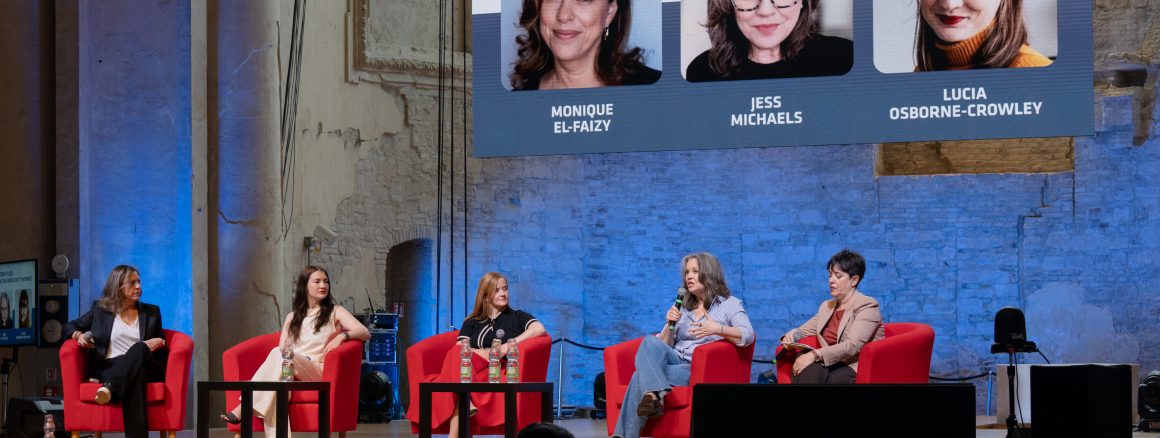
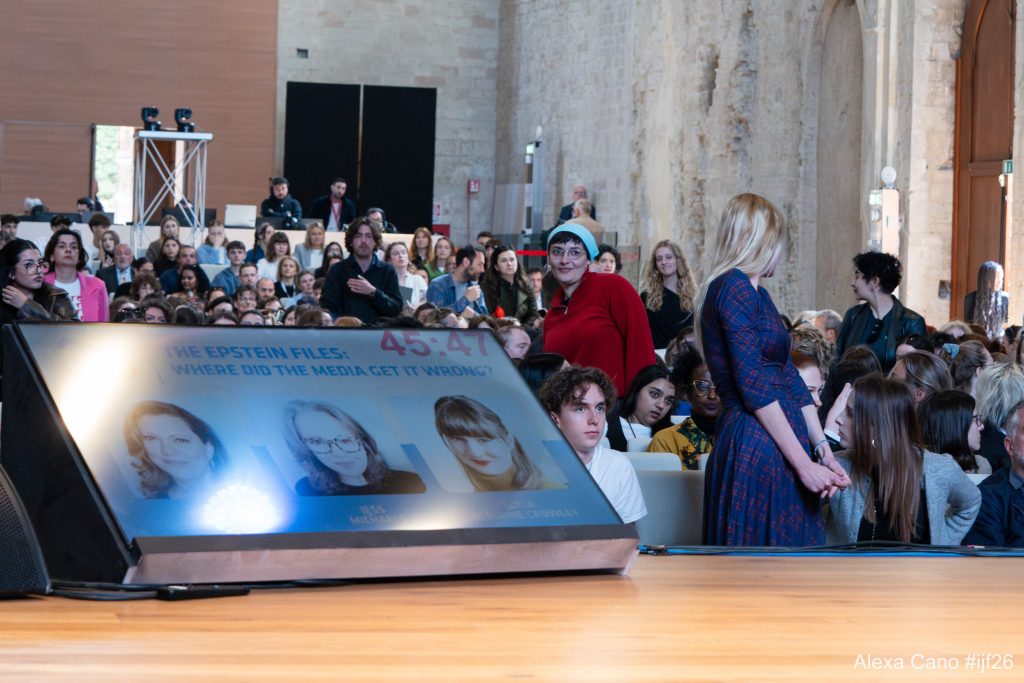
This is how Jess Michaels, an advocate for survivors of sexual assault and founder of 3Joannes Inc, and an Epstein survivor herself, began her talk on the panel at Perugia’s 20th International Journalism Festival.
Shocking or not, it would be safe to say that most of the people in the room stood up, raised their hands, and then quickly sat down. Because that is what we forget – it is not a stranger in an alley or a random person in the park late at night who on average commit acts of sexual violence.
According to the NGO RAINN (The Rape, Abuse & Incest National Network) “60% of rapes are committed by someone known to the victim whereas 2.5% ‘are committed by someone with an unknown relationship to the victim”. Despite its severity, this crime remains one of the most under-reported in the world. Victims often face aggressive interrogation and outright denial, dissuading victims to come forward.
The #MeToo movement saw one of the largest online movements and bravery of women and girls’ testimonies of sexual violence, misconduct and behaviour, drawing awareness to sexual abuse, rape culture and sexual harassment which haunt our streets, our social media, our gaming platforms and day to day life. A movement of exposure, resilience and fight for the protection of women, as well as a call for perpetrators to face the consequences of their actions.
However, as highlighted by the panellists in Perugia, #MeToo was only a starting point, not the end.
We find ourselves in 2026, as the U.S. Department of Justice begins releasing heavily redacted files that peel back the surface of one of the most powerful white men in America, and arguably the world.
The picture that emerges isn’t just of a man, but of something more disturbing altogether; an octopus whose tentacles span across continents from the most influential figures in society, from businessmen to members of the Royal Family in the United Kingdom. The documents trace Jeffrey Epstein’s web of social and financial connections. More disturbing still, they expose not just who he knew, but how he operated,revealing in black and white, his attitudes towards women and the actions that proceeded as a result.
The Epstein Files, despite being heavily redacted, have managed to expose some of the most powerful men in the world and their misogyny, hatred, acts of violence and sexual assault. Yet it remains to be seen whether any of the names mentioned will face prosecution for their actions.
It seems that despite the level of exposure and evidence against them, we are yet again in a situation of lack of institutional reaction and willingness to take these powerful white men and make them face the consequences of their actions. The web around them remains so impermeable that not even the law nor human rights and dignity have been able to break through and shatter their protective glass.
The important thing to remember is that Epstein did not act alone. He had people around him at every corner. From those people who saw what was happening and stayed silent, people who enabled it, and people who took part in it. And yet, the ones who should have been in focus from the beginning, the victims, are still denied the dignity and respect they deserve, across the media landscape, both online and offline.
Instead, we’ve seen coverage that deliberately softens the reality. Victims under 18 are described as “underage women,” a tactic shying away from the actual truth: these are children. It’s a deliberate choice, one that diminishes the severity of the crimes and helps to shield those responsible.
Headlines and articles have been seen to focus on the power, status and influence of these powerful men, reinforcing their importance and position in society while pushing the victims further into the background.
Annette Young, the moderator at Perugia’s panel discussion, drew our attention to an email between Epstein and a French businessman Olivier Colom, a former diplomat and advisor to President Nicolas Sarkozy where Epstein referred to women as “some are like shrimp, you throw away the head and keep the body”. The issue with this sentence, aside from the fact that it was written and sent between two extremely influential and powerful men, is this quote represents a certain attitude towards women which still exists in our society today.
We have all witnessed the case of Gisèle Pelicot, a French woman who was a victim of multiple rape cases orchestrated by her husband Dominique, who would repeatedly drug her and rape her alongside 51 other men while she was unconscious. This case saw justice in the court room with 47 men being found guilty of aggravated rape, two of attempted rape and two of sexual assault. And yet, Gisèle had to endure and suffer years of sexual violence and rape by one of the most trusted people in her life, her husband.
CNN recently conducted an investigation exposing a global ‘rape academy’ with group chats between men encouraging one another to drug and assault their wives. On one specific porn site, there were over 20,000 videos of so called ‘sleep’ content. The website had 62 million views in February alone. One of the users on the website even claimed to be running a business selling sleeping liquids that can be deliveredanywhere across the world.
We need to ask ourselves, why is it that when powerful, rich white men conduct acts of sexual violence and crime, we give them the platform and space to explore their backgrounds, their image, their influence,rather than paying attention to the victims of such crimes. Why is it that the mainstream media yet again has failed the victims of sexual violence by not protecting their dignity, privacy and safety.
Indeed, it goes as far as everyday users on X using Grok, X’s built-in AI system, to unblur or remove the black boxes covering the faces of the children and women photographed and included as evidence in the Epstein Files, whose faces were blurred for the protection of their privacy.
In what kind of society does it become normalised for individuals, regardless of status, to conduct acts of sexual violence and crimes with little to no accountability and consequence?
Towards the end of the panel, attention was drawn to where the media has failed Epstein victims and survivors and where we can do better. The victims of these crimes are human first and foremost, and they cannot be contacted nor respond to every single interview request. It is important we acknowledge that speaking of one of the most traumatic moments and experiences of victims can re-traumatise them.
Furthermore, the importance of protecting these victims is vital; this includes not sharing their personal information such as phone numbers and contact information without consent, to ensuring that their privacy and boundaries are respected. This can also include taking regular breaks during interviews especially when covering sensitive and triggering topics such as trauma and sexual violence. Rather that pushing for the story to come out as fast and as quick as possible, journalists should allow the interviewee to lead the interview and timeline based on their comfort, safety and pace.
Sexual violence and rape are one of the most inhumane acts of violence. As journalists, our role is to make sure we don’t get pulled into the same misogynistic, patriarchal machine that allows rape jokes, sexism, and inequality to thrive. We have to actively go against it. That means being clear about what these crimes are, making sure readers understand them, doing our part in protecting victims from their identity to their personal information and being clear to call out the crimes for what they are – crimes against children, women or men.
The media shapes how people understand society, it has an influence on how people think and view the world, and it is our role to ensure that when reporting on sensitive cases such as sexual violence, we do it responsibly and adhere to the appropriate Code of Ethics. We must remember these are not nameless victims; they are people who have feelings and emotions and who live lives. They are not headlines or case numbers. We must remember this when reporting on such cases, which should be driven by compassion, humanity and empathy rather than competition and sensationalism.
Author: Hana Kojaković
Photos: Alexa Cano #ijf26
Livestock Woes Lost in Headlines Over Former Pageant Queen
April 17, 2026
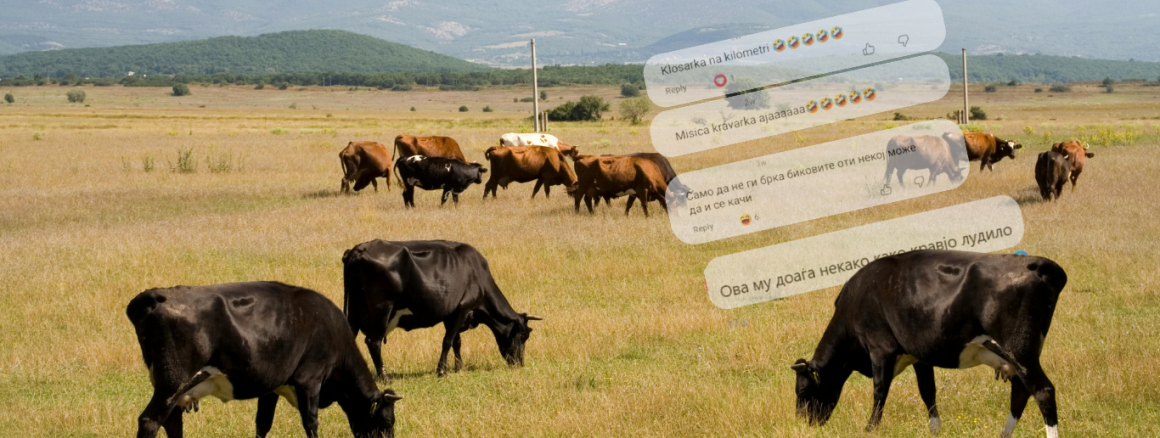
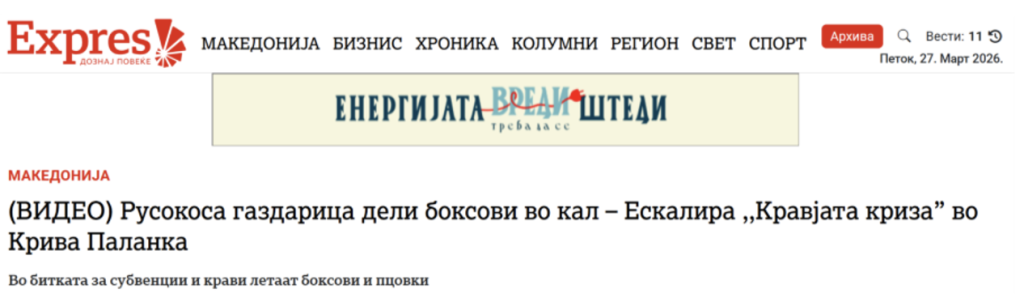
Cattle roaming freely on the streets and highway near Kriva Palanka in North Macedonia have now even crossed the border into Bulgaria. The local problem, which seems to have slipped through the cracks of institutions for years, has now become an international issue.
The issue of abandoned livestock has brought light to the declining trend in quality media reporting, where instead of addressing the real problems, much of the coverage focused on the appearance of the owner, producing cheap sensationalism about her past, ultimately abandoning the struggles of the community.
What happened in Kriva Palanka
For nearly three years, residents have been dealing with the irresponsible behaviour of a father and his two daughters, known for negligently raising their animals. Complaints had been filed against them for property damage, destroyed crops and private property. With around thirty property owners near the village submitting six complaints in 2024 and four more in 2025, an inspection was carried out by the Food and Veterinary Agency in cooperation with police officers from Kriva Palanka but was obstructed by the owners who used force and serious threats.
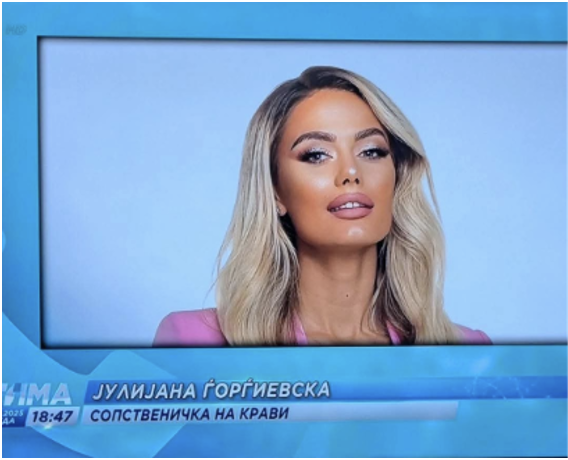
Julijana Gjorgjievska. Photo: TV Telma
While the Food and Veterinary Agency worked to capture the animals, the cows wreaked havoc across Kriva Palanka, and Mayor Saško Mitkovski and the agency became embroiled in a dispute, with events going in circles, until it was revealed that the suspected owner of the stray cattle held the title of former Queen of Europe. Her name is Julijana Gjorgjievska.
Once a photo from her personal Facebook profile was published, it spread across social media like wildfire, and the comments drew no shortage of words.
Clickbait headlines promised drama, chaos, and trading blows
The case drew more attention as media headlines reported the same events but chased higher engagement.
It is worth noting that 13% of the articles got her name wrong (here, here, here, and here). While the media sensationalised the event in their headlines, the articles themselves mostly contained verified information and official statements, most often drawn from the same source.Beneath the social media headlines, comments were dominated by hate speech and insults.
A research article on Facebook’s News Feed and self-perceptions of knowledge published within Research and Politics, shows that audiences who only read article previews think they know more than they actually do, especially individuals who are motivated to seek emotions.
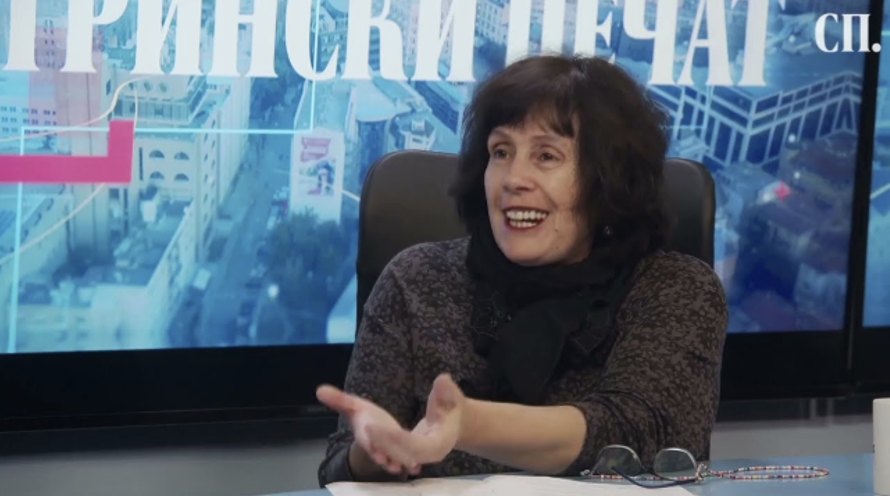
Biljana Bejkova, an expert in communication strategies and public relations, argues that this is not a case of a random editorial or journalistic decision, but a deliberate media choice driven by the pursuit of clicks and attention, rooted in gender stereotypes and misogynistic narratives.
Biljana Bejkova. Photo: Sloboden Pecat TV
“This represents a classic example of clickbait journalism that deliberately sacrifices substance in pursuit of attention. Instead of informing the public about the event and its implications, the focus is shifted toward the appearance and “miss” background of one of the involved parties, thereby reducing the woman to a body and a media spectacle.
Instead of encouraging serious public debate about livestock farming, institutional procedures, or the challenges faced by women and youth in rural areas, the public is drawn into a trivialised, gender-stereotyped narrative with no real informational value,” Bejkova says.
Under such conditions, young people are discouraged in their efforts to raise livestock. When livestock farming and animal husbandry are mocked, rural communities and agricultural productivity suffer even greater stagnation, especially when it comes to young women. Analysis of the perspectives of women in rural and agricultural areas shows that the country lacks concrete measures to promote greater inclusion of young farmers and women farmers in the creation and implementation of agricultural policies.
Reinforcement of gender stereotypes
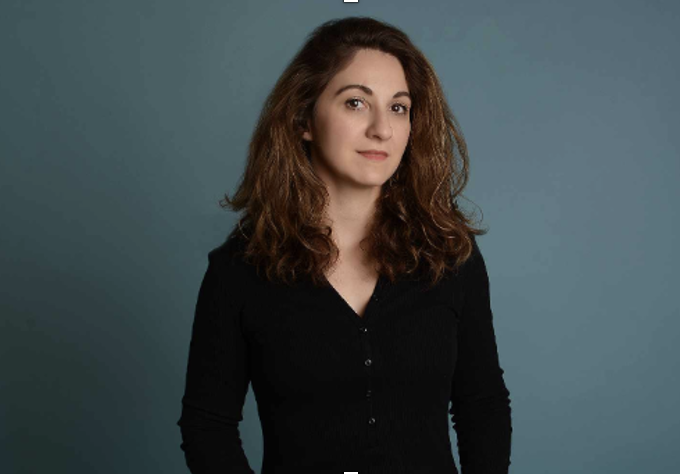
These narratives influence how society thinks, whom it judges, and what it considers an important issue. This leads to the normalisation of gender stereotypes and prejudices, and their use to describe women or discredit them regardless of their profession, says Marta Stevkovska, a communications specialist.
Marta Stevkovska. Photo: Žarko Čulić
“Women are most often judged based on their physical appearance or gender roles and expectations, and this completely diverts public attention from the real problem, whether it will be resolved in the long term, what the institutions will do to address it, or why nothing has been done so far. By reinforcing stereotypes, reality is distorted and attention is redirected, and women’s appearance becomes just clickbait information, without consideration of the potential serious negative impact it may have on them,” Stevkovska concludes.
Author: Viktorija Furnadjiska
Featured illustration: Marija Jovanović/MDI WB/Canva
Monthly Monitoring Highlights: a range of harmful narratives, including those targeting journalists
April 9, 2026
Throughout March, the RDN monitoring team identified a range of harmful narratives, including those targeting journalists, gender-based harassment, as well as misogynistic, homophobic, transphobic, and Islamophobic discourse. Across the region, these patterns were further reinforced by sensationalist and unethical media reporting, contributing to a hostile environment for journalists, activists, and marginalised groups, and undermining democratic dialogue and accountability.
Violence against journalists in Kosovo
Rapper Mossi (Gramos Krasniqi), along with several other individuals, physically assaulted journalist Burim Pacolli. The attack occurred after Pacolli’s analysis and music reviews of the “five strongest freestyles of Meriton Mjekiqi.” In his review, Pacolli included two diss tracks by rapper Buta (Betim Januzi) directed at Mossi.
Pacolli was attacked near the Interex roundabout in Pristina while carrying out personal banking tasks, by Mossi and two other individuals. After the assault, Mossi fled but continued to issue threats against Pacolli, which were repeatedly reported by the media.
The police later arrested Mossi and two other individuals, and they were placed in pre-trial detention for one month. In the days leading up to the arrests, media outlets had continuously reported on the threatening messages sent to Pacolli.
Social media users largely criticized Mossi. The Association of Journalists of Kosovo also reacted, stating: “Freedom of expression, criticism, and reporting is guaranteed by the Constitution and laws of Kosovo, and no journalist can become a victim of attacks for exercising this right.”
Freedom of opinion and expression is guaranteed by law, but many do not accept criticism and do not know how to deal with critical thinking. As a result, those who express criticism often face either physical confrontation or are subjected to hate speech. Nevertheless, the attack against any individual is unlawful and unjustified – in a democratic context, everyone has the right to freely express their opinion without causing direct harm towards others, without having the fear of any violent repercussion.
Misogyny, homophobia, and transphobia in Serbia
On International Women’s Day, a protest march was organised in central Belgrade. It was an inclusive feminist gathering, with representations of different ethnicities, sexualities, and abilities. The central demand of the protest was early parliamentary elections. Other demands included equal participation by women in political life and solidarity in the fight against fascism.
Due to the highly political nature of the demands, the openly and visibly queer speaker, and queer and Palestine flags, the protest caught the attention of pro-regime tabloids and the Instagram page beogradinfo.rs. Tabloids Informer and Novosti, and beogradinfo.rs are infamous for targeting political and ideological opponents. These tabloids sought to undermine the protest by framing its organisers, who support the student-led movement, as propagandists. Meanwhile, beogradinfo.rs had been posting videos of an openly queer speaker from the protest, targeting them for their gender and sexuality. These posts provoked a wave of misogynistic, homophobic, and transphobic comments all over social media. Moreover, the speaker was targeted for their accent, with xenophobic comments questioning their citizenship.
Such targeting of individuals based on their sexual orientation and other identity characteristics, contributes to the rise of public hate speech and deepens discrimination against both LGBTQI+ people and other marginalised groups who are already exposed to continuous targeting by the media. People should be allowed the freedom to be themselves without worrying whether their identity poses a risk to their safety. The right to protest is a democratic right which must not be undermined through identity-based attacks or by spreading hate online.
Sensationalism and sexism in North Macedonia
A horrific incident shook Skopje when a mother and her 10-year-old daughter died after falling from a residential building. Aleksandar Stojanoski, brother of the mother and uncle of the child, revealed on social media that his sister and her daughter had endured years of severe domestic abuse at the hands of the girl’s father. “Today a murder happened,” he wrote, emphasising that the deaths were the tragic result of prolonged violence.
This case is a clear instance of femicide, where the victimised mother took her own life alongside her daughter after enduring relentless abuse. However, some media reports misrepresented the mother as the “killer,” ignoring her position as a victim of systemic violence. They included headlines such as “A mother killed her own 10-year-old daughter in Skopje’s Karpoš, jumping from a building while holding the child in her arms”. Rather than reporting on the tragedy with the facts and causes, emphasising the effects of gender-based violence, the media chose to sensationalise the incident and place blame on the mother, painting her as a child killer.
The tragedy highlights deep structural problems in North Macedonia where unsanctioned domestic violence persists, institutions often fail to intervene, and protective mechanisms for women and children remain weak or unrecognized. The combination of systemic inaction and irresponsible media coverage underscores the urgent need for stronger laws, ethical journalism, and comprehensive support systems to prevent future tragedies. Furthermore, the media should pay attention to such cases not as an opportunity to place blame and sensationalise but rather to expose the reality that many victims of domestic abuse face,including the lack of trust in institutions to react and the impact that this can have on them and their life.
Escalating pressure on journalists in Albania
This month, two closely connected incidents involving Prime Minister Edi Rama highlighted a pattern of escalating hostility toward the media in Albania. During a meeting with the Socialist Party parliamentary group on 9 March, Rama used derogatory and inflammatory language to describe media coverage of corruption allegations involving Belinda Balluku. He referred to reporting as “dog food in 700 media pots,” framed it as part of a “political and media trial,” and described the media as a “paramilitary force for public destruction.” These statements, widely disseminated across media and social platforms, contributed to a narrative portraying journalists as coordinated and hostile actors rather than serving their watchdog role.
Just days later, on 13 March, this rhetoric translated into confrontation during a press conference, when journalist Ambrozia Meta from Syri TV questioned the Prime Minister on the same issue. Instead of addressing the question, Rama responded with personal attacks, accused the media outlet of misconduct without evidence, and dismissed the legitimacy of the inquiry. The situation escalated further when Meta was ordered to leave the press conference and was reportedly permanently excluded from future briefings. Journalist Isa Myzyraj, who supported his colleague, was also insulted and expelled.
These incidents demonstrate how discourse against journalists and media can move from verbal delegitimisation to concrete restrictions on journalistic access. The use of derogatory language, public accusations, and exclusionary practices creates a hostile environment that discourages critical reporting and undermines the role of the media in holding power to account. When press conferences are used to attack and silence journalists, their democratic function is fundamentally weakened.
The reactions from journalist associations and international organisations underline the seriousness of these developments, warning that such practices risk normalising pressure, intimidation, and unequal access to public information. In a polarised media landscape, sustained attacks on journalists not only erode trust in media institutions but also weaken democratic oversight, as scrutiny of those in power becomes increasingly constrained.
Gender-based harassment and threats against journalist and activist in Montenegro
Cardiologist Vladimir Peruničić was arrested in Montenegro after sending inappropriate and sexually explicit messages to RTV Podgorica journalist Magdalena Čelanović on Instagram. What began as a professional contact escalated into harassment, including explicit remarks and requests to send intimate images. The journalist reported the messages to the police, leading to his detention and the initiation of legal proceedings. Notably, this was not an isolated incident, as Peruničić had previously sent similar messages to the same journalist, raising concerns about repeated offenses and the effectiveness of institutional responses.
In a separate case, activist Ida Marković was targeted with serious threats via social media, including threats of abduction, physical violence, and insults rooted in transphobia and misogyny. Civil society organisation Queer Montenegro called for an urgent institutional response, emphasising that such threats should be treated as potential hate-motivated violence. The organisation also warned that this was not the first time Marković had been targeted, highlighting a broader pattern of continuous harassment faced by trans women in Montenegro.
These cases illustrate how online spaces are frequently used to target women and marginalised people with harassment, abuse, and threats that can have serious offline consequences. The combination of repeated offences, gender-based targeting, and threats of violence contributes to a climate of fear and insecurity, particularly for those already exposed to multiple forms of discrimination.
While media reporting in these cases was largely responsible and avoided sensationalism, the incidents underscore the need for stronger and more consistent institutional responses. Ensuring accountability for perpetrators and recognising the misogynistic dimensions of such attacks is essential for protecting journalists, activists, and other public voices, and for safeguarding their right to participate freely and safely in public life.
Anti-Muslim rhetoric in Bosnia and Herzegovina
A controversial television report aired by RTV Herceg-Bosna, a broadcaster closely aligned with the Croatian Democratic Union of Bosnia and Herzegovina, framed the ongoing wars and crisis in Southwestern Asia through the lens of domestic ethno-political divisions in Bosnia and Herzegovina. The report focused on the attacks by the United States and Israel on Iran, warning that global conflicts were “spilling over” into the country and creating new societal divisions. It further alleged long-standing ties between “Bosniak politics and Iran” and argued that Bosnia and Herzegovina must align itself firmly with the West againsttheocratic regimes.
The framing of the report is particularly problematic as it symbolically constructs Sarajevo and Bosnia and Herzegovina as a potential security threat to Europe. Through selective narratives and generalisations, it presents complex political and social dynamics in simplified and polarising terms. This approach is reinforced by the use of archival footage from pro-Gaza protests in Sarajevo, which visually associates the local population with global conflicts, despite lacking clear contextual relevance.
Additionally, the report falls short of basic journalistic standards by relying on a very limitedrange of sources, including only two interviewees, one of whom is not a subject-matter expert. This narrow selection of voices contributes to a one-sided narrative and amplifies political messaging rather than providing balanced or evidence-based reporting.
Most concerningly, the report includes openly offensive and dehumanising language, referring to Muslims in Bosnia and Herzegovina as “the viper in the heart of Europe” and collectively associating them with extremism. Such rhetoric fuels discrimination and deepens existing ethnic and religious divisions, undermining social cohesion and responsible public discourse. Media coverage that reinforces harmful stereotypes and frames entire communities as threats poses a serious risk to democratic dialogue.
Troll of the Month: Tabloid Informer
April 3, 2026
The Balkan Troll of the Month is an individual, a group of individuals or a media outlet that spreads hate based on gender, ethnicity, religion, or other diversity categories. The Balkan Troll is selected based on hate speech incidents identified across the Western Balkan region.
On the night of the 26th of March, a lifeless body was found on the plateau in front of Belgrade’s Faculty of Philosophy. According to initial information, the 25-year-old woman jumped from the fifth floor of the building after the ignition of pyrotechnic devices.
Although the police investigation was still underway, tabloids took this opportunity to begin reporting on the incident without facts or confirmation, making assumptions as to the cause of death. One of the main culprits was tabloid Informer – a Belgrade based pro-government daily. Informer released blurred pictures and videos of the woman’s body, breaking the Journalist’s code of Serbia. They also used her full name while reporting on the incident, thus revealing personal information such as her hometown. Their headlines were sensationalised, and the dignity of the victim was compromised. Furthermore, the editor-in-chief Dragan J. Vučićević spoke about the alleged course of events in a live programme on Informer TV even though at the time, there was no official information available from institutions.
Alongside Informer, other tabloids also began spinning the incident, making false and inappropriate connections between the tragic incident and the student protests ongoing since December 2024, sparked by the station canopy collapse in Novi Sad. Tabloids went on to falsely allege and accuse those who supported the protest and opposed the regime, specifically Danijel Sinani, Dean of the Faculty of Philosophy and Vladan Đokić, Rector of the University of Belgrade. Tabloids claimed that their hands are bloody, a phrase famously used by those responsible for the canopy collapse in Novi Sad. Rector Đokić specifically has been one of the main targets of the months-long smear campaign in these same outlets.
More broadly, they accused the students’ protests and blockades of universities oftransforming these institutions into ones which enable such incidents to occur. The tabloids influenced by the ruling party in Serbia used this opportunity to attack their political and ideological opponents in an ongoing smear campaign while completely disregarding the harm caused to the family and loved ones of the victim, those related to the victims of Novi Sad and all those impacted by the regime’s actions.
With little to no reliable information and confirmation from the police as to the events of the incident that took place, the media cannot and must not use such opportunities to push their own political agendas. Pointing fingers at people and making baseless assumptions and false allegations is extremely dangerous, harmful and risks spreading misinformation in society. They can be extremely dangerous to those mentioned, putting them at risk.
The media has a moral and legal obligation and duty to abide by the Journalist Code of Ethics and professionalism while reporting on cases that concern the public interest. They must report based on facts and evidence rather than assumption and misinformation. In cases like these, the dignity of the victim must be protected, and space must be given for the investigation to go underway without interference.
TV Herceg-Bosne on the “Sarajevo–Tehran connection” – Bias, Manipulation, Incitement
March 19, 2026
A TV report violating fundamental journalistic principles symbolically shows Sarajevo and Bosnia and Herzegovina as potential security threats to Europe
TV report titled “The Sarajevo–Tehran Axis: An Islamist Viper in the Heart of Europe,” by journalist Jurica Gudelj aired on Radiotelevision Herceg-Bosne has sparked numerous reactions in the Bosnian-Herzegovinian public, as media professionals and analysts deem it stigmatizing, inflammatory and one-sided. Its content is also the reason it is has been reported to the regulator.
The Communications Regulatory Agency (CRA) confirmed to Media.ba that it has received several individual complaints in relation to this TV report, adding that it will act accordingly and initiate a preliminary procedure in accordance with the CRA Rulebook on the handling of violations of license conditions and regulations.
In the disputed TV report, the author addressed the United States and Israeli attacks on Iran, as well as the way in which “global conflicts spill into Bosnia and Herzegovina,” warning in the introduction that they are creating “new lines of division in societies in Bosnia and Herzegovina.” The segment also mentions “links between Bosniak politics and Iran,” claiming they “have lasted for more than half a century.” It further states that Bosnia and Herzegovina “must clearly stand on the side of the West and against theocratic regimes that support terrorists around the world and kill their own citizens.”
The report is problematic for several reasons. Nermina Mujagić, professor of Political Science at the University of Sarajevo, believes it represents a classic propaganda-style simplification of the conflict in the Middle East and an attempt to portray Bosnia and Herzegovina as a kind of “miniature version of the global clash of civilizations.”
Such an interpretation, Mujagić told Media.ba, revives the old wartime matrix from the 1990s, which presented ethnic communities in Bosnia and Herzegovina through a simplified civilizational divide: some are allegedly oriented toward the West and portrayed as “civilized,” while others are associated with the East and implicitly labelled as “barbaric.”
“This is a typical example of the securitization of political discourse, in which complex social and political issues are deliberately translated into the language of security threats. In this way, Sarajevo and Bosnia and Herzegovina are being symbolically constructed as a potential security problem for Europe, thereby delegitimizing any form of political or moral resistance grounded in peace, international law and humanistic values,” says professor Mujagić, whose academic and research work focuses on social and political conflicts, civic virtues, media and the democratization of the public sphere.
Beyond the two interlocutors, the accompanying footage is also problematic
Problematic aspects of the report also concern its presentation, for which archival footage of pro-Gaza protests in held Sarajevo was used as illustrative material. Space for commentary was given only to two interlocutors – Frano Yehuda Kolonomos Martinčević and Robert Kolobara – which falls short of professional journalistic standards.
Robert Kolobara, presented as a security expert, is frequently invited as a interlocutor in TV reports and appearances on the same television station which is sympathetic to the politics of HDZ BiH. His commentary on Iran and its “links with Bosnia and Herzegovina” also regularly appears in its programmes. In February this year, he described Iran as the “ mother ship for all terrorists in the Middle East and Europe.”
In June last year, while commenting on military operations between Israel and Iran, Kolobara spoke about “political positioning in Bosnia and Herzegovina”, stating that a meeting between the Minister of Defence of Bosnia and Herzegovina and the Iranian military attaché “was not a gaffe, but rather an evidence of the continuity of policies that sympathize with Iranian regimes.”
In a manipulative column from October last year, writing about Croats living in Bosnia and Herzegovina, he claimed that this ethnic group is being “historically exterminated, removed from their own history, and replaced with a malignant fiction conceived in the minds of guests of a Sarajevo hotel in the early 1990s.” “That is what we call the leukemia of history,” Kolobara wrote.
Commenting on the controversial RTV Herceg-Bosne TV report in a column for RadioSarajevo, Emir Suljagić, director of the Srebrenica Memorial Center, described Kolobara as “a figure who is occasionally released into the public sphere to sharpen political rhetoric or divert attention from another problem.”
Frano Martinčević, the second interlocutor chosen by Gudelj, has also appeared several times as a guest on RTV Herceg-Bosne, where he commented on “geopolitical developments in the Middle East.” A musician by profession, he said in one of the station’s TV reports, that he “developed a political career early on.” His father is a Croat from Kreševo and his mother a Jew from North Macedonia. In the early 1990s, he said, he joined the Croatian Democratic Union, where he “formed his national and political views.” In his views on Sarajevo, he refers to to the capital of Bosnia and Herzegovina as “a hawk of antisemitism in Europe.”
The Jewish Community of Bosnia and Herzegovina has warned, among other things, that Martinčević’s public activity could have harmful consequences for the position of Jews in Bosnia and Herzegovina, relations between communities, interreligious dialogue and overall social relations in the country, adding that he holds no position within the Jewish Community of BiH.
Dangerous and harmful discourse
According to Media.ba’s interlocutors, the aired report is manipulative, one-sided and stigmatizing, marked by inflammatory rhetoric and violating fundamental journalistic principles.
“This is pure stigmatization and inflammatory discourse that is unacceptable under the provisions of the CRA Code, but also dangerous and harmful in relation to socially accepted values of human rights and the role of the media,” says Borka Rudić, Secretary-General of the BH Journalists’ Association.
Since RTV Herceg-Bosne holds a valid broadcasting licence issued by the regulator, Rudić stresses that it must comply with the Code under all circumstances.
“The journalist who authored TV report, as well as the editors of this outlet, should know this. Politicians from the Parliament of the Federation of BiH should also know this and, instead of launching a political campaign against RTV Herceg-Bosne, they could file complaints with the CRA and request action in terms of applying the Code and addressing breaches of licence conditions,” Rudić stressed.
She also noted that it is a devastating that any media outlet in Bosnia and Herzegovina attempts to “stigmatize and insult all Muslims and Bosniaks in Bosnia and Herzegovina and Sarajevo (a viper in the heart of Europe) and portray them as a terrorist threat through a crude and inflammatory interpretation of a war taking place thousands of kilometres away from us.”
A clear parallel between RTRS and RTV Herceg-Bosne
If the TV report is viewed solely through the lens of journalistic standards, the objections include the absence of diverse sources, generalization, strongly rhetorical and propagandistic language, and a lack of genuine contextualization of global events and their reflection in Bosnia and Herzegovina, according to Predrag Blagovčanin, editor-in-chief of Tačno portal. In that context, he notes it is difficult to even describe it as a journalistic piece.
“This is a classic ideological and interpretative segment with a clear political background, the kind that can regularly be seen in RTV Herceg-Bosne reporting,” Blagovčanin says.
“Given that the author of TV report, if it can even be called that, is Jurica Gudelj and that it was broadcast on RTV Herceg-Bosne, we should not be surprised by the level of unprofessionalism and sensationalism with the clear aim of labelling ‘political Sarajevo as an Iranian centre in the heart of Judeo-Christian Europe,’” Blagovčanin added.
He also says it is absolutely clear that RTV Herceg-Bosne, primarily due to the way it is financed and the staff working at this unofficial public broadcaster of the Croatian people in Bosnia and Herzegovina, represents “the most significant propaganda tool of HDZ BiH and the Croatian National Assembly.” In that sense, Blagovčanin adds, a clear comparison can be made between RTRS and RTV Herceg-Bosne.
This TV report is an example of how a good, objective TV report should not look, especially when dealing with a topic such as the US and Israeli attack on Iran, said Minel Abaz, columnist and researcher.
As he told Media.ba, professional standards were not met in this TV report and, moreover, all basic journalistic principles were violated.
“TV report is one-sided and made exclusively for the eyes and ears of the nationalist and Islamophobic segment of the Croatian public in Bosnia and Herzegovina, because it seeks to portray the Bosniak population as backward, Islamist, intolerant, closed, fundamentalist… which may contribute to encouraging hostility and incitement against Bosniak women and men and, more broadly, Muslims in Bosnia and Herzegovina and beyond,” Abaz stressed, noting the the only positive element is that it clearly states at the very beginning that the attack on Iran was carried out by the United States and Israel.
The interviewees’ comments are not based on serious empirical analysis
Abaz also warns about the part of the TV report stating that “anti-American and anti-Israeli sentiments have gained momentum,” noting this is mentioned in a way implying those were present only among Bosniaks.
“On the other hand, this is a legitimate political stance, just as it was normal in the 1990s to be against Milošević and Serbia, or as it is right thing today to oppose Russia’s aggression in Ukraine and Putin. The report does not, for instance, address anti-Semitic views among the Croatian and Serbian public —Croatian especially —in Bosnia and Herzegovina and Croatia. In this public sphere, swastikas are normalized, the far-right is on the rise, and the Ustaša movement and its salute ‘Za dom spremni’ are glorified and/or relativized — yet this does not constitute a problem for HDZ BiH officials or media loyal to them, the so-called security and political ‘analysts,” Abaz stressed.
Commenting on Robert Kolobara’s claim that the Bosniak public is anti-Zionist and that there is no distinction between anti-Zionism and antisemitism, Abaz argues that Kolobara is not only mistaken but is deliberately misleading, presenting – from the perspective of political science – factually incorrect statements
“Being anti-Zionist and opposing Zionism is a legitimate (and still legal) political position and movement. If we can oppose nationalism, fascism or, as many on the Croatian right emphasize, communism, why could we not oppose Zionism, which George Orwell classified as ‘direct, not transferred nationalism,’ and about which he wrote that ‘it has all the usual characteristics of a nationalistic movement, but its American variety appears more violent and malevolent than the British one,’” Abaz says.
He also mentioned Kolobara’s statement in the report about the celebration of the anniversary of the Islamic Revolution at the Iranian Embassy in Bosnia and Herzegovina, which was attended by political actors based in Sarajevo. However, Abaz added that Kolobara remained silent about the “’crimes’ of the Croatian political leadership in Bosnia and Herzegovina, which welcomes and celebrates war criminals (the Herceg-Bosna Six, Kordić), hosts the Ustaša singer Marko Perković Thompson, and in September 2025 attended the marking of Israel’s Independence Day in Mostar“.
“Kolobara also forgets or deliberately conceals the fact that the then mayor of Mostar, Ljubo Bešlić, a member of HDZ BiH, signed a twinning agreement between Mostar and the Iranian city of Isfahan on March 5, 2018 — in Iran itself. Mostar hosted the event ‘Days of Iran in BiH’ in 2016 and 2017, and the programme was held at ‘Kosača,’” Abaz added.
According to Abaz, Kolobara’s most chauvinistic statement is that the Tehran–Sarajevo axis is building a “political viper in the heart of Europe,” thereby exaggerating the influence of Iran in Bosnia and Herzegovina.
“By attributing danger to the ‘Sarajevo–Tehran coalition,’ the reality is actually the opposite: his hateful, chauvinistic and unfounded statements are dangerous for an entire segment of the population, because they are generalizing and collectively place the entire Bosniak people within a particular ideological narrative,” Abaz believes.
Such political statements, which are not grounded in serious empirical analysis, according to Nermina Mujagić, erase key conceptual distinctions between political ideologies and ethnic hatred.
“This creates a false and dangerous narrative according to which anti-Zionism necessarily implies antisemitism, even though these are different categories: the first refers to criticism of a particular political ideology or state policy, while the second represents a form of ethnic and religious hatred toward Jews,” Mujagić emphasized.
Particularly worrying manipulation of religious traditions
Predrag Blagovčanin believes that TV reports like this certainly pose a danger and represent a broader problem for the journalism profession, but he also notes that the only consolation is that RTV Herceg-Bosne has very low viewership and, as he stressed, almost no real influence.
It is clear that consumers of this report, as well as other content broadcast on RTV Herceg-Bosne, belong to an ideological position that believes — and firmly maintains — that ‘Taliban’ live in Sarajevo and that Bosnian Muslims represent one of the greatest threats to the Christian values promoted by HDZ, which sees nothing problematic in concerts by Marko Perković Thompson, the accompanying Ustaša iconography, or the salute ‘Za dom spremni’,” Blagovčanin said.
Through this TV report in the central news programme of RTV Herceg-Bosne, it has once again become evident that in today’s media — and in the Bosnian-Herzegovinian society more broadly — there are no serious foreign policy commentators who possess the knowledge, independence and necessary political distance when discussing global events, according to Borka Rudić.
In this particular case, she added, the interviewees’ comments are assumptions without clear argumentation, accompanied by the media use of photographs from events in Bosnia and Herzegovina and from a dinner at the Iranian Embassy in Sarajevo, which are not unlawful because, as she noted, Iran has its own embassies and developed diplomatic relations around the world, including with Croatia. She also points out that it is particularly worrying that religious customs — the iftar, the meal taken during Ramadan — are being deliberately manipulated for political conclusions and for linking the war in the Middle East with Sarajevo, that is, for the anathematization of Muslims and the entire Bosniak people in this city.
“This is also manipulative media content because images of protests in Sarajevo with Palestinian flags are repeatedly shown during the TV report — protests that have taken place several times in world capitals, including Sarajevo — which may lead the public to believe that these were protests in support of Iran, even though it was stated at the beginning of the report that the announced rally in support of Iran had been cancelled. It should also be pointed out that the report displays journalistic one-sidedness, since the people being talked about were not given an opportunity to present their views, which is unacceptable in journalism in general because it runs counter to journalistic ethics, and is particularly unacceptable as a journalistic approach in news programmes such as the main news bulletin,” Rudić concluded.
Author: Selma Fukelj
This article was originally produced for and published Media.ba It has been re-published here with permission.
Troll of the Month: Laert Vasili
March 3, 2026
The Balkan Troll of the Month is an individual, a group of individuals or a media outlet that spreads hate based on gender, ethnicity, religion, or other diversity categories. The Balkan Troll is selected based on hate speech incidents identified across the Western Balkan region.
On 10 February 2026, during the recording of Përputhen on Top Channel, actor, film and theatre director and political commentator, Laert Vasili, forcibly kissed contestant Esmeralda without her consent during a studio debate. The act followed his statement that there was “only one way to shut a woman up.” He stood up, grabbed her head, kissed her, and remarked that it was “that simple.”
Esme appeared visibly shocked and later stated she did not expect or accept the act. A male contestant minimized the incident by citing Vasili’s profession as an actor. Moderator Megi Pojani intervened, stating that no one in the studio is kissed without permission, and Vasili was asked to leave.
Although the episode was pre-recorded, the production later broadcast and promoted it widely, generating extensive public debate. Online reactions ranged from framing the act as sexual harassment to victim-blaming narratives targeting Esme, reflecting broader gendered hostility and normalisation of non-consensual behaviour in media contexts.
The act itself, a non-consensual physical contact and forced kiss, is an act of gender-based violence aired on live television. The act was not ambiguous flirtation, staged romantic interaction, or mutual contact. It was a unilateral action performed in a power-imbalanced setting: an older male opinionist approaching a seated female contestant during a debate and physically restraining her head before kissing her. This does not only constitute a violation of privacy and consent but equally of bodily autonomy alongside public humiliation and gendered assertion of dominance framed as a symbolic reinforcement of the idea that women’s bodies are available for performative demonstration.
The phrase “only one way to shut a woman up” immediately followed by a forced kiss, transforms the act from impulsive misconduct into a symbolic gesture of silencing through physical control. Even if framed as “demonstration,” the act visually reinforces a patriarchal trope: that women can be subdued physically for rhetorical effect. An act like this cannot be justified through the argument of ‘actor privilege’ nor any other type of justification. Professional identity does not protect an individual from the acts they perform towards others which violates their personal autonomy and consent. An argument like this implicitly suggests: The woman failed to understand art; The audience failed to understand the metaphor; The problem is interpretation, not violation. This is a classic discursive minimization strategy.
Furthermore, the fact that some male contestants attempted to minimalise the situation and soften the act serves to justify and normalise such behaviour. When misconduct is debated as interpretative rather than unequivocally unacceptable, the threshold for recognising harassment becomes blurred.
Although the moderator did apologise and asked Vasili to leave the studio, the fact remains that the production went on to publish the footage, promote the episode and amplify the incident across media platforms. It was both their role and responsibility to react in situations such as these when acts of gender base violence occur which they failed to so and instead, provided a platform for the amplification of this behaviour. As a result, the comment section was flooded by gendered harassment and victim blaming with a split social media reaction discourse with some condemning Vasili whilst others targeted Esme directly, blaming her. The comments targeted towards Esme claimed that women provoke their own harassment, emotional reaction invalidates harm and that women in the public sphere deserve public humiliation.
All in all, the entire incident was unjustifiable, from the act itself to the lack of intervention and appropriate response from Top Channel’s production team to the wave of gender-based violent commentary online. At every level, there was a failure to respond adequately to something that should never have happened in the first place.