Author: RDN

WHY HAVING DEBATE TV SHOWS WHEN THERE IS A LACK OF COMMUNICATION CULTURE
November 22, 2023
The use of hate speech is a serious issue and must be seriously taken into account not only by the government authorities but also by civil society, including journalists.
Television news and programs should influence the emancipation of society and combat ethnic, religious, cultural and local barriers and stereotypes. This is especially the case in a multi-ethnic and multicultural country such as the Republic of North Macedonia. Television should not empower and reinforce stereotypes and hatred between citizens who come from different communities. Unfortunately, in our country, it is often television that contributes to the feelings of even greater ethnic divisions among citizens from different ethnic communities and intensifies the hatred between them.
The example that caused stormy reactions in the public recently is the case of professor Ismet Ramadani and the director of Kanal 5 TV, Ivan Mirchevski in the “Samo Vistina” show.
Professor Ismet Ramadani expressed his concern that there is a nationalist narrative and one-sided statements among the Macedonians and their politicians at the exact moment when, in his opinion, that narrative does not exist among the Albanians. He also accused the journalist Aleksandar Vidinovski of not reacting when such statements were made on his show.
This statement was followed by a reaction from the journalist who denied such a thing. The approach of this journalist was professional and he tried to calm the situation.
But Ramadani continued, saying that even in the Macedonian public sphere there is a narrative against Albanians and Albanian political parties, including nationalist statements. He also mentioned to Vidinovski the statement of his previous guest, who said a month ago that “we will trample the Albanians like cockroaches”, and according to Ramadani, the host of the show did not react at all.
The host of the show denied it, saying that whenever he hosts the show, and there are nationalist statements from any party, he reacts accordingly. Ramadani was right when he referred to the last couple of TV shows on Kanal 5 promoting ethnic intolerance. An example of this is the news piece showing the flags in the old Skopje bazaar as well as the show that Ramadani mentioned.
Request to leave the live broadcast
But the problems started when the director of Kanal 5 TV, Ivan Mirchevski, was broadcasted live on the show. He first accused Ramadani of segregating the journalist. After discussions with Ramadani, he asked the host Vidinovski to stop the show and ordered Ramadani to leave the studio. Summoning a guest on a TV show and then kicking him out is neither ethical nor professional.
According to the announcement of the Association of Journalists of Macedonia (ZNM), Mirchevski is the main culprit for the escalation of the situation. They mention that the incident took an undesirable turn when the director of Kanal 5 intervened, demanding that Ramadani leave the studio immediately. The Association expresses serious concern about this intervention, because it directly violates the principle of editorial independence, which is the cornerstone of independent journalism.
According to the code of ethics, journalists must not incite violence and discrimination on any basis (ethnic, religious, racial, gender, social, linguistic, political, sexual orientation, etc…).
The director of the television station is not the one who should be the judge, let alone ‘kicking’ the guests out of a show. The division between the editors and the management must be respected in the media. You may not agree with someone on many issues, but joining the debate and kicking a guest out of a show is a reflection of the lack of democratic and European values.
The Association of Journalists of Macedonia (ZNM) issued a joint statement with the Independent Union of Journalists and Media Workers (SSNM) and the Council for Ethics in the Media in Macedonia (SEMM) that emphasized the importance and the need to adhere to journalistic standards, as well as to guarantee a discourse that respects and protects editorial independence.
“In a society where live television shapes the public discourse, it is of particular importance that all participants maintain a high standard of communication and speak with their interlocutors in a respectful manner, applying the same to the public as well. The behavior of Mr. Ramadani and his comments towards the host of the show, Mr.Vidinovski, were, unfortunately, confrontational in a certain part of the debate, thus creating opportunities for the debate to stray towards unwanted direction”, says the joint statement.
It is also important to mention the position of the Agency for Audio and Audio-Visual Media Services. They indicated that debates related to political-social issues should contribute to the implementation of freedom of expression, to the culture of tolerance, and must never encourage intolerance.
They emphasize that politicians and holders of public positions should, in particular, be aware of the weight of the publicly expressed word and they must refrain from statements, especially given via media that undermine the dialogue between different ethnic groups in society.
“Labeling media outlets and journalists, as it was done in yesterday’s show by Ismet Ramadani, who is the advisor for Euro-Atlantic values of the Prime Minister, has a negative impact on the freedom of the media outlets and violates the dignity of the journalists. They added that “politicians and public office holders have a special responsibility towards the public, should show the highest level of compliance with the journalistic profession, and should make every effort to make it possible for the media outlets to carry out their work in an uninterrupted manner”, they added.
Avoiding sensationalism
On the other hand, the support that Mr. Mirchevski received from the Macedonian Association of Journalists (MAN) is inadequate. MAN should protect freedom of speech and should not take a side, but have an objective position as ZNM does. The statement of MAN said that they are fully backing the director of Kanal 5, the journalist Vidinovski, and the guest Goran Momiroski. According to them, the politician and adviser to the Government, Ismet Ramadani, was accusing others of ethnic intolerance without any grounds.
According to the journalist code of ethics, journalists must be free of sensationalism in the course of their reporting. But when reporting on this case, there were no elements of “avoidance of sensationalism” in some media outlets.
The Zum Portal published a title “Heat in Samo Vistina’ on Kanal 5 – Ismet Ramadani asked not to inflame inter-ethnic tensions, the television was asked to apologize to them.” Although the title was balanced and neutral, the same cannot be said for the comments. There are a number of hate speech comments about Ramadani there. Some of these include: “Why do you accept donkeys in the shows”; “Chase away this kind of shit, they are a shame for the country”; “The Albanians definitely went too far with their arrogance and insolence”; “This type of ‘abdal’ must be obeyed”, “Bastard from the mountains”.
Portals like lider.mk and inbox7.mk also used sensationalist headlines. On the other hand, DW in Macedonian language, in its article about this case, included both sides of the story and their text is written in an objective and professional manner.
The presence of hate speech and similar phenomena is harmful to society and everyone must commit to their reduction. Some the consequences of hate speech include damage to the image of the country, the growth of extremism, obstacles in dialogues, mutual discrimination and polarization of society.
The use of hate speech is a serious issue and must be seriously taken into account not only by government authorities but also by civil society, including journalists. It is important to promote tolerance, dialogue and respect for diversity in society and actively combat this harmful phenomenon in order to build a safe society that will live in harmony.
For those reasons, the owners of television and media outlets should be more restrained and act without emotions, because they exercise a significant influence. A little carelessness can cause significant reactions and encourage ethnic hatred.
Author: Zenel Miftari
Photo: aerogondo2/Shutterstock.com
This article was originally produced for and published by ResPublica. It has been re-published here with permission.
Monthly Monitoring Highlights – problematic narratives all around the Western Balkans
November 15, 2023
Throughout the month of October, the RDN monitoring team has detected a range of hateful narratives and discourse. This month, we have seen hatred based on gender, ethnicity as well as hatred aimed towards journalists and persons with disabilities.
Trivialisation of rape and attacks on a journalist reporting on sexual abuse in Albania
In the last weeks of October, a horrible case of sexual abuse and rape happened in the city of Vlora, where a 26-year-old girl was allegedly encouraged to use narcotics by some citizens, three of whom were then suspected of having violent sexual intercourse with her. The case was reported by local and national media outlets. A local correspondent, Afrovita Hysaj, who was covering and reporting on the event, was threatened by the administrator of a local television “6+1” in Vlora – Albert Deliaj. This came as a reaction to Hysaj, who reported that there were not three but rather four people who had allegedly raped the girl after having drugged her, without ever mentioning the identity of the fourth person. However, the owner of the local television “6+1”, mistakenly understood as if the correspondent was implying that the fourth person involved was his son.
Due to this, Hysaj proceeded to fall victim to a banal, criminal attack by the television owner. This included a derogatory article published on the local television website and on its social networks. The attack and threats were based on what Hysaj says were incorrect claims that she had connected the television owner’s son with the drugging and rape of the 26-year-old girl. Albert Deliaj, the owner and administrator of the local television threatened Hysaj. As a result, Hysaj reported to the police that she had received death threats.
Following this, the police of Vlora announced that they had started a criminal proceeding against Albert Deliaj on the basis of ‘intimidation’. The attack of Hysaj resulted in a harsh reaction from colleagues and media organisation such as the Union of Albanian Journalists. Furthermore, the Safe Journalists’ Network also condemned the event as an unprecedented attack on a journalist from a media outlet, asking 6+1 Vlora channel to publicly apologise.
After the rape case was reported in the media, lawyer Vjollca Pustina made a very shocking and surprising statement. She claimed that cases like these “usually happen after girls drink too much”. This statement resulted in numerous reactions on social media networks, as it was both said and broadcast on national television Vizion +. Furthermore, being a lawyer and so being by profession, someone who should be implementing the law and bringing perpetrators to justice, one should expect someone in such a role to be professional in their attitudes towards serious crimes and not justify abusers and cases of rape. Victims of rape are never responsible for the violence they endured and the only one to blame is the perpetrator(s). Using victim-blaming narratives can have devastating consequences not only towards the person it is directed to, but to all other women who are enduring sexual violence or have so in the past.
Ethnic discrimination in Bosnia and Herzegovina, North Macedonia, Montenegro
Uroš Bjelica, the advisor to the President of Republika Srpska, said Sarajevo is “Unfortunately, today, an ordinary Islamic quarter in the heart of the Balkans, which we can see only in Arab countries”. This remark was made as a response to the protests held in Sarajevo against the killing of civilians in Gaza. Bjelica reiterated that Sarajevo is indeed a monoethnic, Muslim town and that therefore, it is a false narrative from both politicians and the media who highlight the multi-ethnic and cosmopolitan life of the city.
Milorad Dodik, the president of Republika Srpska, often states the same opinion, that Sarajevo is not a multi-ethnic city, that there are no Serbs in it. His advisor equally continues to uphold and spread this rhetoric. Bjelica emphasises how Sarajevo is falsely multi-ethnic when despite having mosques, synagogues, churches, and cathedrals, it is the people who live there that define the city. To him, Sarajevo is now what he defines as ‘an ordinary Islamic quarter in the heart of the Balkans’. His statement has Islamophobic undertones, as by saying this can only be seen in Arab countries may imply that there is no place for Muslims in the Balkans.
Furthermore, Bjelica goes on to claim that unlike Sarajevo and the Federation of Bosnia and Herzegovina, Republika Srpska has a life of openness, cooperation, and dialogue with an aim of building a system which is to the benefit of all in the county. In comparison, according to him, the politicians of the Bosniak people only send poisonous arrows with the ‘clear intention of creating a unitary BiH’.
Within an ethno-religiously diverse society and country such as Bosnia and Herzegovina, spreading narratives of divide can result in further division and tension amongst various groups in society. Holding a protest for the protection of citizens in Gaza is a democratic right of the people of Sarajevo and not something which should be punished nor taken as an attack on the multi-ethnic and religious nature of the city. An individual with a platform such as Uroš Bjelica, should not be using his influence to spread hateful rhetoric and ethnic discrimination.
Following the recent incident in Kosovo where a group of armed Serbs attacked the Kosovo police in the north of the country, the Minister of Foreign Affairs of North Macedonia, Bujar Osmani, came out with a statement that if it was found that Serbia was in some ways involved in the attack on Kosovo soil, then Macedonia should rescind its membership in the Open Balkans initiative. As a result, a private X (formerly Twitter) user published a Tweet saying that the ‘Shi*** Ministers do not give a f*** about the PM Dimitar Kovacevski’ who is a vocal supporter and champion of the Open Balkans initiative. North Macedonian officials of Albanian origin have been criticised in the past that they care more about the interests of the neighbouring Kosovo and Albania than for Macedonia’s democracy, as revealed by the insulting response of this private X (Twitter) user.
Unfortunately, hate speech and insults towards ethnic Albanians persists in other areas of the country such as in a recent statement, where the mayor of Tetovo expressed a viewpoint that if the government is considering the singing of the Macedonian national hymn in schools, it should simultaneously recognize the significance of the Albanian population in regions where they are a majority. Specifically, in cities like Tetovo, where Albanians comprise a significant part of the demography, their cultural and national symbols should be granted equal importance and respect. Following this, a X (Twitter) user similarly published an insult to the mayor, saying that he should “go to Albania” if he wants the Albanian national hymn to be sung in schools. Cases like the recent debate around the singing of national hymns in schools highlight the fragility of the relationship between these two communities therefore, comments such as these are extremely dangerous and can result in heightened tensions.
Furthermore, this month, a heated altercation erupted on an episode of the political talk show “Only the Truth” on one of the most popular media outlets in the country, the national Channel 5 TV, with journalist and host Aleksandar Vidinovski clashing with a guest, the analyst Ismet Ramadani. The dispute escalated to the point where the director of Channel 5 intervened by going live from outside the studio, defending the journalist and the station and ultimately demanding that Ramadani be removed from the program and his appearance be cut short. The confrontation was sparked when Ismet Ramadani, president of the Euro-Atlantic Council, accused the host of biased reporting by only spotlighting Albanian nationalist remarks while ignoring nationalist rhetoric from the largest opposition party, VMRO-DPMNE, the leftist party “Levica,” and other parties within the Macedonian political spectrum. The incident resulted in numerous individuals on X (Twitter) and Facebook, labelling Ismet Ramadani using a derogatory, insulting label applied to Albanians. This term has been historically used in a disparaging manner and reflects underlying ethnic tensions within the region. In no instance is the use of hateful, derogatory labelling and language justified.
In Montenegro, the citizens received a message from the patriarch of the Serbian Orthodox Church who, two weeks before the initially planned start of the population census, called on the citizens of Montenegro to claim themselves to be Serbs, believers of the Serbian Orthodox Church and speakers of the Serbian language. This message can be viewed as a form of pressure and intimidation towards other ethnicities in Montenegro. Montenegro is a multi-ethnic society and existing tensions are being heightened due to the upcoming census. Divisions along ethnic lines are being amplified with the preparation for the census, which focuses on the citizens ethnic, religious and language choice of identification. Throughout the preparation there was a lot of division and messages being sent out from pro-Serb and pro-Russian influences in Montenegro calling for citizens to declare themselves as Serbs, as well as the pressure and messages coming from the patriarch of the Serbian Orthodox Church. The media was equally divided on this topic, with pro-Montenegrin outlets offering criticism and pro-Serbian outlets supporting such campaigns and narratives. It is the duty of the media to report in a responsible manner and not cause division amongst the public. Likewise, it is important for political and religious leaders and representatives to refrain from using their influence and platform to create and deepen existing ethnic divisions within multi-ethnic countries such as Montenegro.
Transphobia in Kosovo
During a talk show ‘Big Talk’ on TV Klan Kosova, journalist Edona Gashi stated that she has many friends who belong to the LGBTIQ + community. However, she made a point to note that she does not support transgender people, that is, to be more specific, “sex change”. According to her, it is something which goes against God’s will. The term “sex change” is often used by the media in the Western Balkans – however, it is outdated and harmful to the transgender community. It is also inadequate and inaccurate since it refers to a process of adapting or adjusting one’s sex to their gender identity. It is used in different ways, however, mostly when talking about gender-affirming surgeries, which is a much more fitting and accurate term. This statement was also reported on by the online media Insajderi. Although there was not a wide reaction on the social media network Facebook, all the commenters nevertheless supported the position of the journalist Gashi.
Within Kosovo, conservative views often dominate when it comes to the LGBTIQ+ community. Personal religious views and beliefs are often used as arguments against LGBTIQ+ rights. However, it is not anyone’s religious freedom to deny a person their human rights. It is important to note that every individual has the choice and right to express their gender identity freely and to have access to quality health care. Transphobia, as well as homophobia, should never be accepted – narratives like these promoted by journalist Gashi, only serve to promote anti-LGBTIQ+ rhetoric. Furthermore, the media should refrain from spreading these messages to their audiences, which can promote homophobia and transphobia, especially without providing a critical viewpoint to such attitudes.
Discrimination against persons with disabilities in Serbia
Influencer Milica Popadić, in an online show on Hype TV, commented on how persons with disabilities should not get exposure or influence on social media. Popadić justified this by explaining that she believes they will face discrimination, and therefore, they shouldn’t expose themselves “at all costs”. She also said it is okay for persons with disabilities to get exposure on social media if this is a way for “someone to help them”. However, when referring to persons with disabilities, Popadić used harmful terminology such as “physical and mental defects”. She continued talking about this topic and used influencers Julija and Natalija Đukić or Fitness Bliznakinje (the Fitness Twins) as an example, mocking them, even though they have never identified as persons with disability, nor has this information ever been shared before. She mocked the way they speak, their tone of voice and similarities, implying this is a disability. Using someone who does not have disability but only has a slightly different manner of speech as an example may indicate there is little room provided for any kind of diversity on the Serbian and Balkan online space.
Individuals with disabilities are individuals – they should be treated with equal respect as anyone and everyone else. Using harmful and stigmatising terminology to describe and attribute characteristics to individuals with disabilities is extremely hateful and ignorant. An influencer such as Popadić who is making a public appearance, and has over 500k followers on TikTok, should be aware and responsible for her words. She should not use her platform to promote harmful and stigmatising rhetoric towards individuals with disabilities. Furthermore, commenting that individuals with disabilities should refrain from getting exposure due to possible discrimination says more about the society and the population’s attitude towards persons with disabilities than anything else – no one should be treated differently, be discriminated against, or excluded from public life for any reason.

TROLL OF THE MONTH: Aktuelno.me
November 10, 2023
The Balkan Troll of the Month is an individual, a group of individuals or a media outlet that spreads hate based on gender, ethnicity, religion, or other diversity categories. The Balkan Troll is selected based on hate speech incidents identified across the Western Balkans region.
Vanja Ćalović has recently been openly exposed and attacked by Aktuelno.me – an online media portal in Montenegro with a wide readership, known for being supported by the Democratic Party of Socialists (DPS), led by Milo Đukanović, until recently. Ćalović is an economist, executive director of the Network for the Affirmation of the Non-Governmental Sector (MANS) and is focusing on fighting corruption and organised crime in her work.
In two articles published by the media portal Aktuelno.me, Ćalović was named the “starlet of the grants”, or in other words, the “NGO starlet”. This term is used to describe a young woman in the entertainment industry whose main asset is her appearance, rather than talent or work, and is usually used in quite a derogatory tone. The intention behind this message was to discredit and undermine Ćalović as a professional by using sexist insults.
The articles explain how she is “compromised and burdened by various affairs”, claiming that no one can take her seriously anymore. What they are referencing is a so-called “zoo sex affair”, or more precisely, a media campaign against Ćalović, which started in 2014 when she was accused of ‘having sexual relations with her two dogs’. This story was published on the front pages of tabloids in Montenegro and even made it to Serbian media. The campaign was launched almost 10 years ago to discredit the work Ćalović was doing on the deconstruction of the former government’s (led by DPS) involvement in corruption and criminal activity and was a constructed affair with the aim of destroying the credibility and reputation of Ćalović.
The direct attack and hatred, including negative labelling by the online portal Aktuelno, is clearly unprofessional and unethical. Two articles dedicated to undermining the credibility and work of Ćalović as well as to attack her on a personal level is a complete breach of professional journalism standards. Furthermore, articles are harmful also due to the use of sexist language and for targeting Ćalović based on her gender as a woman.
The media have a moral and legal obligation to report on events and issues in a professional and ethical manner, and it is not uncommon for the government-controlled media in the Western Balkan region to try to discredit and attack journalists, activists, and political opponents in similar media campaigns, especially when they deal with topics such as corruption and organised crime.
However, regardless of their political affiliation, Aktuelno and other media outlets should not use their platform and influence over their readership to spread hatred, sexist remarks, and negative sentiments towards individuals, such as in the case of Vanja Ćalović. Manipulating personal attacks can infiltrate into the private life of Ćalović, who may as a result, become a victim of hate both online and offline. This is a reality for many journalists and activists, and being a woman adds the sexist layer to the hate speech these individuals are exposed to. Aktuelno.me and other media who take part in similar campaigns, should bear the responsibility and accountability for their role in spreading hate and sexism through personalised attacks.

STUCK IN THE MIDDLE WITH MEDIA
October 19, 2023
What to read? What to watch? Who to listens to? Who to believe? Can I trust my own judgement?
Gaza. Haiti. Iran. Israel. Kosovo. Myanmar. Nagorno-Karabakh. Niger. Sudan. Ukraine. Wherever there is conflict there are conflicting narratives.
And if you are not in the midst of it you rely entirely on such media outlets as can be bothered to, or have correspondents in place to offer some first hand knowledge.
That decision alone begs many questions. What is newsworthy to our audiences? Too often that depends upon there warring countries’ strategic relevance. Sometimes it is simply a matter of cost, or timing. As each new flare up catches the media’s attention, the last tragic sequence is abandoned, if only temporarily.
At least reporters on the spot can see things with their own eyes, interviews the people most directly affected, and form a view which will help them root their reporting in felt experience. Sights and sounds and smells add a veracity to reporting that distance achieve too achieve.
We must never forget that brave journalists take extraordinary risks, and too often lose their lives or liberty in the process. And we should never forget the local ‘fixers’ and support staff who help to keep them alive and able to send their bulletins home. But that does not resolve the dilemma faced by those receiving if not absorbing their messages.
A Sudanese friend, himself a casualty of civil war, recently asked me why journalists put themselves at risk in such terrifying circumstances as the bombardment of Gaza. It is hard to explain that old journalistic impulse to run towards rather than away from the explosion. “So that we can know what is happening,” I said, “Perhaps in the hope we can do something about it.”
And yet correspondents are frequently asked to provide instantaneous opinions based on hearsay rather than direct experience. An all too common request comes from the safety of the anchor’s chair.
“What are people saying? How are they feeling about recent events?”
Since reporters are themselves often constrained by circumstances that cannot possibly accurately reflect the wide range of opinions which inevitably exists in any society, so what we hear are often the views of those they are most likely mohave contact with. How many of us have taken as our starting point the views of our cab driver, or a trusted fixer, or the officials we rely upon for advice and direction?
And that’s the problem. Situations are complicated and, however hard we try, we carry with us our preference and prejudices. Do we refuse to report opinions we find abhorrent, or give more space to those whose views most closely resemble ours? Reporters often have to swallow hard to overcome doubts about their sources if time and circumstances prevent proper verification. Reputable news outlets at least acknowledge when they cannot independently verify information.
But then there is the question of whose side the reporters are on. In the past good reporters have said that there are times when you cannot but ‘take sides’ especially when you witness atrocities. But having sympathy for victims doesn’t automatically mean you are being partisan.
What type of blame game is being played when a newspaper publishes with harrowing pictures of victims of violence on its front page? Is it taking a stand against the perpetrators? Or is it the usual marketing ploy, with little thought for those who might be traumatised by being confronted by hideous images on the news stand? The reporting of war throws upon many such ethical issues.
Sometimes the context of reporting is determined by the relationship between outlets and government back home. What are the vested interests involved? Where does dispassionate reporting end and propaganda begin? What are the risks in bucking the trend and speaking up for those regarded as ‘the enemy’?
There is a big difference between trying to explain and understand the root causes of a conflict and actually taking sides. It is a distinction rarely acknowledged by those in power, as many journalists have learn to their cost.
The plethora of social media outlets further complicates our understanding of conflicts in the world. As one woman demonstrating on the streets of Paris told reporters. ”There is more than one war going on. The one on the ground and the one online. The Palestinians have won the online war, which is why i thought it was important to come out and show support for Israel.”
But information and opinions online are far less trustworthy than the mainstream media, unless they are clearly from sources who take the trouble to verify facts before publishing them. Euronews, France 24 and the BBC both run verification checks on popular video clips that have spread like wildfire around the world. Few recipients will have bothered to check, or even know how to check the validity of such material.
There are plenty of online guides to finding out how to do a ‘reverse video search’ or a ‘reverse image search’ when in doubt. Nonetheless totally false, if believable, Tik-tok extracts, artificially manufactured images and fake news items regularly enter the realms of public discourse, generating myths and conspiracy theories. The mainstream media is not immune to being hoaxed in this way. And when it happens it further undermines trust journalism.
Small wonder that many people have turned away form reading newspaper or watching the news. It is too depressing/confusing/negative and takes a wrecking ball to mental wellbeing.
Few people have the time, patience or interest to switch between Al Jazeera, BBC, C4, CNN, Euronews. France 24, ITN, and Sky and Twitter as I do, several times a day. That is the privilege of the retired hack and the obsessive news junkie. But at least it gives me an opportunity to allow some perspective into my consumption and digestion of the news. But rarely does it answer all the questions the coverage of conflict inevitably brings to mind.
Author: Mike Jempson
This article was originally produced for and published by Media Diversity Institute. It has been re-published here with permission.
Illustration: Wirestock Creators/Shutterstock.com
Monthly Monitoring Highlights – ethnic tensions, sexism and hate speech
October 12, 2023
Throughout September, the RDN monitoring team has detected a range of hateful narratives and discourse. This month, we have seen gender-based violence, sexism, hate speech against journalists and a rise in ethnic tension.
Gender Based Violence in North Macedonia
During the month of September, a woman was stabbed to death by a person she was supposedly romantically involved with. The person in question stabbed the woman 40 times. Prior to killing her, he also threatened that he would publish compromising and explicit videos which were taken during their relationship. This threat was upheld in the form of blackmail, asking her for money to stop him from acting on such threats.
The victim had reported the blackmail attempts and threats to the police, but no effective action was taken to seriously tackle the issue or to protect her. This situation exposes the potential systematic failures and gaps in addressing and preventing gender-based violence as well as supporting victims of abuse and blackmail. This institutional failure to effectively respond can be attributed to both resource limitations and societal attitudes towards gender-based violence, underlining a lack of commitment and approach to preventing femicide and other forms of gender-based violence. The comment sections on social media networks were filled with harmful misogynistic narratives, which indicate the still present attitudes in society. Media can play a significant role in educating the public on gender-based violence, which can lead to a change in public opinion and awareness on the matter.
Sexism in Albania and Bosnia and Herzegovina
Sports journalist, Tami Kona recently made a sexist statement during an interview for Euronews Albania. His statement was quite discriminatory as he claimed that “women cannot go to the stadium before the men” to watch the matches of the National Team. The journalist was quite indignant about the fact that men ask for tickets for themselves and for their partners. He even went as far to suggest that women may not even know where the Air Albania stadium is located, alluding that women are not interested or informed about sports, and are uninterested in attending the games solely based on their gender.
This case reflects the patriarchal mentality in society where gender stereotypes such as the one that “women are not interested in sports” prevail. Such sexist comments being broadcasted on a national TV channel such as Euronews are extremely harmful as they reinforce the existing stereotypes. Euronews should not have allowed such sexist narratives to be spread on their channel without being challenged.
In the village of Jardol in the municipality of Vitez in Bosnia and Herzegovina, four young people have committed suicide in the past two years. On this occasion, N1 journalists spoke to the local priest Fr. Velimir Bavrka who went on to talk about changing values in society. He claimed that the country made women go to work, commenting that “he thinks that women should not be working, mothers need to be at home”. He backed up this claim by arguing that the pay for men should be increased in order to allow mothers to stay at home. He notes that when both parents go to work, it results in children not having conversations, prayers at home or any dialogue, which according to him, leads to them being vulnerable to various influences.
Arguing that women should “stay at home” is a very discriminatory statement. Narratives such as this not only present the emancipation of women as an “enemy” of a healthy community, but also reduce women solely to the role of mother. Women and men are equal and autonomous, and therefore, should be equally allowed to make the decision to go to work or to stay at home. This is not something which should be enforced on either gender. The role of media should be to look for other opinions and challenge this kind of stance with arguments, rather than just presenting them without a critical lens, particularly when such a sensitive topic as suicide is in question. This stance can be seen as insinuation that women are to blame for the suicide rate among youth, which is a harmful message that some readers could pick up.
Hate speech against journalists in Montenegro
In Montenegro, the president, Jakov Milatović, threatened daily newspaper Pobjeda by saying that it is connected to a criminal group that dug a tunnel between the Higher Court in Podgorica and an apartment nearby. He claimed that “Pobjeda is financed by the same people who made this tunnel”. Milatović’s accusations were triggered in response to Pobjeda publishing an investigation about Milatović, trying to prove his involvement in arms sales. In reaction to this, the Institute of Media in Montenegro responded by condemning Milatović’s statement.
Pobjeda is a daily newspaper that reported in favour of Milo Đukanović and the Democratic Party of Socialist who lost the elections to Milatović back in April. Nevertheless, despite supporting a political opposition and holding varying political opinions, this does not justify accusations being made with no evidence. This is particularly applicable to accusations that have the potential to undermine credibility and significantly damage the reputation of individuals or groups, such as in the case of the daily newspaper, Pobjeda. Milatović, an individual who holds an important, powerful position, should be held accountable for his actions and words. He should not be using his platform to direct accusations and hate towards a media outlet.
Ethnic tensions in Kosovo and Serbia
In the early hours on Sunday, September 24th, in Banjska/Banjskë, a village near Zvečan/Zveçan in the Serb-majority north of Kosovo, there was an attack lead by a heavily armed group of Serbs in which a Kosovo police officer was killed. In the clashes that followed, three Serb attackers were killed. As the investigation is still ongoing, many details of the event are not yet confirmed.
The attack caused a rise of ethnic tensions, amplified by harmful media narratives. In Serbia, the media published very scant information in the first few days including some misinformation and disinformation that was later proved wrong. The mainstream media also reported and continues to report on this situation in a sensationalistic manner often using emotionally charged language.
On the day of the attack, most media in Kosovo were careful in their reporting, only using the official information of the Government of Kosovo and referring to statements of international representatives. A smaller number of online media used this situation for sensationalist reporting. There were instances of unverified information and disinformation.
Some portals published photographs claiming to be of the killed police officer and attackers that were later proven as false. Furthermore, there was false information on how the Wagner group, a Russian state-funded private military company, was involved in the attack, and wrong speculations on the number of dead.
Mutual accusations for the attack started when Albin Kurti, the Prime Minister of Kosovo, accused “the official Belgrade” for the attack, and president Vjosa Osmani followed, as well as others. Later, public officials in Serbia led by Aleksandar Vučić, the President of Serbia, blamed Kurti and his regime for the attack and used harmful language that was later repeated and amplified in the mainstream media.
A National Day of Mourning was declared in Serbia on September 27th “because of the tragic events in Kosovo” and an unofficially three Days of Mourning in Serbian communities in Kosovo. According to the Law on the Observation of Days of Mourning, mourning is to be declared “following a particularly severe misfortune resulting in death, injury or serious damage to the health of a large number of people”. Despite the fact that we still do not have official confirmation of what has happened, treating the Banjska events as severe misfortune is highly disputable. On this day, the front pages of national print media referred to the attackers as “Kosovo heroes” and “victims of Kurti’s terror”. The front page of Kurir even talked about “the legalization of the hunt on Serbs” predicting “mass emigration of Serbs from Kosovo”. These are all very misleading headlines and statements, given that they are followed by very few facts.
Media reporting aimed at fearmongering and appealing to nationalistic sentiments contributes to triggering ethnic hate in a situation where tensions already exist, which can have very dangerous effects.
For Kosovo officials, experts, analysts, and the media, there was no doubt that the attackers were a “terrorist group”, that they were armed and uniformed, and that they were citizens of Serbia. Similar, critical views can be found in Serbia as well, but they are rare and not mainstreamed.
The public in both Kosovo and Serbia still does not have official confirmation on what exactly happened in Banjska/Banjskë. Daily reporting on various opinions on what was the goal of the armed group that committed the attack can easily deepen the divide between Serbs and Albanians and impact the daily live of people in Kosovo. Media could and should have an important role in informing the public objectively. However, that is far from reality in the region and can potentially have very harmful consequences.
TROLL OF THE MONTH: Tabloid Alo
October 4, 2023
The Balkan Troll of the Month is an individual, a group of individuals or a media outlet that spreads hate based on gender, ethnicity, religion, or other diversity categories. The Balkan Troll is selected based on hate speech incidents identified across the Western Balkans region.
Alo! is a popular daily tabloid newspaper published in Serbia, with a large readership within the country. This month, on the front page of Alo! a photograph was published of a half-naked woman who was claimed to be working at the prosecutor’s office. The photograph was, furthermore, said to have been taken at the workplace.
By publishing this photograph, newspaper Alo! took part in image-based sexual abuse. Image-based sexual abuse refers to the ‘sharing of sexually explicit images of an individual without their consent. Images are distributed online, such as through email, social networks, porn sites and messaging platforms, as well as offline’. The term ‘revenge porn’ is often used to describe such behaviour however, according to End Cyber Abuse, this does not accurately reflect the scope or motivation as well as the experience of the crime. Furthermore ‘the emphasis on ‘revenge’ shifts the focus away from the harm done, using victim-blaming language’. The term pornography turns victims into seemingly consenting porn actors as it is conflates private visual material with public content.
The sharing and posting of photography without the consent of the individual captured is harmful in any shape or form. Furthermore, sharing such a photograph as the front cover of a newspaper is not only extremely insensitive, harmful, and wrong but also breaks journalistic ethical standards. Using such an image as the front cover in order to gain readership (clicks) and attention is a form of clickbait, and a highly problematic media practice.
Tabloid Alo! not only violated several journalistic standards as well as ethical and moral principles, but it also made claims which were false. This can be seen in the published photo where the allegations made by the newspaper that the photo was taken at the workplace cannot hold true. This is due to the fact that the furniture in the photo does not exist in any prosecutor’s office. In addition, in the text on the front page, Alo! claimed that the photo was distributed to several addresses within the Prosecutor’s office.
The group Journalists Against Violence Against Women reacted to this front cover the day before it was published. In Serbia, the front page of print media is made available to the public online the night before it is made available for sale. They asked what the prosecutor’s office would do upon learning that public officials knowingly participated in this act.
The group ‘advocates that in media reports of violence against women, this issue must be presented, treated, and examined as a social problem’. This includes pointing out its root causes, condemning any form of violence and calling for the perpetrators and responsible institutions to react and ensure protection.
The group warned the newspaper Alo! that the front page of the edition violated all human and journalistic ethical principles not to mention the level of humiliation towards the unnamed woman.
The weekly news magazine Vreme was one of the first media outlets in the country to publish the groups’ statement and write about this issue, resulting in several other media following this example. The prosecutor’s office reaction followed, confirming that these photos were not taken in the prosecutor’s office, as Alo! claims. Moreover, their statement clearly states that “it is very important to determine who shared exclusively private photos with Alo! newspaper and when, and who published them without the permission of the person in the photos”.
Newspapers and the media in general have a platform and influence over the people who read their publications. In this sense, they also have an unwritten moral obligation to ensure that the information they share with the public is accurate and fair. Publishing headlines and front pages like these are extremely harmful. Without any understanding and consideration for the woman in question and the level of humiliation and shame she could be subjected to is highly ignorant and wrong. Tabloid Alo! should firstly, remove this publication to prevent it being further spread in society but also be held accountable for publishing such an image. Most importantly, they should not have done such an act in the first place, and it should not be repeated. Image based sexual abuse is a reality, and one which needs to be accounted for in order to be prevented.

GENDER INEQUALITY IN THE MEDIA
October 3, 2023
THE MEDIA MUST CHALLENGE SEXISM AND GENDER DISCRIMINATION IN ITS OWN RANKS.
At the beginning of September, the news website Kallxo published an article titled “Radio Television of Men” that investigated the recruitment process at public broadcaster Radio Television of Kosovo (RTK) for the positions of deputy director, radio director and head of Shared Services — all senior management positions.
According to the article, Ilire Zajmi, journalist and head of the Professional Training Center at RTK, culture editor Flora Durmishi at Radio Kosova and Mihrie Beiqi, manager for legal issues, faced discrimination in their workplace where they have been for more than two decades.
Although they all had the highest scores in the hiring process, none were selected when the voting reached the RTK Board, which the Kosovar Assembly installed at the end of 2021 with the promise of reforming the broadcaster. The board consisted of four women and four men, a fact that was seen as a step towards gender equality.
Despite the board’s equal gender representation, they did not elect the three women to leading positions. The roles for which they scored higher were given to their male colleagues. This was despite the fact the men received lower scores in the evaluations made by the recruitment commissions.
Almost a year later Zajmi, Durmishi and Beiqi decided to talk about their experience publicly. The three women spoke to Kallxo, which has closely monitored the hiring process, the work of the Evaluation Committee and RTK’s board and management.
While the article tells these three women’s stories and exposes a difficult and discouraging situation, it could have served as an opportunity for reflection and criticism of workplace gender-based discrimination.
Civil society responds — but the media?
Much like in other cases of gender discrimination, civil society organizations reacted within a few hours. The Kosovo Women’s Network, in their public reaction, showed support for Zajmi, Durmishi and Beiqi and said that RTK, as the only public broadcaster, “has an emancipatory responsibility and should be an example of respect for the law and the promotion of the gender equality values in Kosovar society.”
In response to Kallxo’s article, Edi Gusia, head of the Agency for Gender Equality, an executive agency within the Office of the Prime Minister, said: “With the Law on the Protection from Discrimination, the three candidates have the right to file a lawsuit for discrimination up to five years after the discrimination occurred, and at the moment when they realized that the discrimination happened.” Deputies from the main political parties in Kosovo also reacted.
Eight days after Kallxo published the article, the Association of Journalists of Kosovo (AJK) reacted. “AJK considers that this is a lost chance to promote gender equality in RTK, from the part of the Board of this institution, which in its composition reflects gender equality,” their press release says.
As a media outlet that is financed by citizens’ taxes, RTK has a role to play in promoting gender equality, human rights and the democratization of society. Unfortunately, the public broadcaster has failed to pass the test of equality when it comes to these values within their own organization.
MEDIA OUTLETS DID NOT TAKE ADVANTAGE OF THIS MOMENT TO DRAW ATTENTION TO THE ISSUE OF WOMEN’S UNEMPLOYMENT.
Other media outlets have also failed to pass the test. They mainly published the reactions from civil society, politicians, AJK and some individuals involved in the media. But more work is required to achieve accountability and transparency.
Media outlets did not take advantage of this moment and use their media coverage to draw attention to the issue of women’s unemployment. With all these TV debate shows, some of them could have covered women’s employment and the challenges they face on a daily basis in the labor market. They could have invited experts, lawyers, activists to explain why the statistics of the Kosovo Agency of Statistics constantly report low numbers of women in the workforce.
Above all, they had the opportunity to ask the government where they stand on gender justice. They had the chance to remind Kosovo’s institutions, the public and the directors of public and private enterprises that they should adhere to the Law on Gender Equality, the Labor Law and the Law on the Protection from Discrimination.
There is no right answer as to why the media reacted so mildly to this situation. One of the reasons may be that it did not seem as important to them as political events. Another reason could be that media workers decided that this story should not be further publicized. But what if something similar happened in their workplace?
Perhaps the discussion should begin here, with the premise that gender discrimination is fundamentally a political issue and one of utmost importance.
Regardless of the reason for this lack of a reaction, one thing it did was make an already uninviting environment for women even more exclusionary. The sector continues to serve the patriarchy, which is also firmly rooted in many other industries and sectors. On a post related to the article someone commented “the whores work at RTK.” This is evidence of a sexist environment and arguably a result of the media’s failure to problematize sexism and discrimination against women.
Perhaps some expect women to “change their gender” to be treated equally, as one social media user wrote in the comment section of one of the few media outlets that covered the case.
Society has always held certain expectations for women, the time has come for gender equality to become an expectation of society. Cases like this can serve as moments to question exclusionary practices and to insist that the media be a supporter in the effort for equality.
Author: Violeta Oroshi Berishaj
Feature Image: Majlinda Hoxha / K2.0.
This article was originally produced for and published by Kosovo 2.0. It has been re-published here with permission.
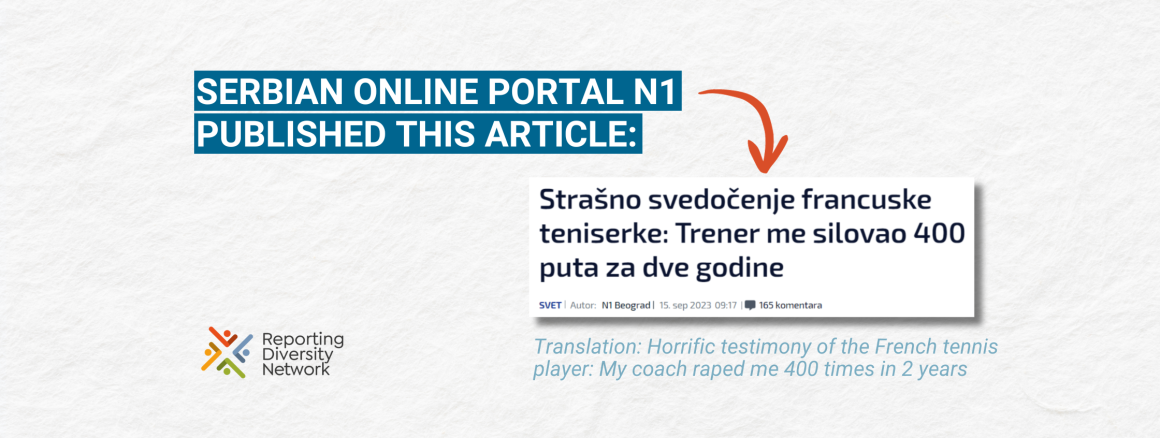
RDN’s request for moderation of the comments under the Serbian portal N1 post
September 21, 2023
User-generated comments below articles of famous media outlets in the Western Balkans can become a way of spreading harmful narratives.
Even when the media content is produced in line with all professional standards, the comment sections, when left unmoderated, can still disturb the general public.
Simultaneously, the media have the power and the responsibility to educate the general public in order to shift harmful perspectives, and negative stereotypes.

Monthly Monitoring Highlights – discrimination and sensational reporting
September 12, 2023
Throughout the month of August, the RDN monitoring team has detected a range of hateful narratives and discourse. This month we have seen hatred based on gender, disabilities, sexuality, and ethnicity; as well as sensationalism in the media.
Gender discrimination in Serbia
Ivana Parlić, a Member of Parliament coming from the People’s Party recently took to Twitter where she attacked singer and influencer Filip Marinkov known as Filarri, who used to frequently do makeup tutorials at a young age. Parlić went on to attack Filarri for wearing makeup, posting photos of him, and reinforcing gender stereotypes by implying that men cannot wear makeup. Filarri gained more popularity over the past year and was even part of the contest for Eurovision, where he was contesting to represent Serbia in the popular music show last year.
A few days later, Ivana posted a photo of Filarri in which he looks pregnant with the caption: “I am against this. As a woman, a mother and as a Member of Parliament. To make it clear to everyone…this photo was part of a photoshoot he did.” This received a lot of criticism in the comments from various users. Filarri responded with a video addressing the situation saying that he got hateful messages after the posts and holding her accountable. Parlić likewise received sexist and insulting messages directed towards her.
This is a clear example of trolling and attacking an individual. Ivana Parlić is not only an MP who holds a position of power and influence, but also has a professional responsibility to be accountable for her actions. Spreading hate online and targeting individuals is extremely hateful and likewise, no one should be subjected to these type of insults in any shape or form.
Hatred Against People with Disabilities in North Macedonia
Zoran Mijalkov is a civic activist and a father of two children who have autism. Recently he got involved in an argument on Facebook with an online user known as Ranko Srbakoski. During this exchange, Ranko directed several obscene insults towards Zoran and his children, calling the father of two, a ‘rotten seed’ thereby, implying that he is to be blamed for his children’s autism, and that he should stop having children. Ranko also called Zoran’s children ‘sick’ and used a number of other derogatory words. It was unclear what provoked Ranko to share these degrading and personal insults. Furthermore, all comments in question have since been deleted.
The public were quick to respond to this incident, flooding social media with requests for Ranko to take accountability for his insulting comments and pointing out that comments like these can have dangerous implications and consequences especially for the lives of those with autism in the country, and their families. The media also responded to this incident, with leading newspapers and online news channels covering the issue. Furthermore, both Mijalkov and the organisation First Children’s Embassy in the World ‘Megjashi’ filed an official complaint against Srbakoski based on hate speech. According to legal provisions, if found guilty, Srbakoski is facing a prison sentence ranging from 1 to 5 years for hate speech and the promotion of violence on social media.
Seeing such comments and insulting, derogatory language being posted and shared online is extremely upsetting and merely serves to perpetuate harmful stereotypes. Words matter, and they can have a direct impact on behaviour. There is a strong stigma in relation to individuals with disabilities and mental disabilities, and these cases are a result of the constant stigma we see in society. There is also a lot of ignorance and lack of understanding when it comes to (mental) disabilities, Srbakoski’s attitude only contributes to that. Everyone should be treated equally and with respect. All forms of hate, aggression and hateful language should be condemned and accounted for.
Ethnic Discrimination in Montenegro
IN4S is a pro-Serbian portal in Montenegro which recently targeted ethnic Albanians by calling them ‘shiptars’, derogatory term used for Albanian people. This, is an insulting expression for Albanians in Montenegrin as well as other languages in the Western Balkans.
This reaction from IN4S was instigated by a wave of online hatred due to a group of Kosovan young people in Ulcinj name-calling Serbians in Montenegro. They called for violence against Serbs on the day commemorating operation Oluja (Storm) by shouting derogatory chants. Pro-Serbian portal IN4S therefore, responded to this incident by insulting Albanians in their headline.
No matter what the incident or where the source stems from, hate should never be met with hate. There is no justification for the use of insulting, derogatory terminology. Furthermore, a portal which is widely read and followed in the country should not be using their platform to spread ethnic hatred or language.
Transphobia and homophobia in Kosovo
Every August, Prizren hosts the DokuFest, International festival of documentary and short films. This year, Canadian musician Peaches performed at the opening of the festival. Images from the performance which featured revealing costumes caused much controversy amongst the public in the country. Peaches also showed support for the transgender community during the performance. In reaction to this, MPs Duda Balje and Eman Rrahmani took to their Facebook to post several photos from the opening act in which they claimed that such a performance was shameful, and that such scenes and events cannot be funded by the budget of Kosovo.
Adding to this, the head of Prizren’s Islamic Community, Besim Berisha also reacted on his Facebook. He claimed that it was shameful to have such images and messages being promoted at the festival. He also claimed that DokuFest has no values and that children should be kept away from such ‘degeneracy’. In another post, Besim Berisha called for a protest to be organised against DokuFest, and on a post with a photo of the words ‘DokuFest’ was a prohibition sign.
The protest kicked off with a large gathering of people holding up signs and banners which read ‘not with our taxes’ and ‘keep drugs away from our children’. Upon being asked if they believe the Islamic preacher, some of the protestors reacted aggressively and physically attacked journalist Vullnet Krasniqi and his cameraman. This resulted in the Association of Journalists of Kosovo condemning the attack and requesting that the police carry out an investigation for those responsible. The police since confirmed that they arrested one of the suspects, with no other updates just yet.
Here we can see the negative outcomes which stem from hateful speech and the spread of negative attitudes due to the support of marginalised communities in society. Universal equality of treatment should be granted to all. The call for protests and use of hateful language by members of parliament can have serious outcomes and consequences. In this case, we have witnessed a link between violent language and violent acts.
Sensational reporting on femicide in Bosnia and Herzegovina and Albania
On the 11th of August, murderer Nermin Sulejmanović physically attacked his ex-partner and proceeded to broadcast her murder live on Instagram. The same day, he killed two more individuals and wounded another three. While he was being chased by the police, he took to Instagram once more to talk about the murders and to ask his audience to guess how many people he had killed. Altogether it took more than three hours for Sulejmanović’s video to be removed and for his account to be blocked. Before the police could catch him, Nermin Sulejmanović committed suicide the same day.
The live reached over 15,000 views at one point, before it was taken down by the platform. This video also kept gaining more likes, meanwhile his account received more followers before the police and Meta reacted.
The media in the country began to report on the events which took place including republishing snippets of the video itself and various photos of the perpetrator on his motorcycle and in the gym. The media described the event as a ‘family tragedy’, a ‘bloody persecution’ and a ‘bloody feast’ – all extremely loaded terms used to gain the attention of readers, but equally extremely harmful, and insensitive. The media dedicated unproportioned attention and focus to the perpetrator, focusing more on stating details which could result in individuals appraising and sympathising with him, despite him being the perpetrator of a horrific crime.
It is extremely important for the media to report on incidents of violence in a professional manner. As a main source of news and information to the public, the media holds a responsibility and duty to ensure that they are unbiased when relaying information to their readers / viewers. The media has a role to play in raising these issues and holding the rightful institutions accountable to respond and prevent such incidents from (re)occurring in the future. They can also use their platform to raise awareness about pressing issues, such as tackling topics like gender-based violence, which has deep-rooted societal causes and remains prevalent in Bosnia and Herzegovina. Equally, social media platforms should utilise incidents like these to improve on their removal of violent content and improve their mechanisms of response to ensure incidents like these are not repeated in the future.
In Albania, the murder of a 32-year-old woman in the coastal city of Dürres in the beginning of August resulted in insultive news reporting. The woman herself was a sex worker which was met with negative judgement from the media reporting on the event. Many headlines and comments highlighted her job. Furthermore, details of the crime, including photographs from the crime scene were made public through a media frenzy, thereby, completely disregarding media ethics and journalistic standards.
Any victim of murder is a victim, someone who has been subjected to violence and a crime. Regardless of their job or profession in life, they deserve equal respect and consideration. What the job of the victim was has no relevance to the crime itself and does not need to be mentioned or highlighted. Sensationalistic reporting like this is extremely harmful, insensitive, and disturbing. Furthermore, disregarding all standards and practices of ethical reporting by sharing photographs of the scene is furthermore, both wrong and should be accounted for. The media should maintain their professional role and refrain from publishing derogatory headlines and details for clickbait, and should equally take responsibility and face the consequences when disregarding such standards.