WHY DID I, AS A JOURNALIST, PROTEST AGAINST A MEDIA OUTLET?
September 28, 2026
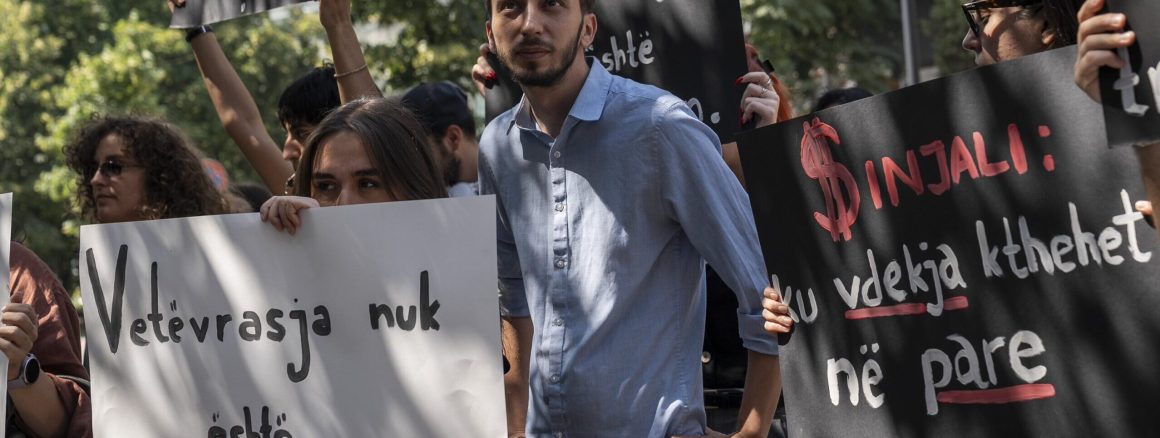
Yesterday, on August 17, I joined a group of protesters gathered outside the offices of the online outlet Sinjali in Prishtina. Journalists usually experience protests from the other side — press cards in hand, close enough to hear, but far enough away not to be counted as part of the crowd. Yesterday, I was inside it, and for the first time since becoming a journalist, I was protesting against a media outlet.
The protest was called for by Linja e Jetës (Life Line), the only center in Kosovo for suicide prevention that offers emotional support. Its volunteers spend their evenings on calls with strangers, staying with them through the hours when everything feels unbearable, until the crisis eases at least a little –– even if only for one night.
What brought them out onto the street was a video that Sinjali had published on August 11. In those images, a person could be seen trying to take their own life. A human being, in the darkest hours of his life, was filmed — without being given the chance to decide whether or not he wanted this moment to be seen. The footage was uploaded, captioned, shared and commented on by people who don’t even know him. Now, if he is able to press onwards, he will have to live with one of the most private moments of his life having become the most public. His family, friends, neighbors and his entire circle have seen the footage. No public interest justifies this. What remains is an online outlet that knew suffering would yield clicks and chose the clicks.
In calling the protest, Linja e Jetës has reminded us that, beyond just the violation of privacy, the science is clear: studies by researchers, psychologists, psychiatrists and organizations –– such as the International Association for Suicide Prevention and the World Health Organization –– have found that reporting on such cases increases stigma and contributes to a rise in deaths, because reporting such cases can exacerbate the situation.
With slogans like “Suicide is not a sensation” and “Who will protect us from Sinjali,” the group of protesters directed their voices toward the windows on the upper floor, from which there were no signs, no names, nothing to indicate that journalism is practiced there. What could be seen was the office of lawyer Besnik Berisha, in whose name the outlet is registered. Berisha is known for his public interventions and involvement in several sensationalist media cases that have stirred controversy. The Sinjali outlet has already made a habit of distributing footage of people in their most vulnerable moments, and of publishing personal data leaked from the Kosovo Police, while itself operating behind unmarked windows, with nothing to identify the outlet.
The protesters had gathered precisely because of the video that was recently shared, but also because of all that Sinjali does: for the journalists who go out into the city in the early morning, looking for the next face they will mock online until evening; for the news items lifted from police reports that include the full names of citizens who are not public figures; for the daily dehumanization of the very people facing power who should be at the center of our stories Their troubles, when told properly, testify to the failures of power; when told as spectacle, that power is left outside the frame, and inside it remains only the subject.
This outlet has turned itself into a morality police, reporting every day on who did what, while remaining invisible itself.
Many of us have written to them directly — to Sinjali itself, and to Besnik Berisha personally. When it comes to this kind of reporting, other media outlets have at least sometimes responded to public complaints; Sinjali never has. The most frequent complaint concerns: names published in full, fragile lives damaged for the sake of content, young people made into headlines for being caught with small amounts of marijuana, families whose quarrels turn into news items and whose identities remain the first in search results for the indefinite future. This outlet has turned itself into a morality police, reporting every day on who did what, while remaining invisible itself.
“We don’t know who their journalists are, or who supports them, but Sinjali knows everything about us,” said Bind Skeja, the director of Linja e Jetës, at the protest, touching on a broader problem: the lack of media transparency in Kosovo.
Linja e Jetës keeps an archive of the kind of content we see every day, collecting similar stories from different media outlets. The latest video is simply the newest addition to it. From this entire archive, three media names stand out: Sinjali, Insajderi and Klan Kosova.
” Sinjali and Insajderi compete with one another, and Sinjali always wins the race. That’s why the protest started with them,” Skeja told me. “If it can be stopped, then the rest will follow.”
A free press is not exempt from criticism
I went to the protest fully aware of what a time this is for journalism in Kosovo, and of how dangerous it is to put journalists even further in the crosshairs. It cannot have been easy for the Association of Journalists of Kosovo (AGK) either, which nonetheless supported the protest. They, like Skeja, keep a large archive; only their archive documents attacks and demeaning, threatening and humiliating statements directed at journalists.
Press freedom in our country rests on fragile foundations, and to be aware of this, we need neither Reporters Without Borders’ reports nor those of the Council of Europe. An ordinary work week is enough to know what these organizations have only reported on. Institutions respond less and less frequently; requests for access to official documents get lost somewhere between a single email and a follow-up; and officials and politicians always have the same words ready for the media: irresponsible, corrupt, bought, fake.
In recent years, under the Vetëvendosje (VV) led government, this situation has visibly worsened, with the government itself directing contemptuous rhetoric toward the media — going so far as to portray them as tools of the country’s enemies or as representatives of Serbian interests. It is a language that spreads easily, from one outlet to the rest, from the Parliament down to the comment sections beneath every article.
It would be easy to conclude that precisely in such times, journalists should stay silent about one another — and I understand the temptation of this conclusion. But journalism justifies its freedom through its public mission, through its claim that it exists to serve the public and to keep power under scrutiny. When an outlet turns the most vulnerable moment of a person’s life into sensational material for distribution, it betrays its core mission. If we, as journalists, do not react when this happens within our own profession, we become part of the problem just as much as the outlet that violates this principle.
Trust in journalism is earned across a lifetime but can be lost all in one moment.
A free press cannot mean a press exempt from criticism, but the key question is who has the right to judge. The state must never have the power to decide what journalism is responsible enough to exist, because governments that take on that authority demonstrate, in almost every case, that the most “irresponsible” journalism is precisely the one investigating them. Meanwhile, citizens and civil society have every right to organize against us, and journalists have a particular duty to criticize what happens within their own craft. The freedom to publish everything is not the same thing as being responsible for what we publish.
The harm does not stop at the person in the video or the person whose personal data is published. The public rarely experiences “the media” according to the distinctions we make among ourselves; an investigative newsroom that spends six months documenting an abuse and an outlet that distributes a police report within minutes arrive on the same phone, under similar labels.
Trust in journalism is earned across a lifetime but can be lost all in one moment. Every unnecessary intrusion into privacy makes it harder for investigative journalists to convince a frightened source in their next story that their testimony will be handled with care. And when trust is damaged, sources hesitate to speak, and people begin to assume that journalists only come to take things from them.
If we, journalists, do not draw the clear line between journalism and exploitation, power will draw it for us — and it will not stop at one media outlet.
This vacuum serves power more than anyone else, and power knows it: censorship becomes unnecessary once enough people believe journalism deserves contempt — and it comes even more easily when these examples come from journalists themselves. If we journalists do not draw a clear line between journalism and exploitation, power will draw it for us — and it will not stop at one outlet. What this means is that journalists cannot be trusted, and that conclusion then turns against the very reporting that a free society needs most.
Sensational reporting erodes trust; eroded trust clears the way for political attacks; attacks discredit newsrooms; and discredited newsrooms turn back to worthless, shocking content. Thus, the vicious circle touches all of us, including those who are not part of it.
Sinjali’s ethical violations are happening within a system where every link fails to carry out its mission to the end: the full names of arrestees leak from the Kosovo Police, the institution obligated to protect them; the Press Council of Kosovo (KMSHK), as the self-regulatory body for print and online media, issues dozens of rulings finding violations of the Code of Ethics by Sinjali — rulings that are ignored because the KMSHK has no enforcement power; while the Agency for Information and Privacy (AIP), which should be protecting citizens from the misuse of their personal data, rarely reaches the media, apart from a few isolated cases.
When self-regulation and responsible institutions fail to act, citizens turn to demands that the state intervene. This creates a danger for the media, because state intervention can easily turn into control over their freedom.
“The Society of the Spectacle”
A small book, published in Paris in 1967, comes up with my friends and colleagues whenever private videos like the one that spurred this protest are published. In the book, “The Society of the Spectacle,” author Guy Debord uses the word “spectacle” to describe a system for organizing social life, not merely a world filled with images. The book is concerned with how relations between people increasingly seem to pass through images, so that the other appears to us more and more as something to be seen, consumed and circulated — and less and less as a person.
Debord never saw a phone with a camera, and yet it would be hard to find a clearer illustration of what he describes than cases when someone’s personal suffering is circulated, stripped entirely of context and reduced to its visual effect. Somewhere between that moment of crisis and the moment that video becomes content — the camera, the upload, the caption, the shares, the comments — the person at the center stops being a human and becomes an object used to grab attention. No one decides this. It simply happens, step by step, and each step looks small. Vulnerability becomes visibility, visibility becomes value and value is measured in clicks.
Newspapers have always known that death, scandal and humiliation draw attention. It is no coincidence that one of the best-known sayings about the media industry is “If it bleeds, it leads.” There is nothing new here in terms of appetite — only the speed at which it is fed has changed. Media sociologists had already noticed by the 1990s that competition between newsrooms does not necessarily make one more distinguishable from another; instead, because each one constantly watches what its competitors are doing, they all end up covering the same stories, in the same formats, in order to try to capture the same attention.
In a market where the most shocking cases win, this becomes a race to the bottom — a race Skeja described in front of Sinjali’s offices. Today, that race has a scoreboard. Analytics and audience engagement show newsrooms in real time which headlines are being clicked, which videos are being shared and how long readers stay on an article. And when these figures become the primary measure of success, the decision not to publish a degrading image leads to concern that audiences might be lost to other outlets that will snatch up the same content, rather than to the fear of lowering professional standards. Whoever was careful on Monday sees on Tuesday what their care cost — in exact figures.
What does the public need to see in order to know?
In this climate, we defend the public’s right to know far more often than we ask the harder question: what does the public need to see in order to know? Footage from shocking cases can carry great public value when it documents war crimes, police brutality or institutional abuse. The history of journalism is full of images we might not have wanted to see but were forced to. But on the suffering of a private individual is not journalism of public interest just because someone happened to film it. Ultimately, knowing the difference between these two is what makes our profession.
If visibility itself becomes the product, if the camera no longer asks what constitutes something the public needs to understand, but only what the public wants to see, we become less witnesses and more spectators who produce spectators. This is perhaps the question Debord leaves us with, more than half a century later: what kinds of relationships are created with others through the act of looking?
Protesting in front of a newsroom’s office felt unusual to me — and perhaps it should be. But discomfort is not a justification for silence. The protest was against Sinjali, but also against all those alike. The most serious defense of press freedom I know is an insistence that freedoms worth defending must always leave room for what the economy of the spectacle persistently ignores: the human.
This article is also available in Albanian.
_________________________________________________________________________________________________________
Author: Dafina Halili
Featured photo: Ferdi Limani / K2.0
This article was originally produced for and published by Kosovo2.0 It has been re-published here with permission.