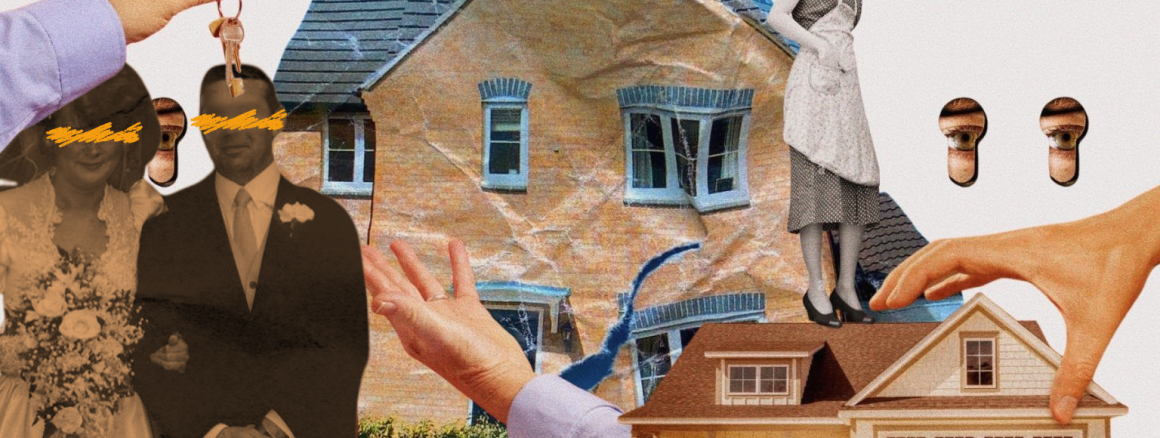
The daughter belongs to someone else’s family
December 11, 2025
Stories behind the disparity in property ownership at the expense of women
Inheritance of property by women in North Macedonia is so rare that over time it has become a customary practice that is seldom questioned. Like many traditions, this one too is rooted in inequality, upheld only by our socially constrained perceptions of what women “deserve” from their families and communities. Beyond it being blatant discrimination, the issue of women’s property rights cuts deep into gender inequality, both personally and politically.
After reading the statistics on the huge discrepancy in property ownership at the expense of women, we decided to look into the stories behind the numbers. Starting from 2023, available data highlights significant gender gaps, showing that men account for 71% of registered property, compared to only 29% owned by women – a consistent trend across different regions. Additionally, according to research by the National Federation of Farmers, “in rural areas, only 4% of women hold ownership rights, usually after becoming widows.” Research by Reactor — “Is There Land for Women? Gender Analysis of Property Ownership” also reveals a gender pattern in declarations of waiver, where women more often give up their inheritance in favor of a brother.
This is a result of a patriarchal and traditional culture, in which during inheritance distribution, property most often goes to the son, or daughters renounce what legally belongs to them during probate procedures. For this purpose, we conducted a survey and spoke with women of different ages, ethnic communities, and social backgrounds who shared their stories with us.
Methodologically, our goal was to listen to their voices, the voices behind the disturbing statistics.
Their testimonies, the similarities in their stories, and the unravelling of toxic family dynamics that they have carried on their shoulders, sacrificing their own futures, reveal a culture, politics, and ideology that resist equality, democratic values, and basic common sense.
These dynamics also show the urgent need for the state to recognise the importance of this issue to include it as an essential topic in education and to address it through special campaigns and programs led by the Ministry of Labour and Social Policy.
Only a son can inherit a land
A dominant narrative we observed is that inheritance is given to the son, with the assumption that he will start a family, while the daughter “does not need” property because she will become part of another man’s family. Numerous testimonies reveal the different treatment women received compared to their brothers, and the most painful example was one woman being told: “A girl (a daughter) is a part of another family.”
“My father wanted me to inherit something as well, but after his death my mother completely succumbed to my brother’s pressure, who manipulated and convinced her that ‘a girl child belongs to another family.’ I want my experience to show that such abuse and manipulation of elderly parents must not be tolerated, because they have the right to their own will and dignity. A whole life of working and saving is in vain if, in the end, the son becomes a despot and dictates the lives of frail parents.”
“My brother pressured my parents terribly, telling them that a girl shouldn’t take property. Today, it seems that this pressure shortened their lives.”
“My father told me that only men are given inheritance – you’re a woman, your husband should take care of you.”
“Everything was transferred to my brother, with the reasoning that everything remains with the son. It’s not about money. It never was. I just wanted to be treated like a human being, a daughter of equal worth not a burden. I forgave them once, when they said: ‘Leave, your brother is getting married, you’re in the way.’ I didn’t forgive the second time. Something died inside me then. I’m his only sister and he hasn’t contacted me in years. The hardest part is that I never asked for anything material, only love. Equality. Because of that pain, I spent so much money on therapy. But finally, I’m done. Everything I have, I earned myself. And even if they offer me something now, I’ll throw it back in their faces. I don’t need it.”
“I come from a family of four – my parents, my brother and me. After studying in Skopje, I married into a village near Valandovo. That’s where my hell began, years of domestic violence. My brother got married and moved to Italy. He helped me secretly, afraid of my mother’s reaction. One night, my abusive husband attacked me. The neighbors saved my life. I fled with my children to my parents’ home, but there a new torment awaited. I was forbidden to use the boiler; there were insults and threats. After a fierce conflict, I ended up on the street. I moved to Skopje, found work at a real estate agency, rented an apartment, and started a new life with my children. My parents didn’t call for a whole year to check if we were alive. Years later, I found out that my mother had transferred all the property to my brother. Then my brother died in Italy, and I remained the one caring for my parents. My mother was bedridden for a year; I left my job to take care of her, despite the continued insults. I spent my whole life trying to earn her love but never received it. I’m still here, caring, even though there is neither gratitude nor support from the other side.”
“Before my father died, my mother secretly brought a notary to sign that the apartment would be left to my brother. He was the MAN; I was the girl – expected to marry and leave the house.”
“What hurts isn’t that I received nothing material, but that my ‘exclusion’ from inheritance was equal to psychological, emotional, and physical abandonment by my parents – no empathy for my situation (divorced, living alone under rent), while my brother received property worth over 1 million euros. It left anger, grief, frustration, permanently damaged the family relationships. They told me simply: ‘Girls don’t get property.’”
“For my family, the house was ‘for the boy,’ and the occasional help was ‘enough’ for me. I regret one sentence the most: ‘Don’t take anything from your brother.’ I realised too late, I wasn’t taking his property, but the inheritance of my parents – I am also their child.”
“Because I’m a woman, I was expected to find a husband and another roof over my head.”
I gave it up to keep the peace in the family
The research shows that more than half of the women gave up most or all their property so their brother(s) can inherit it. Yet some do not feel discriminated against, believing they freely chose to renounce their inheritance.
This is the result of systemic discrimination and injustice woven into upbringing – where sons and daughters are treated differently, shaping expectations that a daughter should voluntarily give up what “rightfully” belongs to the brother, most often to “keep peace in the home” and preserve family harmony. The reasons for renunciation vary among women, but the essence remains the same: behind these decisions lies a deeply internalized tradition and social norm that sons should receive the property, while daughters will “find their roof” with a husband or elsewhere.
A crucial question emerges from many responses: How free is a woman to choose, when that “choice” is conditioned by expectation and pressure from her family and the wider community?
Part of the testimonies come from women who voluntarily, fully aware of the consequences, renounced their property and, de facto, demonstrate freedom of choice. And essentially, we would never question that freedom – after all, everyone has the right to give something away. But what made us reflect were the subtle and delicate pressures of the political and social context, so deeply internalized that they result in a significant statistical discrepancy.
Namely, what kind of system teaches a woman that her peace and tranquillity correlate with her renouncing what legally belongs to her? On which sociopolitical, familial, and intimate pillars is this peace built, and ultimately, what does it camouflage? What sort of system reduces one’s own so-called self-sacrifice to a feeling of moral obligation, even to a sense of self-satisfaction in fulfilling that obligation?
This subtly led us to the thesis of the influential American philosopher and feminist theorist Sandra Lee Bartky, who writes that those who claim that women can simply reprogram their consciousness if they are determined enough have a shallow perspective of the nature of patriarchal oppression. (…) One of the evils of the system of oppression is that it can cause harm that cannot always be undone. Patriarchy attacks the intimate cracks of one’s personality, where it can creep in and permanently cripple the spirit.
The following testimonies illustrate this:
“I am 37 years old, a mother, a wife, and a sister. My mother died when I was 12. That’s when we started taking care of each other – my father, my brother, and I. At age 26, I lost my father as well. After his death, I moved in with my boyfriend (now husband). My brother and sister-in-law sent me money until I became independent. Then came the time for the inheritance. I still didn’t have a family of my own, but I was certain I didn’t need property – not a land, nor a house in my name. I needed family, I needed people. All I wanted was to go to my father’s house, still cozy and warm. And that’s how it is – I go when I can to see the people I love immensely. After my father’s death, we went to a notary and, consciously and willingly, I asked for nothing. Still, I often wonder if the relationship between my brother and me would have been different had I kept my share, and honestly, I think the answer is yes.”
“I renounced my share at the notary; I fulfilled my mother’s wish for everything to be left to the sons.”
“I agreed with my parents that, for the sake of peace in the household, the larger portion should go to him. I don’t feel discriminated against – I simply didn’t want to spend my whole life in court, nor burden my children with problems. At the end of the day, we must earn and create something of our own. That is part of maturity.”
“I voluntarily left all the property to him. I don’t want to interfere in my brother’s household. This way, I know I always have a place to return to and that I have his support. What matters most to me is having a brother with whom I can share both sadness and joy. That is worth more to me than any property.”
“Together with my sisters and our one brother, we began the division of our parents’ property while my mother was still alive. In court, we, the sisters, voluntarily gave our share to our brother; it was our wish.”
“We are three sisters and one brother. When our father died, we – the three sisters – voluntarily renounced the inheritance, entirely by our own initiative, because we were raised from a young age to believe that the greater share should go to the brother. We went even further and renounced our entire portion. We ourselves suggested that the entire property be transferred to our brother’s name, so there was no situation in which we would question why we didn’t receive our share.”
A paradigmatic case – one that has repeatedly reaffirmed the thesis that the personal is political – is that of Arta Mero, an Associate Professor of Family and Inheritance Law at the Faculty of Law at the South East European University, who shared her testimony. Despite the fact that in her family the property had been divided equally and fairly, pressures unexpectedly came from those who had nothing to do with the family’s property – from relatives, friends, and the wider community. According to her:
“After the division of my parents’ property, I faced numerous criticisms and insults from relatives, colleagues, friends, and even my own students. The accusations were degrading: ‘If my sister did this to me, I would close the door on her’; ‘You turned out to be a spiteful sister’; ‘How did your brother accept this – are you still on good terms?’; ‘You will never enjoy that property’; ‘Does your brother even speak to you?’; ‘I would never do this to my brother’; ‘Let’s see how you’ll feel when your husband’s sister takes her share’; ‘Aren’t you ashamed before your brother?’; ‘I would never allow my mother to do that to my uncles’; ‘A daughter who takes her share deserves to be thrown out like a dog.’ And even: ‘I would rip the hair out of my sister’s head.’”
My brother sold the house, and with nine children I ended up in Vizbegovo
Several testimonies showed that it is often impossible to maintain full control over real estate and the way it is transferred, especially when the property is unregistered or illegal, which is common among socially marginalized communities. Among many such cases, one stands out—resulting in homelessness due to an illegal property sale:
“We lived – two sisters and one brother – with our parents. After our parents died, my brother, who was married and had children, decided to sell the house and move with his family to Germany. My sister and I were left with nothing, and although I opposed the sale, I didn’t even know when he sold it or anything about it. At the time, my sister and I were married and living with our husbands and children. Then my husband died and I was left alone with nine children in the homeless shelter in Vizbegovo. Had I inherited my parents’ property – had my brother not sold it – I would have a house today and wouldn’t be homeless. My parents’ house had no property papers, and the whole sale was suspicious.”
***********************************************************************************************
The above twenty or so testimonies, grouped into three basic thematic lines, are only the tip of the iceberg we have been investigating these past months. What became clear in the research process is that women, even if mostly anonymously, are finally more open to thinking and talking about this issue. Additionally, the testimonies raise the question of economic violence, directly linked to women’s financial powerlessness and dependence on their partners – made worse by not owning property in their own name. In fact, the control and denial of inheritance rights, the pressure and manipulation from families for daughters to renounce property in favor of sons, is itself a form of economic violence.
In a society where violence is normalized, how can a woman leave an abusive environment if she has nowhere to go? Economic dependence is one of the reasons why women remain in violent relationships or marriages, and being excluded from inheritance, which legally belongs to them, can contribute to ongoing abuse or the need to endure an abusive partner just for a roof over their head. When women do not inherit property equally to their brothers, they face structural discrimination – an added burden that directly affects the quality of their lives.
This momentum shifts the focus onto state institutions, which are obliged to respond to the needs of those citizens who feel oppressed and deprived of their rights, and which – through media, education, free legal aid, and similar mechanisms – must commit to ensuring that this injustice does not become the fate of their daughters as well.
This story inspired a cross-border collaboration with the Meduza platform. As part of this collaboration, we will publish stories of women’s experiences with inheritance from Western Balkan countries.
Authors: Marta Stevkovska and Leni Frckoska
Featured photo: Meduza platform