“IN THE NAME OF THE PEOPLE OF KOSOVO” DID NOT FEEL LIKE JUSTICE
September 30, 2026
The Specialist Chambers verdicts exposed a deeper sense of defeat shaped by unresolved wartime crimes, contested accountability and political failures at home and abroad.
On September 16, as the judge in The Hague began reading out the verdict, he said in English, “In the name of the people of Kosovo.”
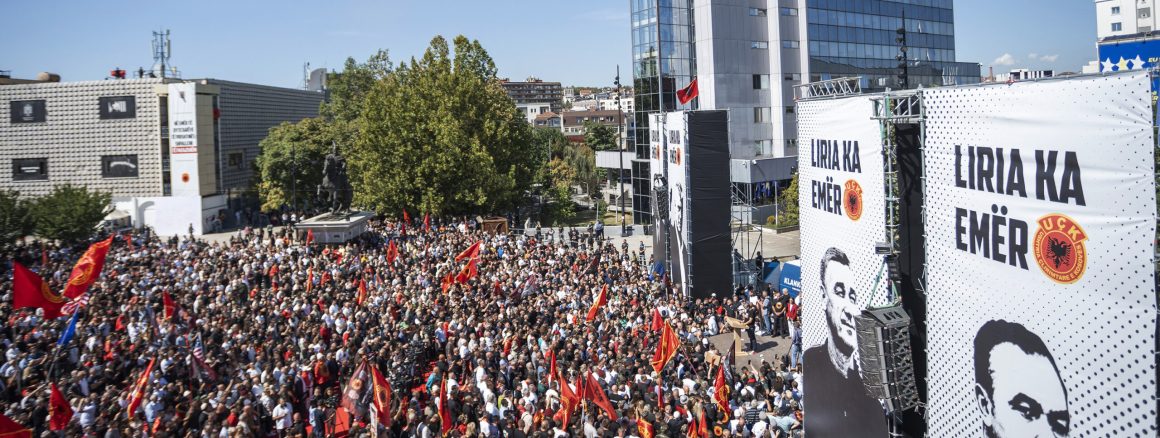
The crowd of thousands of Kosovar Albanians, who had gathered in front of the Assembly and Government buildings in Prishtina, screamed as if in unison: “No.” It was a “No” heavy with emotion –– an angry and sad cry at once.
This did not feel like a court of the people of Kosovo, and on Wednesday, September 16, its judgement broke many of their hearts.
I went to “Skënderbeu” square in downtown Prishtina just as the first judgement was being announced. When former KLA leaders Hashim Thaçi, Kadri Veseli, Rexhep Selimi and Jakup Krasniqi were found not guilty of crimes against humanity, there were cheers, hugs and “UÇK” chants.
The square was not as full as I had expected, perhaps because of the many warnings issued in the days beforehand, cautioning of potential unrest and violence. Despite these warnings, my curiosity got the better of me. As a scholar of social movements, I know that there is no better way to get a feel for a protest than to attend it. TV and social media never do it justice.
I felt the full range of emotions in the crowd. After the cheers came the more sobering part.
The guilty verdicts on the war crimes charges did not land easily with the gathered crowd. People listened in silence, hanging on every word. I could sense people growing anxious from the amount of cigarette smoke filling the air and the fidgeting of those gathered.
As detailed accounts of the victims were read out, I found myself thinking that this public viewing of the decision might not be such a terrible idea after all. Hearing the stories of victims was also a form of justice. From time to time there were cheers or boos, but these would come when the judge addressed the culpability of the accused, not while recounting the victims’ stories.
When the judgement was announced and the four former KLA leaders received their sentences, people around me started crying and breathing heavily. In what I would consider a breach of ethical standards, a prominent Klan Kosova journalist broke the news of Thaçi’s sentence from The Hague before the judge announced it. This visibly shook the crowd, and I mention it because the media need to reflect on how they have handled this entire process. On the days leading up to the verdict and in the days that followed, there were many conflicting and polarizing narratives regarding the sentencing, making people more anxious and confused about what verdicts themselves meant. As the sentences for all four were announced –– Thaçi and Krasniqi 25 years each, Veseli 18 years and Selimi 13 years –– the crowd grew even more despondent. It was painful to watch.
When the broadcast on the large screen ended, most people turned and walked toward Mother Teresa Avenue in Prishtina, with their heads and their flags down, looking utterly defeated. Later that evening, some protesters whose anger got the better of them, gathered outside the EULEX offices, throwing stones and objects at the building, with pyrotechnics causing a small section of the roof to catch fire; others blocked the street at one of the entrances to Prishtina. Crowds also gathered in front of the Government building, where some participants tried to restrain masked protesters and discussed what it would mean, in such a situation, to turn against the government or the police.
The court, voted for by the Kosovo Assembly, was in The Hague after all. Both the Kosovo Specialist Chambers and the Specialist Prosecutor’s Office are part of Kosovo’s judicial system but operate in The Hague with international judges, prosecutors and staff. These subsequent protests could be seen as attempts to take back some control after a very emotional day. But the judgement remains.
And the protests did not end that day.
In the days that have followed, protests continued to gather in “Skënderbeu” Square, with thousands joining the September 18 gathering and smaller crowds returning on successive evenings, culminating in a fifth consecutive night of protests on September 20. Organizers have called on Kosovo’s institutions to maintain financial support for the defendants’ legal defense, saying the protests will continue until the former KLA leaders are released. Notably, the protests and the social media mobilization after the verdict have brought parts of this history to a younger generation, many of whom are now participating in the protests.
Justice deferred, access denied
There is a broader discussion to be had about transitional justice, what these verdicts mean, and how the process itself has been handled. While much of the debate in Kosovo has focused on the court’s distinction between the KLA’s broader struggle and the individual criminal responsibility it established, there is another question that matters just as much: what happens when the legitimacy of the court itself is contested, and when citizens no longer experience the justice it delivers as legitimate or even-handed?
There is also an urgent need to treat reconciliation and dealing with the past as ongoing policy questions, not as issues that can simply be left behind or used as symbolic tools. They continue to shape how citizens understand justice, institutions and their relationship with the international community. But this article focuses on the sense of defeat and the aftershock of the verdict, because both sit within a wider context that needs to be acknowledged and understood.
First, the legitimacy of the court and the painful statement “In the name of the people of Kosovo” could not have felt further from the hearts and minds of those attending the protests. Soon after the verdict, many on social media posted the statement #NotInMyName. That feeling was most palpable in the crowd. Perhaps the phrase deepened both the disbelief and the sense of betrayal.
Has justice been served for Kosovo? This is the question that ties together many of the reactions I have been seeing on social media. As it stands, Kosovar Albanians defendants have received 128 years of imprisonment for the Kosovo war, while Serb defendants convicted for crimes committed during the campaign of ethnic cleansing and violence against Kosovo Albanians have received 107 years. These figures only take into account international courts and not the verdicts given by EULEX, UNMIK or local courts, whether in Kosovo or Serbia. The anger does not simply come because the former fighters were accused; it also comes from a sense that justice remains far from being served for the countless other victims of the Kosovo war.
This justice seems even more elusive after Ratko Mladić’s recent funeral in Serbia, which was attended by government officials and included military honors. Mladić, the “Butcher of Bosnia”, had died while serving a life sentence for genocide, crimes against humanity and war crimes. The anger in Kosovo and the pride in Serbia are not the same thing. Anger over the absence of accountability for Serbian state crimes is not equivalent to the public glorification of people convicted of those crimes.
Justice must offer accountability and resolution for victims, but it must also not forget the context. Presiding Judge Charles L. Smith cited Howard Zinn’s, saying: “There is no flag large enough to cover the shame of killing innocent people.” It is a true statement, but the question remains: is the Serbian flag somehow bigger? Does the former oppressor still hold more tools than the former oppressed?
Secondly, the feelings of defeat that many Kosovar Albanians felt on September 16 did not occur outside of context. Beyond the sense that justice has forgotten countless Kosovar victims, there is a broader sense of defeat that has been building among citizens for years.
For more than a decade, the EU-mediated dialogue with Serbia has been presented as the route toward normalisation and, ultimately, European integration. Yet for many Kosovars, some of the questions most intimately connected to the war have remained at the margins of that process. The fate of the missing has formally been part of the dialogue, including through the 2023 Declaration on Missing Persons, but families are still waiting for answers. Just this past weekend, the remains of three of the 23 persons found in a mass grave in the north of Kosovo were identified, giving their families some closure after 27 years and showing how present this issue still remains for the families of missing persons.
Questions of reparations for the destruction and suffering caused during the war have never occupied the same political space as questions of normalisation, territorial arrangements or the status of the Serb community in Kosovo. Over time, this has contributed to a persistent perception that reconciliation has too often meant asking Kosovo to move on while Serbia is asked much less forcefully to confront what came before.
Whether or not Brussels would recognise that description of its policy, the perception itself has political consequences. The verdict on September 16 landed on top of all this. For citizens who see the court as another consequence of the difficult decisions Kosovo has had to make on its path to EU integration –– while candidate status remains elusive –– it felt like another blow, and not one that can easily be reasoned away. Nor do I see the EU trying to address that sense of defeat.
Lastly, responsibility for the defeat felt by many citizens of Kosovo also lies inside its borders. Kosovo has spent much of the past year in institutional deadlock and has gone through repeated elections. A new government was finally elected on September 13, but the presidency remains unresolved, and the prolonged political crisis has further contributed to a sense that the country’s institutions are failing to treat the mandate given to them by citizens with the gravitas it deserves. However, the stalemate is not the only source of frustration. Social media reels are full of statements made about the Specialist Chambers over the years, as people try to figure out “who is at fault?”.
But the facts are perhaps much simpler: successive governments have all failed to address the issue of dealing with the past properly. Serious institutional work to document the crimes committed during the war is now underway through the Institute for War Crimes in Kosovo, but it began far too late. For years, Kosovo did not sufficiently systematise its own evidence, insist consistently on questions of reparations, or develop a long-term strategy for how the story of the war and its victims would be preserved and pursued internationally. Even now, the political class is calculating how this new crisis might benefit their political interests, while a serious question remains about how to channel the current anger and sadness into a framework for dealing with the hurt of the past and building institutions that truly honor the victims.
The citizens of Kosovo are good at remembering the price they had to pay to get a state and reminding politicians of the same, but today, they are tired. They are exhausted by both their own politicians and the international community; they do not feel heard or seen by either, and this is a cause for serious concern. In this context, it is not the protests that worry me; it is the prospect of citizens feeling completely alienated from their own agency.
As I saw the bowed heads of old and young alike on September 16, I instinctively felt an old defeat, not a new one, and it is worth fully considering what this means for the future of Kosovar society. A sense of defeat and disenchantment at this level is a serious political issue, and domestic politicians would do well to take heed.
_________________________________________________________________________________________________________
This article was originally produced for and published by Kosovo2.0 It has been re-published here with permission.
Author: Lura Pollozhani