CAN JOURNALISM HEAL FROM HOMOPHOBIA?
November 4, 2026
When the existence of a community is measured in clicks.
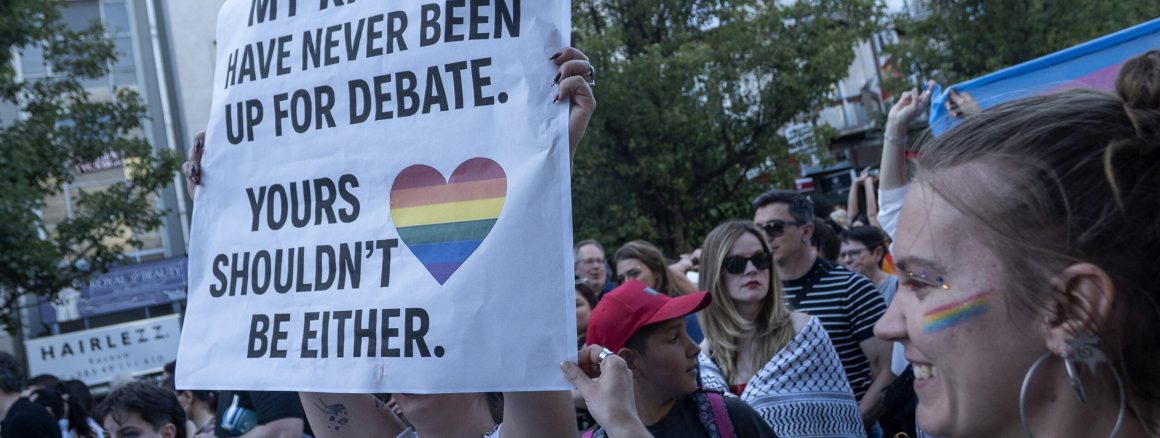
Not everyone participates in public debate on equal terms. Some are invited to judge which identities, relationships and ways of life are acceptable, while others are constantly asked to justify their existence and their rights. This inequality becomes particularly visible when the media discusses LGBTIQ+ people. The questions change form, but the logic remains the same: Is Kosovar society ready? Is this the right time? Should these relationships be allowed?
Fundamental human rights are subjected to a test of public legitimacy, as if the right to live without discrimination were a privilege that the majority can grant or take away, while the responsibility of institutions to guarantee equality and protection from discrimination remains outside the debate.
This is precisely what happened on October 19, on “Kosova Today,” a show broadcast on Klan Kosova, during a debate about the Civil Code and the provision stating that “registered civil unions between persons of the same sex are permitted,” with their conditions and procedures to be regulated by a separate law. The episode was titled “Civil Code — Is Same-Sex Marriage Being Legalized?” and invited guests were asked whether Kosovar society was ready for same-sex marriage.
The problem went beyond the legal inaccuracies in which the topic was presented. During the discussion, participants made claims that pathologized homosexuality and linked it to sexual abuse of children, without being fact-checked.
Avni Çakmaku, a sociologist and member of the Fjala Party, claimed that homosexual people needed psychiatric or religious treatment. Asked what he would do if his child were gay, he said that the first time someone had asked him this question, he had replied that the child would be cut off from his life. He later described homosexuality as something that goes against humanity and implied that normalizing it amounted to indoctrination.
The journalists created an opportunity to challenge this claim with facts when they repeatedly pressed him on whether anyone had been “cured” or whether he knew anyone who had “improved” after visiting a psychiatrist or an imam. But even then, no clear scientific explanation followed to clarify that homosexuality is not an illness.
To remind readers of the facts once again, at the risk of repeating what has been known for more than half a century: on December 15, 1973, the American Psychiatric Association voted to remove homosexuality as a diagnosis from the Diagnostic and Statistical Manual of Mental Disorders (DSM), while the remaining diagnostic categories related to sexual orientation were finally removed from the manual in 1987. The World Health Organization (WHO) removed homosexuality from theInternational Classification of Diseases in 1990, more than three and a half decades ago. Apparently, we will have to repeat these dates until there is no longer any need to explain on television that homosexuality is not a mental illness and that it does not need to be cured.
A debate built on a false premise
Even if no homophobic statements had been made, the way the debate itself was framed would have been enough to call it into question, especially given that this pattern is nothing new in our media. When the question is whether society is ready to accept the rights of LGBTIQ+ people, the latter risk being turned from subjects with voices, lived experiences and political demands into objects of discussion, while others assume the authority to determine what is acceptable, natural or legitimate. This framing reproduces heteronormativity by treating heterosexuality as an unquestionable norm and queer identities and relationships as something that must be explained or justified.
When a television station presents scientifically discredited claims as valid contributions to a debate, it lends them an authority they do not have. A claim does not become true simply because someone makes it in a television studio. But when it goes unchallenged, the audience may perceive it as equivalent to established scientific knowledge. In this way, a broadcast that is supposed to inform risks spreading misinformation and making prejudice appear to be a reasoned opinion.
This is precisely where a media outlet’s obligation to give space to different viewpoints ends and its editorial responsibility begins.
The criticism, therefore, concerns the leading question that framed the debate from the outset and the way unsupported claims were handled.
Freedom of expression also protects conservative and religious views that oppose LGBTIQ+ rights, and a guest can express their beliefs without being censored. However, when an editorial team invites someone whose views it already knows onto a television show and then frames the question itself around whether queer people’s rights should be accepted, it cannot hide behind the guest’s freedom of expression, because it has itself chosen to put these rights up for debate.
In such a debate, when someone describes homosexuality as an illness, the claim must be corrected, and when they link it to sexual abuse of children, it must be challenged with facts.
The Code of Ethics for Media Service Providers of the Independent Media Commission (IMC) also establishes responsibilities for the content that media outlets broadcast, including issues related to discrimination and incitement to hatred. This responsibility requires that statements be placed in context, claims be verified and the public not be left confused about prejudice versus fact, because simply giving different sides a chance to speak is not enough.
In this case, several participants, including the journalists themselves, also expressed support for LGBTIQ+ rights. The criticism, therefore, concerns the leading question that framed the debate from the outset and the handling of unsupported claims.
Editorial responsibility does not end in the studio
The harm deepened when Klan Kosova published a clip featuring Çakmaku’s remarks on social media, accompanied by the question: “Can a homosexual person be cured by a psychiatrist or an imam?” The wording reinforces the claim by framing it as a question and keeping the false premise at its center, while omitting the facts that would debunk it. We cannot know the editorial team’s intention from this post, but we can criticize its editorial choice and its effect.
The most provocative statement is taken out of the discussion, turned into social media content and circulated without the context that would allow the public to assess it accurately. Sensationalism works precisely this way: it does not need to invent anything when it can simply select the most shocking statement, repeat it and leave out the information that challenges it.
Following the October 20 broadcast, the organization CEL Kosova filed a complaint with the Independent Media Commission (IMC) against Klan Kosova. According to the organization, the content gave a platform to scientifically unfounded claims that could contribute to the stigmatization of LGBTIQ+ people and reinforce prejudice and discrimination against them. Citing the Constitution of Kosovo, the Law on Protection from Discrimination, the Law on the Independent Media Commission and the Code of Ethics, CEL Kosova called for the material to be removed from all Klan Kosova platforms, a public apology to LGBTIQ+ people and communities, and the imposition of fines under Article 30 of the Law on the Independent Media Commission. Meanwhile, CEL, QIKA, CSGD, the Sekhmet Institute, QKSGJ, YIHR and Dylberizm issued a joint statement, condemning the language used and calling for the episode to be taken off the air.
The question of whether Kosovar society is ready for same-sex marriage must be rejected as the starting point of any debate.
When a community that already faces discrimination becomes the subject of this process, the consequences extend beyond viewership, comments and clicks. Discourse that portrays queer identity as an illness, a danger or a threat to children can fuel family rejection, institutional discrimination and hostility in the everyday lives of people who, far from the studio, must live with the consequences of what is said about them. When a parent hears on television that a gay child needs to be cured or could be cast out of the family, the message ceases to be an abstract clash of opinions. It may convince them that their own queer child “can be cured” or should be “cast out.”
Therefore, the question of whether Kosovar society is ready for same-sex marriage must be rejected as the starting point of any debate. Human rights are not a reward that the majority grants to minorities once it is convinced that they deserve them. Nor does the homophobia of the majority make discrimination acceptable, just as history has not taught us that injustice disappears by waiting until the majority feels comfortable with equality.
When we talk about LGBTIQ+ people, we are talking about human beings, their lives, relationships and families. Yet they continue to be the subject of debate on television, while others discuss whether they deserve acceptance.
Journalism can and should create space for debate, but not a space where the dignity of a community is put to the test for the sake of spectacle. Media responsibility begins where the pretense of neutrality ends: with the obligation not to present hatred as an alternative equal to the truth.
As long as LGBTIQ+ people’s rights are treated as an issue that requires the majority’s approval, and the media circulate prejudiced statements like any other content, public debate will continue to reproduce the same power relations, in which some are granted the right to judge while others are left to question their right to exist.
_________________________________________________________________________________________________________
This article was originally produced for and published by Kosovo2.0 It has been re-published here with permission.
Author: Medinë Dauti
Feature image: Ferdi Limani / K2.0