Author: Ivana Jelača
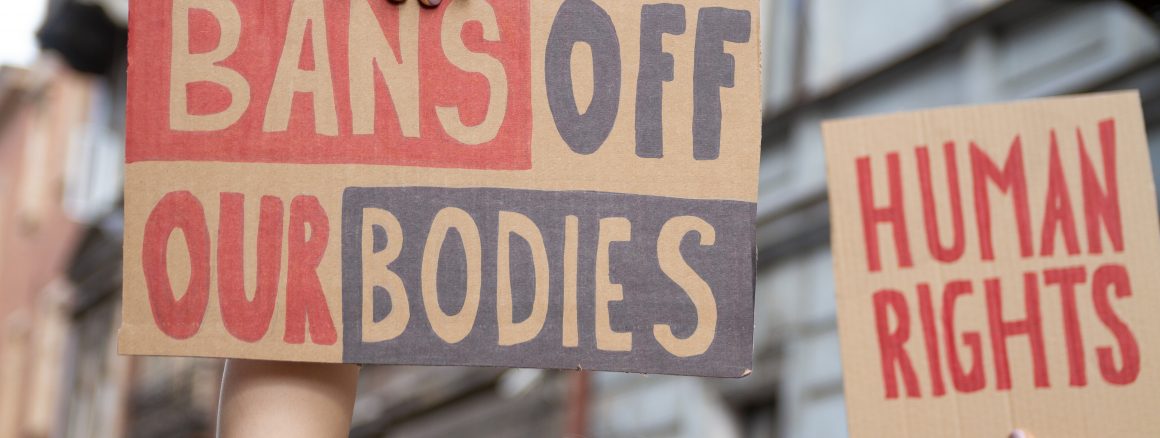
FROM THE US TO THE WESTERN BALKANS: The Abortion Debate Reaches Western Balkan Media
July 4, 2022
One could say that it would make sense to assume that the freedoms we have today and which we once fought for, are won forever. However, the US Supreme Court’s decision to overturn Roe v. Wade which protected women’s right to choose to have an abortion proves that rights are not guaranteed and cannot be safeguarded forever. The publicity that the Supreme Court’s decision has taken globally, brought to the fore the abortion debate in the Balkans.
The media agenda in different Balkan countries seems to be influenced by one another. As such, when the abortion debate reached Croatia, it sparked a debate in Serbia. During a discussion in a Serbian TV channel a representative of the Serbian Orthodox Church said that Serbia ‘is disappearing due to abortion’. Such arguments are in line with the government’s views regarding abortion. Ratko Dmitrovic, the Minister for Family Care has accused women for being so emancipated that they no longer want to give birth: ‘Women who do not want to give birth are to blame for the population decline in Serbia’, the minister said, and further in attacked those who have a single child or those who will not or cannot give birth: ‘We have women who say – ‘I just don’t care, I won’t give birth’. And no one is allowed to say anything to her, to resent her. Those who have attacked me, (…) are mostly women with one child, or those who do not have children. So, they simply do not allow it to be discussed,’ said Dmitrovic.
At the same time, controversial topics such as abortion and reproductive rights in general seem to be used by the mainstream media in order to distract the public from other crucial issues that have political implication of the country’s government.
Reproductive rights, including the right to abortion, in the region became a public issue in 1969, when Serbia was part of Yugoslavia, with the case of Šefka Hodžić who was convicted for murder of her pregnant friend Alija Hasanović. This case is also an example of how patriarchal matrices are woven into motherhood and how the imposed patriarchal patterns could lead to fatal situations.
According to the indictment, a woman from the Bosnian village near Zvornik killed a pregnant acquaintance, took the fetus out of her womb which lived, and then presented it as her own child. Before the incident, the women who was unable to conceive, wore a pillow for nine months and pretended to be pregnant. This incident has also inspired playwright Maja Pelević to write the shocking piece titled “The Last Girls”, which talks about how wombs have become factories that “produce” babies, how women are losing control of their bodies, and how capitalism is becoming the “majority owner” of women’s wombs.
‘I’m not saying that the right in Serbia is not steadily growing. It is growing, but it is still, it seems to me, controlled. Everything that the government is currently doing regarding world events and our attitude towards it is quite a big ping-pong game. In a country that has not even come close to some serious EU negotiations, a very big problem would be if the issue of abortion were suddenly raised. We are now fulfilling various EU quotas: human rights, gay rights, and even the Pride that took place (Pelević calls it “Vučić’s Pride”), but if only that were really the Serbian mentality. I do, however, think it’s all purely on paper. Because it had to happen. That is why it does not seem realistic to me that now the church is suddenly strengthening so much that it regulates things such as the ban on abortion. I don’t know if something different will happen in the future, if the extreme right will develop enough to enter the parliament in large numbers. But it doesn’t seem like that to me. I think that the right-liberal current is much stronger at the moment and in that sense it would not allow itself that kind of mishap. That is the way it balances out, it is a kind of game Vucic plays between “being a great European” and flirting with Russia, but I don’t believe that he would go that far because it would not be in his favor, and not because he wishes women well. I think that for him, on his path, which is the proverbial path of sitting between two chairs, it would be very radical,’ Maja Pelević tells RDN.
Maja Pelević also connects the emergence of the abortion narrative in Serbia and in the region the understanding of liberal capitalism.
‘Capitalism, is closely tied to patriarchy, which is again tied to the right. The neoliberal order is the right order. Not the left one. In some left-wing practices, there are freedoms and much more humane ways of life, regarding all aspects of life: people and classes, religion and nation, men and women. These rights must be won again because they do not really exist in capitalism. They do exist on paper, as in America, for example, there are anti-racist policies, but still, there are cases where African-Americans in Central America are killed without pardon. Capitalism has all these totalitarian fascist ways of functioning, but it masks them well: the media and various phrases like – freedom, equality, justice, but in essence, we all know very well that these are countries where, daily, human rights are very much endangered indeed. The case of Julian Assange is a very eloquent example in that sense,’ concludes Pelević.
The patriarchal narratives in the Serbian society and the media seem to be the root of the reemergence of the abortion issue in the country.
‘The female body in Serbia, unfortunately, belongs least of all to women. Her body is in constant ownership of the patriarchal mentality: the only acceptable female body is the female body which lacks freedom. Even while she is a little girl – they pierce her ears and decorate her without her consent, telling her “others decide regarding you”. If a woman wants to dress at her own discretion – it is as unacceptable, as – according to the standards of masses – it is to decide regarding her own offspring, if she does not say “no” loud enough, if she says “yes” too loudly. The oppression served through tradition and the church, and now through politics, is never direct, but insidious. This oppression is presented as freedom, but with restrictions: to have measures, to have good taste, to be feminine, to have feminine manners, to respect the elderly. A woman in Serbia thinks she is free until she starts practicing the definition of true freedom. Only then does she realize that this original freedom was actually a cage,’ Bogdan Stevanovic tells RDN.
Stevanovic, who is also known as Blogdan, is a ardent advocate of women’s rights in Serbia and his social media are followed gather a very large audience.
The abortion debate in Bosnia-Herzegovina
The issue of the right to abortion in all Western Balkan countries seems to be on the same path. Like Serbia, the abortion debate has reached Bosnia-Herzegovina as well.
‘It is interesting that every freedom must be fought for, but for every abolition of freedom, only one signature on a document is enough. The problem with abortion, whether we are “for” or “against”, is that it can be banned, but it cannot be stopped. What can be done is to make a phenomenal ground for illegal “butchers” who have always operated, not only in the movies we watch, but also in real life. The legal ban on abortion is not only a threat to the right to choose, but also a direct threat to a woman’s life. And again, it is very interesting that what happens to a woman’s body is decided by the law,’ says Verdana Božinović who is the first woman director of the Sarajevo National Theater Drama in its 100 years history.
Božinović also referred to Margaret Atwood’s book the “Handmaid’s Tale”, which was adapted as a series which depicts a world without individuality. A conservative world where women are merely the property of men. Art, music, and theater are forbidden. “Offenses of homosexuality”, abortion, reading books, disagreements with the system – they are punished by public hanging. In the same world there are women who are, legally, raped once a month by their ‘owners’ in order to give birth to children.
‘The abolition of one freedom always brings the abolition of the second and the third and the fourth… until there are no more freedoms. Until there is no more life,’ Bozinovic tells RDN.
Author: Snežana Miletic
Photo: Longfin Media/ Shutterstock
Monthly monitoring highlight: Hate speech in the Western Balkans during May
June 10, 2022
Throughout the month of May, the RDN monitoring team has detected a range of hateful narratives and discourse. This month we are highlighting religious hate speech, ethnic discrimination, homophobia and sexism in the Western Balkan region.
Islamophobia in Bosnia and Herzegovina and Albania
In Bosnia and Herzegovina, the former member of the presidency of the Republic of Bosnia and Herzegovina, Stjepan Kljuić, shocked the public after a series of insults and Islamophobic comments against the Minister of Education of the Sarajevo Canton, Naida Hota-Muminović, who wears a hijab.
During the show, Kljuić openly spread hateful and anti-religious narratives aimed at the faith of the Minister of Education of the Sarajevo Canton. Kljuić commented “when I see the Minister of Education of the Sarajevo Canton with a hijab…what is she thinking, what are the little children of non-believers thinking”.
Not only is this incident highly problematic for the spread of Islamophobic sentiment, but furthermore, broadcasting such comments on a TV Channel with a wide reach and audience leads to spreading Islamophobic tropes and discriminatory narratives within society. The media’s role and duty is to hold responsibility for what is broadcasted and shared on their platforms, thus they hold accountability for the spread of such narratives. In this instance, by allowing Kljuić to make these personal, insulting comments in relation to the religion and appearance of the Minister of Education in Sarajevo Canton, the media helped to diffuse these discriminatory narratives and Islamophobic rhetoric amongst the wider public.
In Albania, during the show ‘Arnautistan’ for MCN TV, Analyst Mustafa Nano called for the ban of prayer within public spaces in Albania. This was accompanied by an image of a mass prayer in Elbasan on Eid-al-Fitr where he stated that “this is not my Albania; my Albania has been stolen”. Nano argued that prayer should be restricted to religious sites as such displays “may affect the non-religious part of the country”. “At this rate, Albania will turn into an El Dorado for religious fanatics all over the world”, the analyst added. In reference to the photograph itself, he added that “these women in the photo are humiliated…these women dress like this because their husbands want them to.”
This incident has resulted in a response by the head of the Inter-Religious Institute for Albania, Dr. Arben Ramkaj, who called out Nano for his Islamophobic comments and made a statement for the Audio-visual Media Authority as well as the Commissioner for Protection from Discrimination to react to such statements and incidents.
TV channels such as MCN TV hold a moral and legal responsibility to prevent the spread of discriminatory and hateful narratives. Providing a platform for the dissemination of Islamophobic narratives only upholds and justify religious hate speech in society.
Ethnic discrimination in Kosovo and Montenegro
In Kosovo, marking the occasion of the Abetare Day, an event was held at Xhemajl Kada school in Peje, to mark the usage of the children’s Albanian language textbook (Abetare) which will be used both in Kosovo and Albania.
At the event, students from the Roma, Ashkali and Egyptian communities watched the programme separately from other children. Journalists who covered the event and questioned this practice received an answer from the teacher of this school claiming that the students themselves asked to sit separately. This, however, did not match up to the version of events told by the students. The students from the Roma, Ashkali and Egyptian communities said that the teacher told them that if they wanted to follow this program, they had to sit separately from the other children. Later on, there was a statement saying that children from Roma, Ashkali and Egyptian communities do not regularly attend school and that they study in a separate, special class. Furthermore, although it was not planned, at the students’ request, they were allowed to follow the programme.
There are only a number of schools within Kosovo where students from various communities attend, and although this has received criticism from civil society as unacceptable behaviour, school principals continue to justify and explain that this was a reflection of the demand of parents of students who do not want their children attending classes with Roma, Ashkali and Egyptian students.
Following this incident, the Minister of Education reacted to this discriminatory attitude and in addition to a number of civil society organisations, the Ombudsperson also stated that this was an unacceptable attitude towards students of Roma, Ashkali and Egyptian communities. Despite the media in Kosovo reacting and responding well to this type of discrimination and racism, including a number of social media commentators, this incident highlights the level of discrimination within public institutions – in this case schools. This incident is highly sensitive one. By creating a division and excluding children and pupils from various ethnic communities, this only further upholds and perpetuates the social exclusion and marginalisation of ethnic communities in Kosovo.
In Montenegro, under the slogan for the celebration of the Day of Victory over Fascism in Danilovgrad, a protest was organised calling for Russian aggression against Ukraine.
Victory Day over Fascism is a day which commemorates and highlights the fight against fascism – the fight for individual rights, defence of democratic values and individual freedom. Calling for active aggression by Russia against Ukraine, only leads to further division within society and undermines the significance of the celebration and organised event taking place. Montenegro is a country with a highly polarised population, divided on many issues including that of the Russian-Ukrainian conflict. This type of public support is extremely dangerous and runs the risk of promoting further tension, fragmentation and hostility within society.
Sexism in North Macedonia
This month, the Macedonian representative at Eurovision, Andrea Koevska, was being photographed holding the Macedonian flag. During the photo shoot, she was asked to be photographed without the flag which led her to leave the flag on the floor at that moment. Following this, parts of the public in Macedonia condemned the singer for her action and insulted her using various offensive names as a reaction to her actions. The prosecution even opened a case to see if she violated the relevant legislation.
This led to a number of hate speech comments on various social media, where individual users insulted Andrea in a highly derogatory and personal manner. One comment read: “Stupid, freak, and I don’t know what else”.
Controversies involving Macedonian singers and the Macedonian flag is not a new phenomenon. There has been a similar case involving Macedonian singer Tamara Todevska who once sang the Macedonian national anthem and curiously omitted some of the text within the anthem resulting in her being blamed for acting out of political motives. In this case, citizens were quick and prompt to react following the publication of the video depicting Andrea throwing the flag.
This incident highlights the importance of monitoring social media including the need and significance of various mechanisms put in place to prevent the spread of hate speech and insults aimed at individuals and groups.
Homophobia in Serbia
There has been a number of reported cases of the monkeypox infection in Europe, the United States, Australia and Canada. After the cases of infection were discovered amongst gay and bisexual men, the media began to spread homophobic narratives surrounding the spread of monkeypox.
Various media in Serbia began to report on the infection, claiming it to be a disease that is “transmitted by gay sex”. In its original title published by newspaper Kurir, their headline read “Monkeypox transmitted by gay sex! Still no cases in Serbia but if the husband has them the marriage can fall apart”. Kurir, alongside the evident homophobic headline, presented a number of misinformation surrounding the spread of the disease. In addition, they intentionally left out the information that the advisor for HIV, hepatitis and sexually transmitted infections at the World Health Organisation (WHO), Andy Seale emphasized that although “we can see some cases amongst men who have sex with men this is not a gay disease”.
Some media also had headlines and narratives similar to that of Kurir, including Radio Television Vojvodina who shared an article titled “no need for panic: mostly homosexuals get infected with monkeypox”. These narratives and headlines only spread fear and mistrust within society, especially towards gay and bisexual men. These headlines and articles which spread information holding little to no truth can result in dangerous homophobic rhetoric and divide amongst the public resulting in the stigmatisation and targeting of certain groups in society. The media should approach topics of importance as public health issues, by providing factual, objective and relevant information for public interest and knowledge without spreading homophobic and harmful disinformation.

TROLL OF THE MONTH: Metropolitan of the Serbian Orthodox Church in Montenegro, Joanikije Mićović
June 2, 2022
The Balkan Troll of the Month is an individual, a group of individuals or a media outlet that spreads hate on the internet based on gender, ethnicity, religion, or other diversity categories. The Balkan Troll is selected based on hate speech incidents identified across the Western Balkans region.
May Troll is the Metropolitan of the Serbian Orthodox Church in Montenegro, Joanikije Mićović, who spoke out in support of the recent initiative by the American Supreme Court, wishing to overturn abortion rights within the United States. The topic of abortion rights is one of much contestation within modern society whereby such narratives create further tension amongst the public.
Earlier this month, the Metropolitan of the Serbian Orthodox Church in Montenegro, Joanikije Mićović, came out and voiced his stance on the recent initiative of the American Supreme Court who is looking to overturn abortion rights within the United States. The recent debate surrounding abortion rights within the United States begun with a leaked document published by the media company, Politico, which revealed that the Supreme Court was looking to overturn abortion rights established in the 1973 federal constitutional protection. The immediate ruling would result in putting an end to the “half-century guarantee of federal constitutional protection of abortion rights” alongside the right for each state to decide for themselves where they stand on abortion rights.
As a reaction to this political debate, this incident has received worldwide attention and global spotlight including a variety of reactions and debates. Amongst these was the Metropolitan of the Serbian Orthodox Church in Montenegro, Joanikije Mićović, who also spoke out. He argued that such a ruling would indeed be one of reason and conscience. The Metropolitan of the Serbian Orthodox Church in Montenegro, Joanikije Mićović, stated:
“Deliberately terminating a pregnancy at any stage of it is a terrible sin and is directly directed against God’s original biblical command to give birth. Man alienated from God want to legitimize what is against God’s law, it is, on the one hand, an expression of pernicious selfishness, and, on the other hand, an escape from life, a renunciation of love and God’s blessing. This sin leaves severe, long-lasting and traumatic consequences on the soul of the parents, and is only cured by sincere and long-lasting repentance. Because of what has been said, we accept every initiative for the protection of unborn children, especially this one of the Supreme Court of America, as humane, saving, and pleasing to God”.
Abortion rights is a topic and issue of much contestation within today’s society and globally; there are extremely polarised and fragmented opinions surrounding the topic of abortion. However, the fact remains that women and individuals in society have both the autonomy and right over their own bodies. Furthermore, an individual’s autonomy and personal rights should not be debated, discussed or decided by others. Within a secular state, the church is a separate institution and sphere of influence from the government which has no place in the debate and decision-making regarding women’s autonomy and abortion rights.
By spreading such narratives regarding abortion rights, especially by individuals such as the Metropolitan of the Serbian Orthodox Church in Montenegro, who has a high authority and influence over the public’s opinion, such narratives can only result in further division within society. Montenegro is a country with a large Orthodox religious population, therefore, by having such a predominant religious figure spread such narratives and statements, this only further influences and affects the population’s opinion surrounding abortion rights. When discussing abortion and forming opinions surrounding the topic, this should be treated as a health care matter which is both private and separate from the sphere of religion.
This statement was picked up by various media portals and social media, further spreading it amongst the public in Montenegro. The media, instead of using their educational role and influence to open up the space for medical professionals, researchers and individuals with personal stories regarding abortion, only transmitted the statement of the Metropolitan of the Serbian Orthodox Church in Montenegro, thus providing the church with the legitimacy to speak and comment on the legality of abortion rights.
Media should open up a debate over such important social issues, however this includes having opinion from various sides. Only transmitting the opinion of a (male) church representative, without hearing from those who are affected the most – a that is women- does not contribute to the democratic public debate.

Osuđuje se neprofesionalno izveštavanje medija o širenju majmunskih boginja i dovođenja u vezu sa LGBTQ+ populacijom
May 25, 2022
Poslednjih nedelja zabeleženo je više slučajeva infekcije majmunskim boginjama u Evropi, Sjedinjenim Američkim Državama, Australiji, Kanadi. Nakon što su otkriveni slučajevi infekcije kod gej, biseksualnih i drugih muškaraca koji imaju seks sa mušakrcima, mediji su počeli da izveštavaju o majmunskim boginjama kao bolesti koja se „prenosi gej seksom”.
Tabloid Kurir je u svom tekstu „MAJMUNSKE BOGINJE SE PRENOSE GEJ SEKSOM! Još ih zvanično nema u Srbiji, ALI AKO IH MUŽ IMA MOŽE DA PREKINE BRAK! (FOTO)” pored homofobije, izneo i niz neistina i dezinformacija.
Kurir se u tekstu poziva na informacije koje je objavila Svetska zdravstvena organizacija (SZO), i prenose „kako je najveći broj slučajeva zabeležen među muškarcima koji su imali seksualne odnose sa muškarcima!”. Međutim, izostavljaju informaciju da je savetnik za HIV, hepatitis i polno prenosive infekcije pri SZO Endi Sil naglasio da iako „vidimo neke slučajeve među muškarcima koji imaju seks sa muškarcima, ovo nije gej bolest” i dodao da „svako može dobiti majmunske boginje u bliskom kontaktu sa zaraženom osobom”.
Naslove i narative slične onim u Kuriru imali su i još neki mediji. U razgovoru sa virusologom i mikrobiologom Milankom Šekler, koristi ih i Radio Televizija Vojvodine (RTV). Javni servis umesto da jasno i blagovremeno informiše javnost o majmunskim boginjama, svojim tekstom „BEZ PANIKE: Od majmunskih boginja uglavnom oboleli homoseksualci” doprinosi stigmatizaciji, širenju straha i nepoverenja prema gej i biseksualnim muškarcima.
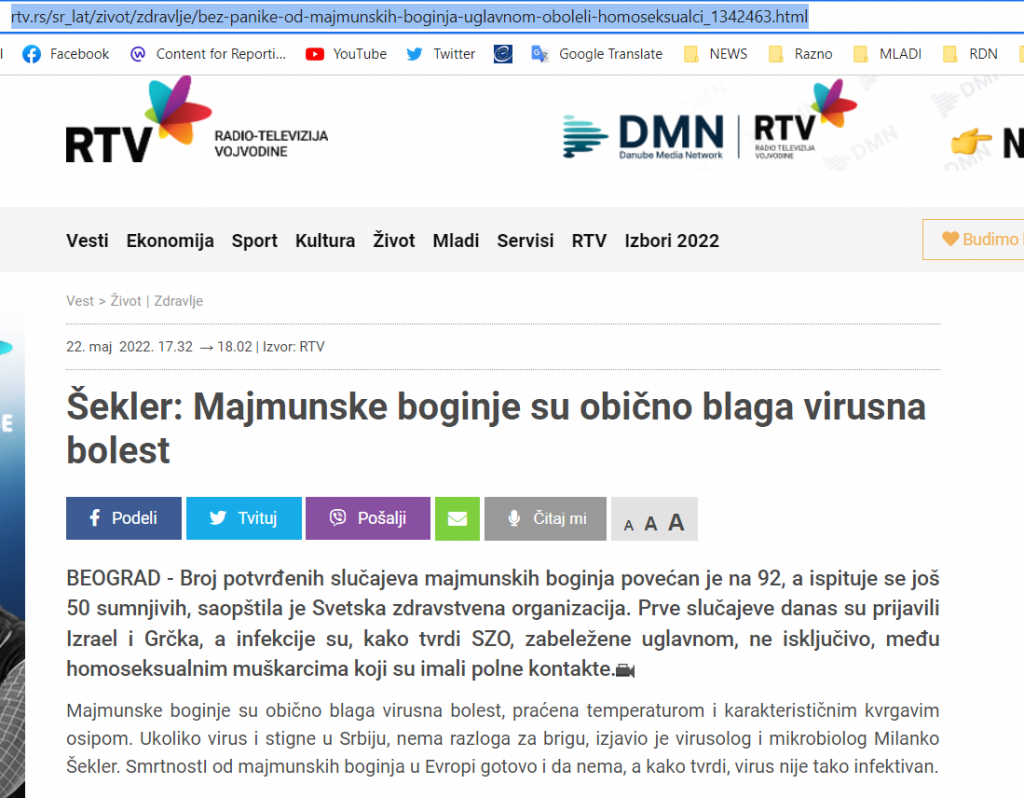
RTV je naknadno izmenio naslov, što govori o uočenoj grešci, ali tekst i dalje doprinosi stigmatizaciji LGBTQ+ zajednice umesto da objektivno informiše o bolesti u skladu sa javnim interesom.
Ujedinjene nacije su takođe skrenule pažnju na problem: „Stigma i krivica potkopavaju poverenje i sposobnost da se efikasno reaguje tokom epidemija poput ove“, rekao je Metju Kavana, zamenik izvršnog direktora UNAIDS-a. Ovim je naglašena šteta koju ovakvi narativi čine javnom zdravlju i celokupnom društvu.
Stigmatizacija i targetiranje pojedinih grupa ne samo da nanose štetu određenoj zajednici, nego remete i javno zdravlje. Mediji bi trebalo da pristupe ovoj temi kao zdravstvenom problemu, pružajući relevantne informacija od javnog interesa, bez širenja homofobije. Nasuprot, ovakvo izveštavanje medija veoma podseća na izveštavanje o HIV-u tokom 80-ih godina i predstavlja realnu opasnost od jačanja stigme prema LGBTQ+ zajednici.
Mediji bi trebalo da izveštavaju u skladu sa Etičkim kodeksom novinara Srbije, ali i da budu svesni svoje odgovornosti kada izveštavaju o osetljivim temama. Etički kodeks izričito kaže da „novinar mora biti svestan opasnosti od diskriminacije koju mogu da šire mediji i učiniće sve da izbegne diskriminaciju zasnovanu, između ostalog, na rasi, polu, starosti, seksualnoj orijentaciji, jeziku, veri, političkom i drugom mišljenju, nacionalnom ili društvenom poreklu”.
Pored toga, podsećamo medije na njihovu ulogu i odgovornost prema društvu, u ovom slučaju važno je zaštiti javno zdravlje i bezbednost građanja i građanki, a stigmatizacija jedne društvene grupe i stvaranje zablude o načinima prenošenja bolesti doprinose sasvim suprotnom efektu.
Ovo saopštenje zajednički potpisuju:
Institut za medije i različitosti – Zapadni Balkan
Nezavisno udruženje novinara Srbije
Beograd Prajd
Nacionalni centar za seksualno i reproduktivno zdravlje – POTENT
Udruženje Da se zna!
Asocijacija Duga
Labris – Organizacija za lezbejska i ljudska prava
Rainbow Ignite
Udruženje L* – Communio
ZOOMER.rs
Centar E8
Reflektor teatar
Talas
ERA – Equal Rights Association for Western Balkans and Turkey
Grupa “IZAĐI”
XY Spectrum
GLIC
Geten
Konsultacije za lezbejke
Sexism, ethnic hate speech and hate speech against the LGBTQ+ community present throughout the Western Balkan region
May 17, 2022
Sexism, misogyny and hate speech towards women and the LGBTQ+ community, as well as hate speech based on ethnicity, are most prevalent in Western Balkan media and something that is common to the whole region, according to the results of media monitoring in the Western Balkans which followed problematic trends in reporting on social diversity.
These results were presented at the regional conference ‘Where have diverse voices gone’ in Belgrade. Monitoring of hate speech and representation of diversity is conducted within the Reporting Diversity Network 2.0.
The findings were presented by media experts from the region: Kristina Lani (Albanian Media Institute), Leila Bičakčić (Center for Investigative Journalism), Violeta Oroshi Berishaj (Kosovo 2.0), Željana Kandić (Center for Investigative Journalism Montenegro), Bojan Georgievski (Institute for Communication Studies Skopje) and Ivana Jovanović (Media Diversity Institute Western Balkans).
Sexism, misogyny and hate speech towards women and the LGBTQ+ community, as well as hate speech based on ethnicity, is the most prevalent discourse in Western Balkan media according to the results of the media monitoring in the region which assesses problematic trends in reporting on social diversity.
These results were presented at the regional conference ‘Where have diverse voices gone’ in Belgrade, May 5, 2022. The monitoring of hate speech and representation of diversity is conducted within the Reporting Diversity Network 2.0.
The conference was opened by Milica Pešić, Executive Director of Media Diversity Institute, Tatjana Prijić, deputy Commissioner for the Protection of Equality in Serbia, and Victor Dragutan, Programme Manager at the European Commission’s Media and Civil Society unit, who all highlighted the importance of fair and balanced representation of social diversity in the media. While addressing the participants, Prijić highlighted the efforts that the office of the Commissioner for the Protection of Equality does in order to react to hate speech and ensure the equal treatment of all social groups in Serbian society.
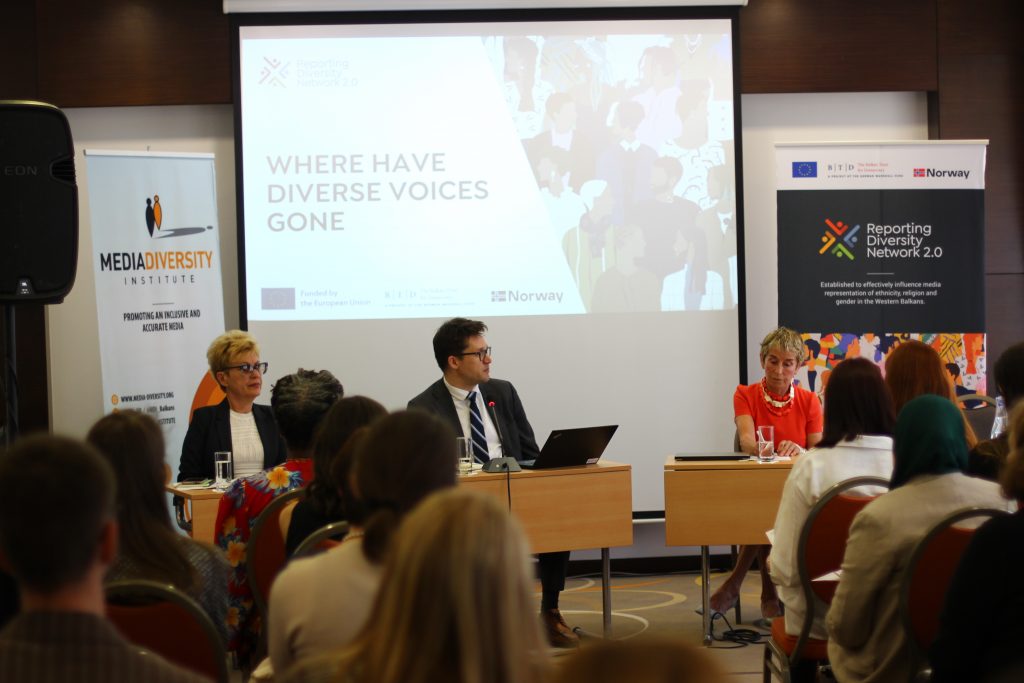
“European Union takes increasingly bold steps to support democracy and freedom of expression, that depends of course on media freedom, pluralism, independence and viability, as well as on the ability of journalists to do their job without fear. Diversity and making all voices heard, which is the topic of the conference today, is of utmost importance too”, said Dragutan after commenting on increased polarisation in media globally, the spread of the “Fox News model” of opinion media, disinformation circuits amplified by social media.
The RDN2.0 media monitoring findings were presented at the conference by media experts from the region: Kristina Lani (Albanian Media Institute), Leila Bičakčić (Center for Investigative Journalism), Violeta Oroshi Berishaj (Kosovo 2.0), Željana Kandić (Center for Investigative Journalism Montenegro), Bojan Georgievski (Institute for Communication Studies Skopje) and Ivana Jovanović (Media Diversity Institute Western Balkans).
“Hate speech along gender lines mainly presents itself in the form of victim blaming, perpetuation of the tradition that women should possess virtue, as well as objectification of women for entertainment” said Kristina Lani from the Albanian Media Institute.
Željana Kandić from the Center for Investigative Journalism Montenegro pointed out that in Montenegro, the most frequent targets of hate speech are women who are engaged in public affairs.
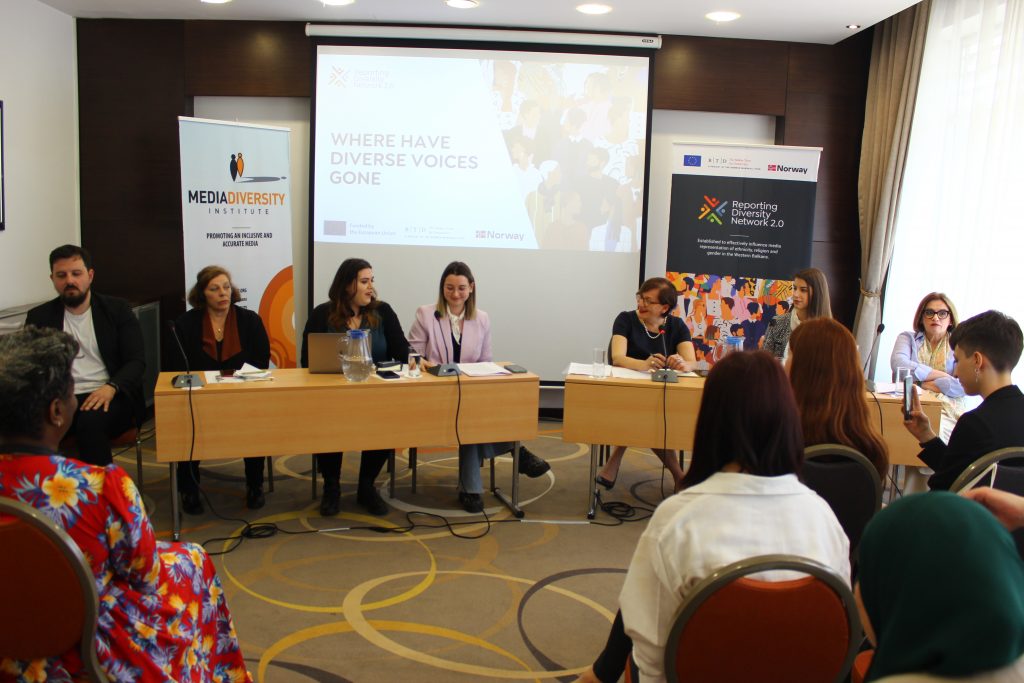
“Most often, women who are engaged in public affairs are targeted, i.e., politicians, journalists, representatives of the NGO sector. In the last few years various examples of misogyny have been noticed – from insulting comments, through to caricatures in which women are shown naked and in an inferior position, all the way to death threats” said Kandić.
Ivana Jovanović from Media Diversity Institute Western Balkans said that the situation is not any better in Serbia, and that the results show that women are the most exposed to hate speech and gave the example of the media with a national frequency that in 2021 participated in the secondary victimisation of women who reported rape allegations and sexual harassment allegations.
“Certain tabloids, as well as televisions with national frequencies, spread narratives that shift the blame to the victim who reported (sexual) violence, as well as conspiracy theories that rape and sexual harassment allegations ‘represent an attack on Serbia’ and thus they participate in the secondary victimisation of victims” said Jovanović.
The panellists said that the targets are those who challenge traditional values, such as women who are fighting for their emancipation or members of the LGBTQ+ community who do not fit the traditional norms.
Bojan Georgievski from the Institute for Communication Studies Skopje also pointed out the role of social networks when he spoke about the ‘Public Room’ case – the Facebook group within which men shared private pictures of women without their consent. Georgievski also noted that this case is in a way an example of good practice, because the administrators of the group were punished with imprisonment, but he also pointed out how this case pointed out the weaknesses of the system, as it took a year to process the case.
Ethnicity is also a sensitive category of social diversity and the results in all six countries can confirm this. The reporting on neighbouring countries is problematic, and there exists particularly sensitive topics such as the Serbia-Kosovo relations or the wars of the 1990s.
“When journalist Pero Jovović went to Pristina for the festival ‘Mirëdita, dobar dan!’ and posted it on his private Facebook profile, pro-government tabloids used it as to target him and his media outlet, which led to Jovović receiving death threats on social networks. A similar thing happened to activists as well as journalists who reported on the mural of convicted war criminal Ratko Mladić. From these examples we can see that the media are very often generators of hate speech” said Jovanović.
Violeta Oroshi Berishaj, who followed the media coverage in Kosovo, also pointed out the relations between Pristina and Belgrade as the initiators of negative trends in the media, which then spill over into social networks. She also spoke about how the media often do not use open hate speech, but the way they report influence public opinion, which is then manifested in an avalanche of hate speech on social networks.
Leila Bičakčić from the Center for Investigative Journalism (CIN) of Bosnia and Herzegovina pointed out that the media in the region are polarised and follow in the footsteps of politicians. The findings from the research confirm that politicians in the Western Balkans are often the initiators of rhetoric that encourages social divisions and hate speech.
What is also common to all Western Balkan societies is the absence of Roma from the media. Interestingly, the monitoring findings do not show many examples of hate speech against Roma. However, this is an indicator of an equally negative trend – Roma are reported only on the occasion to mark World Roma Day or in reports on crime and similar negative contexts. Conference participant, Kristina Lani, called this “hate silence”.
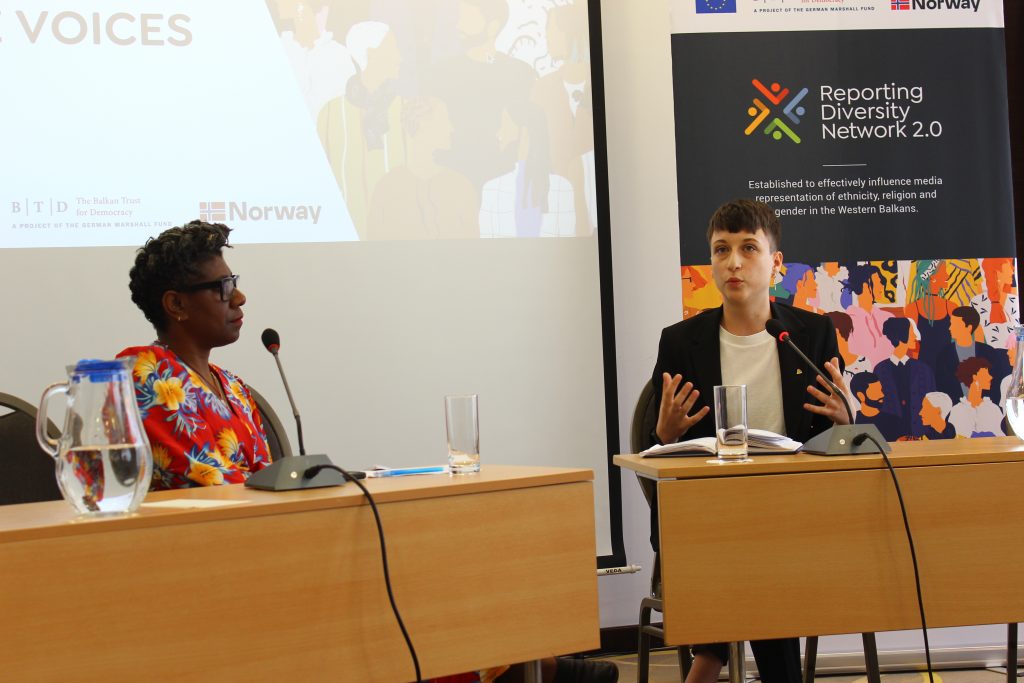
At the conference ‘Where have diverse voices gone’ media representation of diversity was further explored through several panels that dealt with the importance of creating counter-narratives, the thin line between freedom of speech and hate speech, the role of social networks in spreading hate speech, but also in fighting against it. Also, a panel with representatives of regulatory and self-regulatory bodies from the Western Balkans aimed to raise discussion about existing practices to combat hate speech and harmful practices in media representation of social diversity, as well as the cooperation of civil society with institutions.

Monthly monitoring highlight: Hate speech during April across Western Balkans
May 13, 2022
Throughout the month of April, the RDN monitoring team has detected a range of hateful narratives and discourse. This month there has been a rise in ethnic discrimination, sexism, and homophobia in the Western Balkan region.
Ethnic discrimination in North Macedonia, Serbia and Bosnia and Herzegovina
The now-former Secretary-general of the Government of North Macedonia, Muhamed Zeqiri, was arrested on suspicion of abuse of his official position of authority. Muhamed Zeqiri has been accused, alongside two Croatian citizens, for concluding a contract for public procurement of consulting services with a legal entity without conducting a public call for the procurement, thereby damaging the state budged by a total of 795,000 euros. He has now been imprisoned and is currently serving a 30-day detention.
Following his sentence, a Twitter user posted a picture of Zeqiri during his imprisonment, while taking a walk outside, with the caption “is there something more beautiful than an Albanian in prison?”
The public in North Macedonia is inclined towards believing that Albanian politicians are often spared from arrest and imprisonment despite law breaking, due to the political allegiances between the political figures and Albanian political parties. Thus, hateful and discriminatory narratives are often presented along ethnic lines as seen in this Twitter post. This comment on Twitter was motivated and rooted by a similar belief, further fuelling tension between the two ethnic communities.
In Serbia, the Instagram page Bunt Kosovo and Metohija is one which shares numerous pro-Russian posts including denying the crimes and acts of violence in Ukraine, labelling it as ‘Western propaganda’. Furthermore, they publicly deny the Srebrenica genocide, equating these – what they call – ‘fake crimes’ in Ukraine to the ‘made up genocide in Srebrenica’.
The post itself read “The Ministry of Defence in Ukraine published a disturbing video in which it informs that during the previous few weeks, civilians in Bucha were randomly killed, some with their hands tied behind their backs, and bodies were scattered on the city streets. They called Bucha ‘the new Srebrenica”. At the bottom of the post was written “Russia must win this war. Work, brothers, everything is fine at home!”.
This post is harmful and problematic for a number of reasons. The war in Ukraine is an extremely sensitive issue with many people falling victim to the conflict. Apart from spreading unverified claims, harm is done by labelling Srebrenica as a ‘fake crime’, undermining the Srebrenica victims and casualties in the 1990s. Posts such as these promote ethnic discrimination and divisions amongst the public, further opening the wounds of the conflict in the 90’s, which remains highly sensitive and polarising topic in the Balkan region.
In Bosnia and Herzegovina, the Twitter page ‘Samopoštovanje’ (samo_postovanje) tweeted a post which read “by forcing lies and half-truths, we will not reach reconciliation, but we will only sink deeper into mistrust, disbelief and even hatred”. The group Samopoštavanje is a group which comes from Prijedor, who present themselves as a group which wants to restore national and cultural self-esteem.
Despite the fact that the Hague Tribunal’s ruling has confirmed that the Prijedor Crisis Staff in 1992 had ordered both Bosniaks and Croats from the area to wear white stripes on their upper arms as a sign of their ethnicity, the Samopoštovanje group denies this. Attached to the twitter post is a YouTube video titled ‘A lie called a white stripe’.
By denying the events which took place during the war in the Balkans in the 90s, including the experiences of the victims of Prijedor war crimes, these statements actively spread misinformation and disinformation regarding historical events. These events have both been confirmed and ruled by the Hague Tribunal. By further denying and labelling these events as ‘half-truths and lies’, it is both insensitive to those who fell victims and those who lost loved ones in Prijedor, but also harmful for the reconciliation process and building peace in the region.
Homophobia in Kosovo
Following the election assembly, the Union of Kosovo Tarikats issued a joint statement in which amongst other things, it expressed a wish to cooperate with institutions; “the Union of Tarikats especially wants to work together with institutions in Kosovo in building a society without prejudice, which we know as racism, ethnic hatred, misogyny and Islamophobia, Sufi-phobia, and other exclusive forms that undermine trust and understanding in society”. As a result of this statement, several influential online media such as “Gazeta Express” and “Insajderi” claimed in their headlines regarding this news, that this religious community advocates same-sex marriage. The headline reads: “The first religious community to support same-sex marriage”. This inaccurate headline, also published on their Facebook page, provoked mostly negative comments in which various individuals used hate speech aimed at the Union of Kosovo Tarikats and the LGBTQ+ community. The Secretary of the Union, Sheh Lulzim Shehu told several media outlets that same-sex marriages are decided by the state, and that this issue should be resolved by law, but that they are against homophobia.
The Union of Kosovo Tarikats has around 250,000 believers, and the general public considers the dervishes members of the Islamic religion. However, the Union has refused to be part of the Islamic community of Kosovo. Unlike the three largest religious communities in Kosovo (Islamic, Catholic and Orthodox) which openly oppose same-sex marriage and the LGBTQ+ community in general, believing them to be dangerous to the future of mankind, the Union of Kosovo Tarikats have very different, more liberal ideas and attitudes on these topics.
This case is an example of the news fully taken out of its original context, resultingd in hate speech and narratives targeting various communities and individuals. The media has a duty to report factually and accurately, especially when the news has an effect on marginalised groups in society.
Sexism in Albania and Montenegro
In the feature by Top Channel on the rising number of divorces in Albania, divorce lawyer Vjollca Pustina argued that women are becoming initiators of divorces in most cases as “they can no longer stand being violated by their spouses”. The economic independence of women was also listed as another factor and contributor to the rising divorce rates. The headline read “Why is the number of divorces increasing? The lawyer: women can no longer stand violence”.
The framing of the statement, as well as the headline provided by Top Channel, are prime examples of victim blaming. Divorce is seen as a social problem, and in Albania is often still seen by many as ‘scandalous’. However, the real social problem lies in the gendered abuse and violence, which should be considered as a much more serious issue than simply a factor in divorce rates. Such headlines and statements divert attention from the true, root cause of the issue. Many women are victims of domestic violence and abuse, and so offering a platform to narratives suggesting it is simply a factor in divorce rates rather than an issue of concern in itself is a problematic approach to the topic.
In Montenegro, the MP of the opposition Democratic Party of Socialists, Dragica Sekulić, was a victim of brutal insults as a result of a Twitter post where she criticised the measures of the Minister of Economic Development Jakov Milatović, who suggested that every new-born in a municipality with negative natural growth should receive one thousand euros and with positive natural growth, 500 euros. At that time, Milatović held a meeting with the Metropolitan of the Serbian Orthodox Church in Montenegro, Joanikije.
Sekulić stated on Twitter that “if you choose to give birth in a certain municipality, you will receive 500 or 1,000 euros, with the blessing of the priest. Is it worth it?” in reference to that meeting. Following her post, Sekulić was attacked with vulgar insults on the basis of her gender on the Facebook page of the portal I Love Podgorica, which published her tweet. Nearly 400 comments, dominated by hate speech, are still on the site.
The attacks on Sekulić were condemned by almost all of the opposition parties, as well as non-governmental organisations and members of the Montenegrin parliament, with appeals to the authorities to react urgently.
This case has an interesting follow up, as MP Sekulić has announced lawsuits against authors of 381 online comments as well as the portal I Love Podgorica because they did not remove the comments fast enoughThis could set a precedentin the sense of extending the editorial responsibility on social media.
This case sparked debates about free speech, which is a continuous struggle for the legal system as well as other institutions charged withits supervision. In addition, there is discussion about the privileged position of public figures compared to private individuals, who would rarely be able to initiate such legal response.
TROLL OF THE MONTH: Duda Balje, the President of the Social Democratic Union and Member of the Assembly of Kosovo
May 6, 2022
The Balkan Troll of the Month is an individual, a group of individuals or a media outlet that spreads hate on the internet based on gender, ethnicity, religion, or other diversity categories. The Balkan Troll is selected based on hate speech incidents identified across the Western Balkans region.
April Troll is Duda Balje, the President of the Social Democratic Union and Member of the Assembly of Kosovo, who spread hate speech directed at an individual contributing to a surge of hateful attacks and violent threats against the individual and her family.
Recently, the director of the Nexhmedin Nixha Technical High School in Gjakova/Đakovica, Florentina Gjergjaj, was forced to resign from her position due to a wave of hateful and personal attacks towards herself and her family.
It all started following the revelation of a set of school rules which included a headscarf ban on wearing a headscarf alongside other bans including carrying weapons, wearing make-up, and more. The headscarf ban led to an outcry and backlash towards Gjergjai as this ban is thought to be her decision. As a result, Florentina Gjergjaj was asked to step down from her role as director of the technical school at the insistence of Gjakova/Đakovica County Educational Director Eranda Kumnova.
Following the revelation of the situation and of the ban itself which spread amongst the public, Gjergjaj received an overwhelming number of personal attacks on various social media. The comments and attacks were directed personally at her and her family and included, among other things, threats of burning down her house. As a result of these attacks, she and her family were forced to move away, and they are even considering leaving Kosovo.
Florentina Gjergjaj reported the hateful comments and threats she was receiving to the police which, in her opinion, stem from the reaction of MP Duda Balje, who publicly addressed and called out Gjergjaj to answer regarding the school’s ban.
Balje, among other things, wrote on her Facebook profile “Director of the Secondary Technical School ‘Nexhmedin Nixha’, in Gjakova/Đakovica, Mrs. Florentina Gjergjaj, on the basis of which Constitution or law did you set the symbols of prohibition?! I agree with some of them, but the symbol of the girl with the headscarf and comparing symbols in this way is scandalous and an insult to every citizen and our Republic, not excluding religious beliefs”.
This was seen as an instigation to the stream of hate speech and threats that Gjergjaj and her family received.
Most threats and comments that Florentina Gjergjaj received were based on religious grounds. In the context and period of Ramadan or Eid, the media and headlines focused on a variety of topics including that of the permission of individuals to wear headscarves in primary and secondary schools. The President of the Islamic Community of Kosovo, Mufti Naim Ternava stated that he believed the case at the Technical High School to be an omission as in no case can a headscarf be equated with a weapon or alcohol and other negative things.
That headscarf ban was probably imposed at an earlier stage, but was rather used at this timing to initiate a public conversation on the topic itself.
There is an Instruction by the Ministry of Education which does not allow underage girls to wear headscarves in schools. Indeed, following this case, the ‘Kosovo’s Islamic Community Council has requested from ‘the Ministry of Education, Science, Technology and Innovation, to remove the ban of wearing religious symbols in high schools’.
In addition, it is believed that the fact that Gjergjaj is a Christian Catholic adds another layer to this story as her religion have been misused in some comments directed at her.
Almost every media in Kosovo covered this case and incident at the Technical High School in Gjakova/Đakovica, reporting primarily in a professional and correct manner. However, there were also a number of comments on social media networks which insulted and demanded punishment for Florentina Gjergjaj whilst others defended her, reminding the public that Kosovo is a secular state.
This incident is one surrounding the important topic of religious freedom and individual rights in Kosovo. As a result of the direct targeting by MP Duda Balje and other social media users, both Florentina Gjergjaj and her family were forced to move away from their home and are even considering moving out of the country altogether. Both her and her family have fallen victims to hate speech and violent threats as a result of social media trolls and comments.
Reflecting diversity in the media: why and how?
May 5, 2022
The importance of reflecting diversity in the media
On April 28th 2022, the Albanian Media Institute organized the conference: “Reflecting diversity in the media: why and how?”.
The conference took place as part of the activities of the Reporting Diversity Network 2.0 Project, which has been implemented since 2020 in Albania, Kosovo, North Macedonia, Serbia, Montenegro, and Bosnia and Herzegovina. The project aims to replace divisive narratives and hate speech mainly of ethnic, gender and religious backgrounds, thus contributing to the promotion of the values of coexistence, tolerance and good neighborliness in the region.
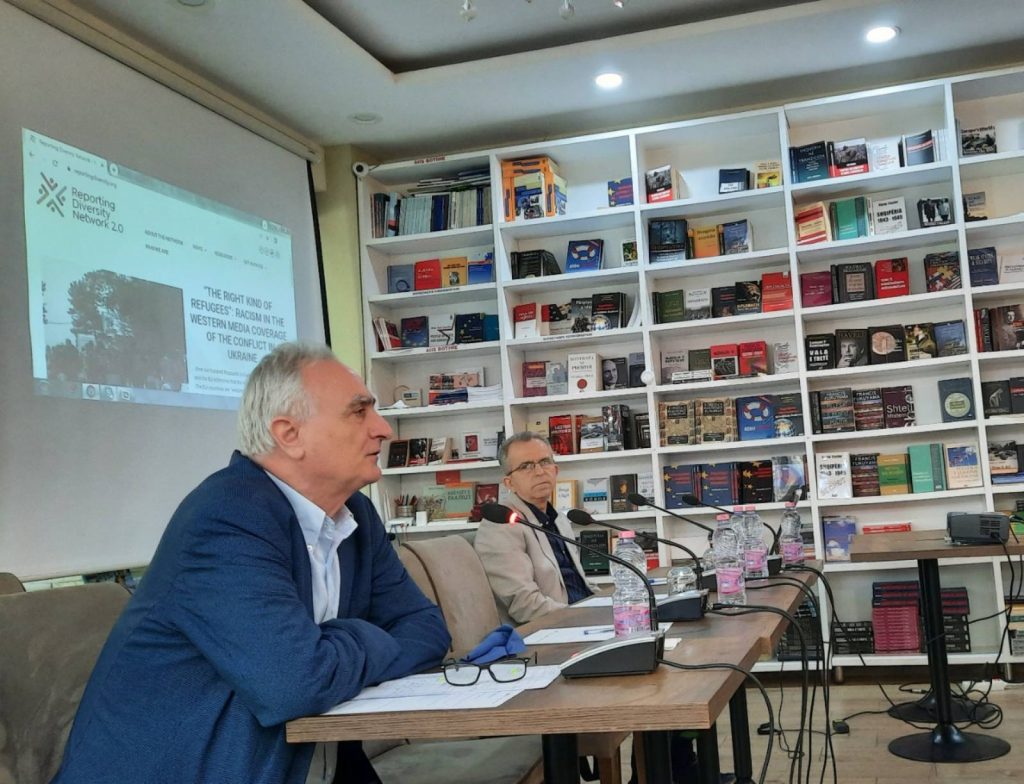
Reporting Diversity Network 2.0 is a continuation of the network established in 1997, at which time the First Reporting Diversity Manual was drafted and the Media Diversity Institute was established in London. The purpose of the Network is to promote accurate reporting and dignified representation in the media of diversity with racial, ethnic, gender, religious, and other, backgrounds.
The Albanian Media Institute (ISHM), as part of the Network, strives to improve the reporting of diversity in the media by pursuing a proactive approach, which means creating space for society, as it really is and looks like, to be reflected in the media. Thus, ISHM does so by embracing the fact that we are all different, we have different beliefs and opinions, different ethnicities, but we have a common right, which is to present ourselves with dignity, professionalism and accuracy in the media. As Remzi Lani, director of the Albanian Media Institute, emphasizes, “Albania needs reporting on diversity in society more than reporting on minorities, because the media has a duty to reflect the diverse world as it is, with ethnicity, religious beliefs, gender orientations, etc.”
This proactive approach was also reflected in the conference, which invited representatives of the Audiovisual Media Authority, the Commissioner for Protection from Discrimination, the Committee of National Minorities, the Center for Interfaith Cooperation, academia, civil society organizations covering target groups such as women in the media, women in science, children, people with disabilities, the LGBTQ+ community, etc. Journalists, students, teachers and representatives of youth and media organizations were also present.
The current situation of the reflection of diversity in the media
Despite the different institutions and target groups that the guests represented, they have one common concern: the misreporting of diversity in the media, which often includes hate speech, bias, offensive language, sensationalist language, derogative language, and sexism or misogyny. Prof. Rrapo Zguri stressed that “even in the mass media in Albania, animosities based on erroneous generalizations are present in the portrayal or reflection of the other or of the one who is different.”
Furthermore, other issues identified in the reporting of diversity in the media are “prejudices as a strategic form of self-reliance,” which appear in the phase of aggressive awakening and that of “dormancy.” The presence of the discourse of the majority or the “syntax of hegemony” leads to the denial of the rights of the ‘minority’ to be heard and represented in media and society. Other problematic lines of media discourse are related to religious or ethnic origin, rhetoric of ethnic, religious or regional superiority, collective instead of individual portrayal, euphemistic and ableist language, etc.
Suela Lala, from “Fondacioni Së Bashku” (Together Foundation) shared cases of inappropriate reporting on people with disabilities in the media, such as through the use of euphemisms as “differently abled,” or “special needs,” or denigrating terms such as “blind” or “deaf.” On the other hand, stories that present them at the dramatic extreme, with compassionate language or that which attributes supertalents, according to her, do not reflect reality, but stigmatize this target group and do not represent it as it really is.
Suela Musta from “Albanian Women in Audiovisual” shared the findings of the study conducted during the period May-June 2021, on women and girls in the media, who continue to remain underrepresented and misrepresented. The use of sexist language prevails, gender stereotypes are reinforced and women and girls who are victims of domestic violence or sexual abuse are blamed, while perpetrators and aggressors are justified. A sensationalistic approach and disrespect for the right to privacy also remain extremely problematic.
Reporting on religious topics also remains problematic, where, according to Sokol Lulgjuraj, from the Center for Interfaith Cooperation, the media reports in a biased manner and messages are distorted or used out of the context where they are stated. The rush to bring the latest news prompts immediate reporting and increases the risk of inaccurate reporting, non-verification of information or statements. Media outlets turn out to be selective and not inclusive in reporting on religious activities, which, according to him, occurs because “the media has no economic interest” in presenting a peace gathering of believers of all faiths.
Sead Kazanxhiu, from the Committee of National Minorities, stated that the media reports “in an exotic, prejudicial and discriminatory manner” on topics related to national minorities. He stresses that the media and journalists need to be more in-depth and professional when reporting on minorities. When it comes to reporting on minorities, “hate silence” is present, indicating a lack of reporting or representation of these groups in the media. Negligence and forgetfulness are just as harmful as misreporting.
On the other hand, Xheni Karaj, from the LGBT Alliance raised concerns about inappropriate media reporting on topics that affect the LGBTQ+ community, where it is observed that statements are taken out of context, headlines are sensationalistic in nature and television moderators and hosts are not professional and impartial during programming. All this lack of professionalism affects the spread of hate speech against the community and its particular individuals, the consequences of which can also be physical attacks or persecution in real life. “Reporting for clicks, or just a headline for a journalist in the newsroom, can turn into a nightmare in a person’s real life,” she added.
The current situation of diversity reporting in the media is obviously problematic, for all social categories without distinction. Unprofessional and unethical reporting, especially when it contains hate speech, insults, contempt and bias reinforces negative and harmful stereotypes about the “other”, whoever he/she is, creates social divisions and incites violence, which can then lead to discrimination or hate crimes.
Suggestions for improving diversity reporting in the media
In addition to sharing the current situation, the purpose of the conference was for guests to provide suggestions for improving the reporting of diversity in the media. Thus, Arben Muka, from the Audiovisual Media Authority, stressed that, in addition to reviewing complaints and content, an effective approach is to promote information and awareness on proper diversity reporting, as well as to encourage self-regulatory engagement. The fine against media service providers, as a punitive measure provided by law, does not always give the expected result, as the same violation may occur again by the same subject. In this case, education rather than punishment seems to be the most promising approach, although what this education/literacy involves and how it is enforced concretely in cases of violations of the code of ethics of journalism, remains to be clarified.
On the other hand, Robert Gajda, Commissioner for Protection from Discrimination, stressed that a good practice of improving the reporting of diversity in the media is the “immediate response” right after an incident or a misreporting has occurred. According to him, a timely reaction provides an opportunity to correct the news without going viral and without causing “greater harm,” as well as due to the fact that it is more effective in real time.
Regarding the representation of women and girls in the media, Blerjana Bino from the Center “Science and Innovation for Development” (SCI-DEV) & Network of Albanian Women in STEM, emphasizes that the presence of women in STEM in the media should be increased and a proactive approach should be followed to the identification and provision of media space. Education/literacy and awareness, as well as monitoring and responses remain active forms of improving media reporting of women and girls. Suela Musta, meanwhile, emphasizes that the new Broadcasting Code should pay special attention to sexism and misogyny in audiovisual media, with the aim of reducing them as much as possible.
Suela Lala says that improving reporting on people with physical, sensory and mental disabilities can be improved by avoiding the use of euphemisms, reporting in a balanced, non-sensationalistic way, as well as by reporting from a human rights approach rather than from a defensive approach that presents them as categories to be pitied.
In conclusion, other practices for improving media diversity reporting are immediate social and media responses, through reporting or public statements; taking stronger measures against national televisions which use television space to reinforce negative stereotypes, sexism, misogyny or denigrating language towards different social groups; large-scale media literacy for all age groups, as well as reports and complaints to the “Complaints Council” or the “Alliance for Ethical Media.”
Who asked her for her opinion – women in the media in Serbia
April 20, 2022
Although they make up half of the population, women as subjects and sources of news are in only a quarter of the world’s media content, according to the latest results of the Global Media Monitoring Project. The situation in Serbian media is below the world average, because women appear as interlocutors in a fifth of the content. Serbia has been participating in this research since 1995, and current results show no major progress since then.
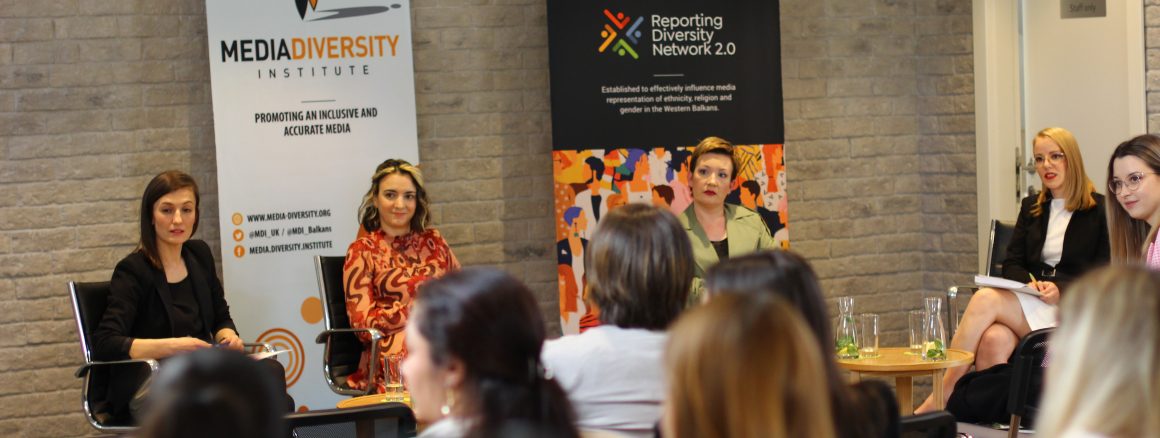
Whether the statistics reflect the situation on the ground, how are women reflected in the media, in which areas we witness positive progress and what are the solutions for improving the image of women in the media in Serbia, was discussed on Thursday, April 14th, in Belgrade at the conference ‘Who asked her for her opinion – women in the media in Serbia’.
The changes do exist, but that they are very slow, concluded Ivana Jovanović (Media Diversity Institute Western Balkans), Danka Ninković-Slavnić, (Fakultet političkih nauka/Faculty of Political Science, University of Belgrade) i Ivana Kahrmann, consultant for media development and civil society, who shared their experiences at the first panel. The speakers agreed that women are mostly interlocutors on the topics of everyday experiences, they rarely speak form an expert position, they are more visible in the field of culture, entertainment, fashion, health, rather than, for example, politics, economic and security.
The feminisation of the profession has led to more female journalists working in the media than male journalists, but, paradoxically, they are not found in large numbers within editorial and decision-making positions, except at the local level.
Where there is less money, there are more women, because men leave those positions – Ivana Kahrmann explained this phenomenon and presented data from Association Local Press research on the position of the media in the local context. Of the 56 media workers from 28 cities in Serbia, 21 are media owners or directors, and some of them are also editors, not because they necessarily want to be, but because they do not have enough resources. They usually establish their own media, because they will not tolerate pressure or mobbing. The research of Local Press also showed that the most endangered category of all media workers and journalists are female journalists, who face the greatest pressure – from not being invited to events, through both verbal acts and violence in the digital space, as well as sexism.
On the other hand, when it comes to media content, of all the discriminatory topics, misogyny and sexism are the most common, and this is common across all countries in the region, according to the results of media monitoring conducted by the conference organiser – Media Diversity Institute Western Balkans – revealed. All the countries in the region are rooted in deep patriarchy, and that is reflected in the media, adds Ivana Jovanović, who conducts media monitoring in Serbia within the Reporting Diversity Network 2.0.
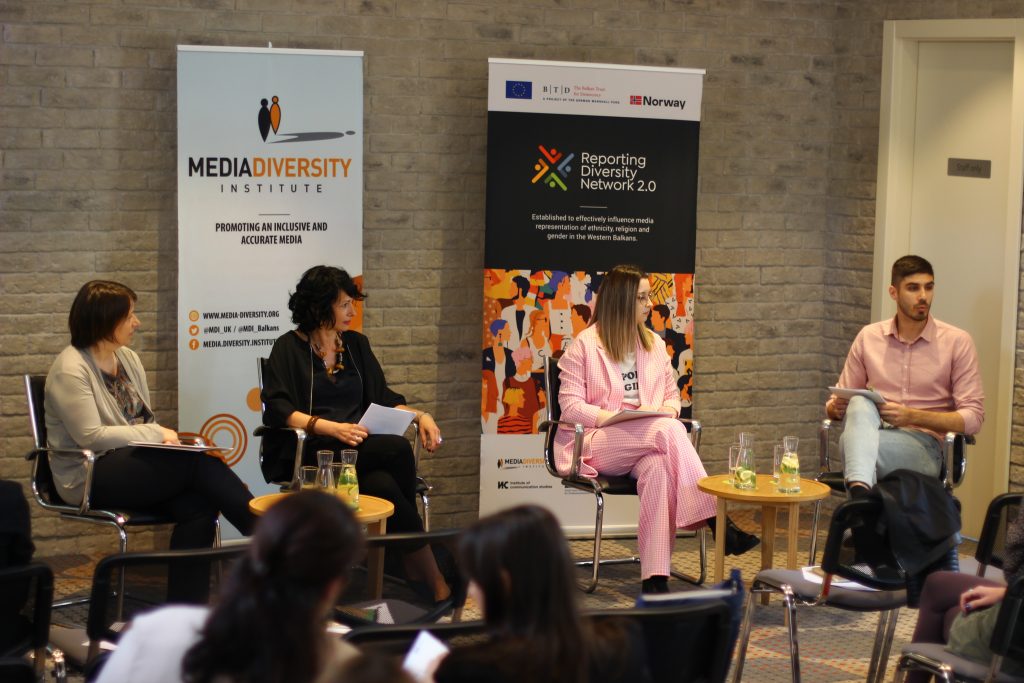
The media do not approach the topic of violence against women as a social problem, but stick to sensationalist reporting – said Jovanović and added that reporting on femicide is deeply problematic, because within the content on this topic you can read everything from secondary victimisation to conspiracy theories.
On a more positive note, the analysis of the group of Journalists Against Violence Against Women (Novinarke protiv nasilja prema ženama) showed that reporting on violence against women is better than it used to be.
In the past three years, 36,000 media publications have been reviewed, and according to all indicators, reporting on violence against women has improved, but the problem is still big – said Jovana Gligorijević (Journalists Against Violence Against Women) and added that she has hope for the young generation because they are young and more willing to be sensitive, as they are living in that which the older generation report on.
Minja Bogavac, agreed with her when presenting an example of good practice – the youth portal ZOOMER.
At the conference Who asked her for her opinion – women in the media in Serbia, the author of the series Ona se budi (She Wakes Up), Mia Bjelogrlić, also spoke about how the idea behind the series was to position the topic of gender equality within the mainstream arena.
– It is now the turn for women to tell the story form their point of view, how they see their position in society, and not for men to talk about it instead of them – said Bjelogrlić and added that there is no single answer to the question of how to unravel the patriarchy, but that she sees the solution to be one of a parallel process, both in the institutional and in the private sphere.
– There is an implied consensus in society as to how a women should live and behave, and changing that requires additional engagement, regardless of laws and quotas, because if the institutional framework does not reflect on everyday life, then there is a gap in which we live – explained the author of the series Ona se budi (She Wakes Up) and added that that is why proactive activism of various kinds is important.
One such solution is the Feminist Media Declaration presented by Jovana Netković (Feministički kulturni centar Befem/Feminist Cultural Center Befem). This document is the result of the continuous work of media experts and is another tool in the fight towards more gender-sensitive media reporting.
In addition, Befem created the Equality Bureau (biro jednakosti), where 19 lists are available to the media wither over 385 women experts in various fields and which integrated the gender perspective in the fields of education, security, sports, culture, economy, mental health etc.
The participants in the gathering agreed that the media is a powerful tool for socialisation, and that is why it is of importance how various identities are presented through them and how topics are discussed. As potential solution to changing the media image, the speakers also mentioned the tools created by the group Journalists Against Violence Against Women. Namely, there is a database of photographs and illustrations that responsibly and ethnically depict the problem of violence, forms and reactions to violence, and /or are aimed at strengthening and showing solidarity with those exposed to violence.
Media Diversity Institute, in addition to monitoring and analysing media content, offers as a solution to this issue – the creation of alternative and counter-narratives in order to contribute to the diversity of images of women in the media.
All speakers at the conference agreed that examples of good practice should always be highlighted, especially supporting female journalists who bring stories in a professional and sensible way, and recommended that colleagues and media workers always consult with those with whom the report refers to as to how they wish to be represented.
The Minister for Human and Minority Rights and Social Dialogue, Gordana Čomić, Deputy Commissioner for the Protection of Equality, Tatjana Prijić, Special Advisor to the Deputy Prime Minister and Minister of Culture and Information, Gordana Predić and representative of the Press Council, Jelka Jovanović, spoke about the protection mechanisms and the institutional framework for improving the image of women in the media, as well as the position of workers in the media.
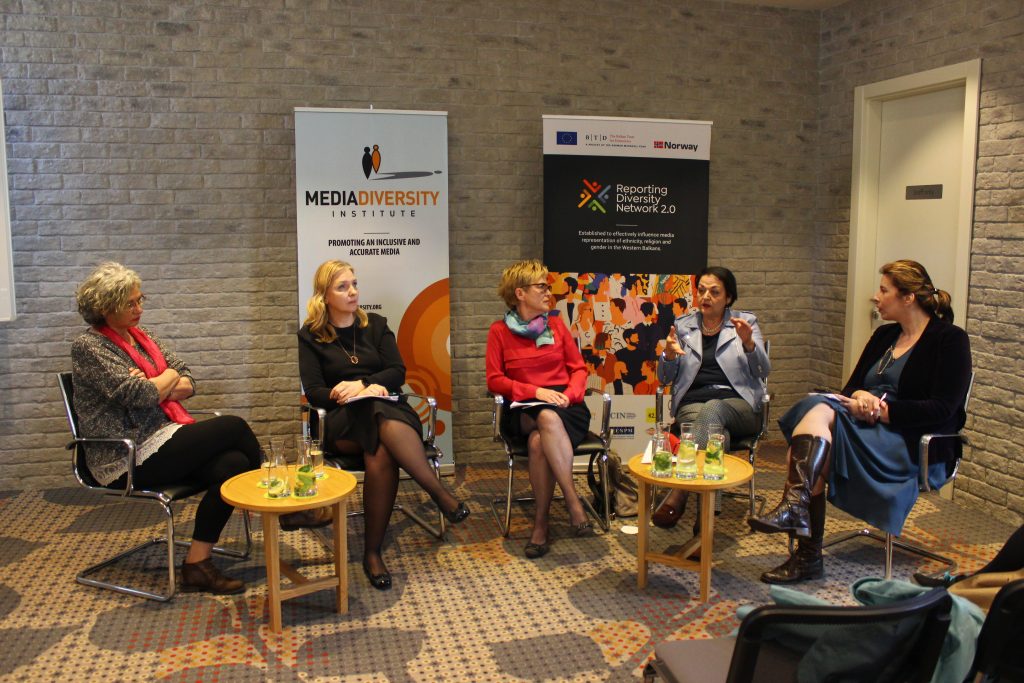
Gordana Čomić stated that all acquired rights must be defended, and explained that the introduction of obligatory quotas for women in decision-making positions is reformative work that cuts into all layers of society.
This is a beginning that must be defended, because first you have to fight for your rights to be written down, then to be turned into action, and then you have to fight so that someone doesn’t bring you back, and only then to improve those papers – said Čomić, adding that you cannot ban prejudice, but you can ban behaviour based on prejudice.
Tatjana Prijić confirmed that stereotypes and prejudices are a big problem and added that one of the solutions to this is to start by not doing to others what we do not want to be done to us, and not just because the commissioner or the law will tell us not to.
The gathering was concluded with the words of Jelka Jovanović who said that the media is a mirror of society, but often also a generator of ideas or initiators of topics, and that only a small number of media raise the issue of the position of women, and therefore, men in society.