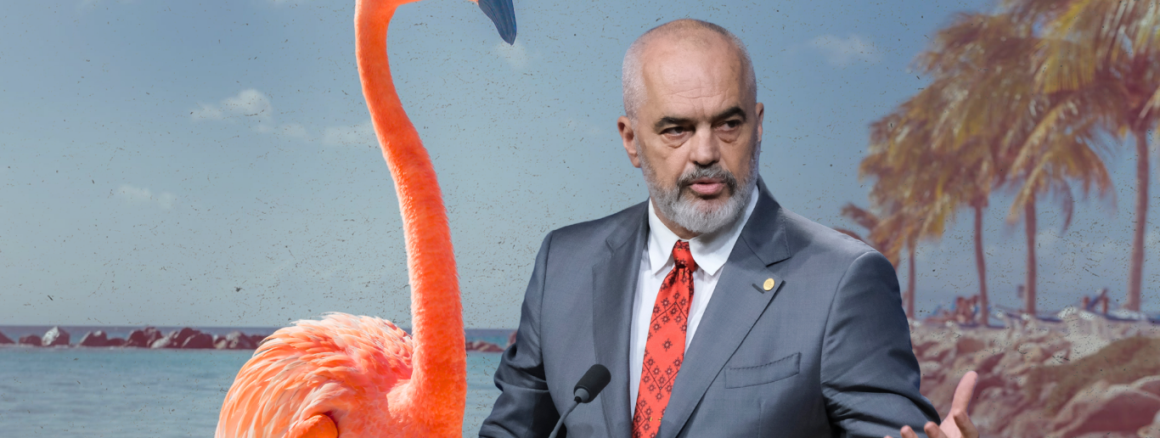
A Lie Has No Legs, Flamingos Have One
July 14, 2026
What began as a local revolt against the construction of a luxury complex in the protected area of Zvërnec, in Albania, transformed within a few weeks into what is being labelled the Flamingo Revolution. This protest, which has now taken on the dimensions of a broader resistance against a 35-year-old political system, is taking place not only in the squares but also on another, equally fierce front: that of information. In the midst of this confrontation, disinformation has become the primary tool to control the narrative and delegitimise the demands of citizens.
Deflection as Strategy
For Prime Minister Edi Rama, the protest is not an organic civic reaction, but a movement initiated and fueled by false information widely spread on social media platforms. He claims that so-called “external” and “internal enemies” are behind it, aiming to damage tourism and destabilise the country at a time when Albania is close to joining the European Union. His accusations have targeted everyone from influencers to entire states such as Greece and Iran, which he has described as instigators of the protest through the spread of misinformation.
Speaking from Berat, the Prime Minister responded harshly to protesters on the second day of demonstrations in Tirana, arguing that they had fallen victim to manipulation regarding the Zvërnec project. According to him, claims that the land had been sold to Israel are fabricated. He stated: “Normally, those who protest should say ‘I protest against this project.’ But they cannot, because the project is not even finalised… They fall prey to some pseudo-Muslims who spread a legend that Zvërnec has been sold to Israel.”
Monitoring of public communication shows that the government has followed a deliberate strategy to shift attention away from the real causes of the protest. Geri Emiri, journalist and founder of Amfora Media, explains that after the initial wave of protests, the government’s communication changed focus: “Instead of keeping the debate on the reasons that brought citizens to protest, attention gradually shifted toward individuals who became more visible in organising and articulating it.” According to him, this serves as a mechanism to avoid accountability on issues such as environmental protection and investment transparency.
He further notes a shift toward personal denigration aimed at discrediting civic resistance: “We have seen a move toward denigrating language, including elements of bullying, exposure of private life, or publishing information out of context, creating the impression that the aim is to discredit public figures supporting the protest.”
Kristina Voko, Executive Director of BIRN Albania, emphasises that this narrative directly targets the protest’s legitimacy. “Public discourse has often focused on delegitimising the protest by labelling organisers or participants as manipulated, incited, or linked to certain interests.” According to her, this is a well-known political communication technique that shifts the debate from the substance of the protest to its legitimacy.
When asked about the risks such rhetoric poses to democracy and activism, Voko highlights its impact on fundamental rights: “When public communication is accompanied by labels or accusations not supported by publicly available evidence, there is concern that this may have a chilling effect on the exercise of the right to peaceful assembly and freedom of expression. Citizens should not feel exposed to stigmatisation simply for participating in a protest.”
Enemies, Real or Imagined
Prime Minister Rama has also chosen an aggressive approach on his social media, portraying protesters and activists as victims of misinformation or, in more severe cases, as instruments of foreign agendas. He has labelled activists as “delirious individuals acting with arrogance” and protesters as resembling “Nazi Germany squads.” In an interview with CNN International on June 3rd, Rama described journalists’ questions as misinformation: “We are in a hybrid war. Albania is under attack from enemies we know very well… from hundreds of thousands of fake profiles created to generate this storm.”
Kristina Voko argues that the main objective is control of the public narrative: “Instead of focusing on the reasons citizens are protesting, the debate shifts to whether the protest is authentic, who is behind it, or whether it poses a threat.” She warns that this may deepen polarisation and mistrust in institutions.
Silence, Then Spin
While the government accuses protesters of misinformation, evidence shows that official channels and some traditional media outlets have also spread false information. A flagrant case occurred on June 1 in the studio of the show “Real Story” on ABC News, where a guest published a photograph showing a bus surrounded by Greek flags and several people wearing winter jackets and coats, anathematising the arrival of protesters from Greece to participate in the protest held in Tirana. The photo, treated in the studio as evidence of organised external intervention, immediately turned out to be an image created with artificial intelligence.
A few days later, the General Secretary of the Socialist Party, Blendi Klosi, a guest on the show “Të Paekspozuarit” on MCN TV, labelled an aerial photograph of the protest shown in the studio as AI-generated, alluding to the fact that the number of protesters was smaller than it appeared. This same photograph had been selected and published by the prestigious “The Guardian” as the photograph of the week.
Besmir Semanaj, an IT and Cybersecurity expert, emphasises that “The main victim of misinformation is the Albanian public, and unfortunately a part of it has come from official channels or representatives of the majority.” He also mentions unfounded labelling of Reuters journalists and the use of antisemitic narratives without evidence.
Dissatisfaction with traditional media has led to the popular call to “boycott the media”. Denisa Kasa from the Preservation of Natural Environment in Albania (PPNEA) NGO explains that this happened because television stations ignored the early stages of the protest in Zvërnec: “The absence of media led to a lack of visibility for the protests… and even when they started covering them, they were highlighting elements with negative connotations, in support of the government.”
Geri Emiri adds that traditional media have often covered only the political clash, neglecting the substance. “In traditional media, there has often been a lack of context regarding which properties are the subject of the conflict, which companies are involved… These are precisely the elements that help the public form an informed opinion,” he emphasises. In this information vacuum, social media has become the primary source of information and civic education.
Rama and the socialist majority followed a similar strategy regarding the European Parliament’s June 17 decision on the progress report for Albania and accompanying amendments regarding the 2024 legal changes for protected areas. Despite the EU’s opposition to the Albanian government’s decision to allow construction in protected areas, including its call for a moratorium on development in these zones, Rama portrayed the outcome as a victory for his government, once again linking the debate to disinformation and criticising the protest. “Either Europe has gone crazy and become corrupt, or there is something wrong with those who started the protest,” Rama wrote. A day later, the Prime Minister argued his position by saying that “the government shares the same stance as MEPs on protecting the Narta–Vjosa area and that any change in the law on protected areas will be reviewed within the framework of negotiations with the European Union, in cooperation with the European Commission”.
Denisa Kasa addresses the European Parliament decision, explaining that the government presented it as a victory while, in reality, “on paper it was clear that a moratorium was requested for the law on protected areas”. Kasa adds that disinformation is used to raise “collective fears” by claiming influence from foreign agencies, which particularly affects older generations who get their information from traditional media.
Who Owns the Feed
Alongside traditional media, new media and social media platforms appear equally important in this confrontation, a space for which Prime Minister Rama has frequently expressed concern, viewing it as a machine put into function by protest instigators to influence citizens in altering reality.
From the SP parliamentary group meeting on June 20, Prime Minister Edi Rama spoke extensively about how social networks and algorithms function, which he claims directly affect the way public opinion and the perception of reality are formed, thereby misinforming and consequently orienting protesters. According to him, in the digital age, certain accusations or labels can be perceived as “stable truths” in the online space fed by platform algorithms. Rama reinforced the same position a day later in his podcast “Flasim,” where he described the protest as “algorithm hysteria” and claimed that those participating in rallies have only illusions and are far from the truth. “There are only illusions and distortions of facts and nothing true. The algorithm does its job, and there is only algorithm in that protest, nothing else. The algorithm explains what shocks and not what explains. They are half-truths, which spread very quickly,” Rama expressed, among other things.
IT expert Besmir Semanaj observes that the Prime Minister’s concern relates to the failure of old propaganda mechanisms. “For many years, public perception has been influenced by an organised presence of patronage workers and the use of the ‘Aktivisti’ app… Today, citizens have the opportunity to publish and distribute images and information in real-time,” says Semanaj. He dismisses claims of decisive foreign intervention, emphasising that the large amount of authentic material published by participants themselves makes the success of a false narrative produced from abroad impossible.Misinformation surrounding the “Flamingo Revolution” is not simply a series of fake news stories but a political tool to control public perception. As Geri Emiri emphasises, “Disinformation is not fought with counter-propaganda, but with transparency, the publication of documents, access to information, and verifiable communication”. Until institutions begin to protect the truth instead of producing political narratives, the gap of trust between citizens and the system will continue to deepen.
_________________________________________________________________________________________________________
Author: Ina Allkanjari