31 years later, part of the media in Republika Srpska still relativises the genocide in Srebrenica
July 16, 2026
Once again, judicially established facts are omitted, the victims are portrayed through ethnic or military affiliation, and the commemoration is presented through narratives that diminish its importance.
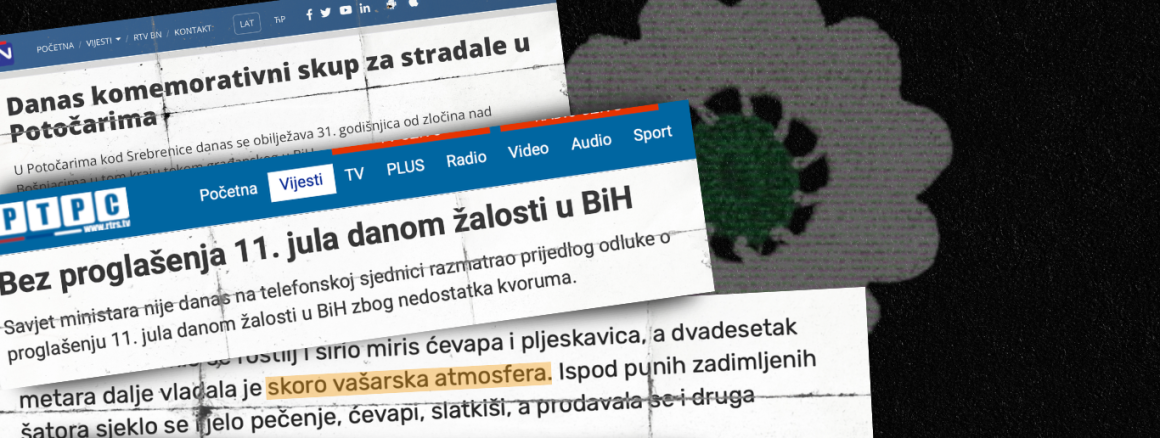
Relativisation and revisionism were also present during the commemoration of the thirty-first anniversary of the genocide committed against Bosniaks in Srebrenica in the majority of analysed portals of the Bosnian entity Republika Srpska (RS).
This year too, those media omitted the facts determined by the court, they portrayed the victims through ethnic or military affiliation, and they presented the commemoration through narratives that diminish its importance. They provided the audience with information that “every year on July 11, the Memorial Center in Potočari commemorates the anniversary of the crimes against Bosniaks in Srebrenica during the civil war in Bosnia and Herzegovina”, without stating that genocide took place, thus diminishing the legal and historical nature of the event, which was established in the judgments of international courts.
Instead of stating the scale of the crime and the facts established by the court, the editors decided to report on the guests at the commemoration, but also on the fact that “the commemorative meeting ‘Srebrenica 2026’ in Potočari, took place peacefully and with dignity”.
A particularly problematic media portrayal of the anniversary of the genocide is noticeable in ATV’s announcement. This portal, quoting the writing of the SRNA news agency, which is documented in reports on the denial of the genocide in Srebrenica as one of the media that openly denies the genocide and engages in warmongering propaganda, described the anniversary of the worst individual horror that happened in the former Yugoslavia during the wars of the 1990s and the worst massacre that happened in Europe after the Second World War as a “massacre” and as “a fair that was ‘seasoned’ with white flags with lilies, but without swords”.
It was also stated that “the gathering was attended by thousands of citizens, numerous delegations from the FBiH and foreign diplomats, mainly from low-ranking countries, mostly from Muslim countries, who laid flowers at the central stone in the Potočari Memorial Center for the fallen Bosniak soldiers, members of the infamous Srebrenica 28th Division commanded by Naser Orić”.
This type of reporting indicates that the commemoration and burial of the Srebrenica victims do not have wider international support, as well as that it is a gathering that is of interest to countries with a majority Muslim population, which diminishes the entire event. Also, the focus is shifted from the victims of genocide to the events of the war, which suggests that it is primarily a military conflict, and not the systematic killing of prisoners and civilians.
Allegations that flowers were laid for “killed Bosniak soldiers” are incorrect and contradict the facts established by the courts, which, among other things, say that the Army of Republika Srpska recklessly killed civilians, i.e. prisoners of war, which is a serious violation of international humanitarian law.
The following were buried in the Memorial Center in Potočari this year: Senad Jusić, Muriz Baraković, Hamed Musić, Ramo Alić, Muhidin Osmanović, Huso Ćerimović, Nuko Nukić, Ahmet Gušter, Asim Kunić and Ramo Dautović. The youngest among them was 20, and the oldest 56.
In addition, it was established that Bosnian Serb forces and other units affiliated with them killed between seven and eight thousand Bosnian Muslim men of various ages in the period from July 11 to 19, 1995. The tribunal found beyond a reasonable doubt that the vast majority of those executed were not killed in combat, but were victims of executions. The International Court found beyond a reasonable doubt that the killings did not take place in a moment of rage, but were the result of a well-planned and coordinated operation. Finally, the International Court found beyond a reasonable doubt that the killing of between seven and eight thousand captured Bosnian Muslims was genocide.
The belittling of the commemorative gathering in the reporting of ATV, and the SRNA agency, continued in the with the statement that “just 200 meters from the place where the commemoration was held, ‘Bujrum, Hamo’s famous Zenica watermelons’ was heard”. The reporting, which has no informative value, but produces an emotional effect that portrays the event as frivolous, continued with the description that “a barbecue was smoking across the road and the smell of kebabs and burgers was spreading”.
RTRS – same old, same old
The public service in the entity Republika Srpska – RTRS did not pay special attention to the anniversary of the genocide in Srebrenica this year either. This broadcaster is also mentioned in the reports of the Srebrenica Memorial Center as a significant source of genocide denial.
Along with a brief statement from the Zvornik Police Department, RTRS reported that “the rally in Potočari passed peacefully and without incidents”, without explaining what was held as part of the “Srebrenica 2026” rally.
In a separate information dated July 10, RTRS reported that the Council of Ministers did not consider the proposal for a decision on declaring July 11 a day of mourning in Bosnia and Herzegovina due to the lack of a quorum, without stating the reason for that proposal.
The same information was transmitted on the BN portal, with the additional sentence that “The Day of Mourning for the Bosniaks who died in Srebrenica has been declared in the Federation of Bosnia and Herzegovina and in the Brčko District”.
This portal also had a short piece of information on July 11, stating that “the 31st anniversary of the crimes against Bosniaks is being marked” and stating that “according to Bosniaks, more than 8,000 people died in Srebrenica.” This information was transmitted by the news agency Tanjug from Serbia. BN also didn’t state that it was a legal qualification of genocide.
Glas Srpske about flags
Glas Srpske was not more detailed when reporting about the anniversary. Besides the sentence that “the commemoration on the occasion of the 30th anniversary of the suffering of Bosniaks during the last war in Bosnia and Herzegovina has ended in the Memorial Center in Potočari, which will be followed by the collective burial of 10 more victims”, Glas Srpske reported some of the statements of officials from the commemoration.
On the other hand, this portal paid attention to the flags of Bosnia and Herzegovina, stating that “a column of about 200 participants of the Bosniak so-called peace march passed through Srebrenica, at the head of which was a prominent flag of Bosnia and Herzegovina, while individuals carried several white flags with lilies, but without swords”. The journalist of this portal stated that these flags are perceived as a provocation, because “they remind of the crimes committed by members of Muslim armed units under that symbol against the Serbs in this region and almost the entire Podrinje during the last war in Bosnia and Herzegovina”. It was also said that “there were no other provocations”.
The flag with lilies was the official flag of the independent Republic of Bosnia and Herzegovina from 1992 to 1998, when the new flag was imposed by High Representative Carlos Westendorp.
The Nezavisne novine portal had somewhat more extensive reports. Without specifying the wider legal context and court-established facts, Nezavisne also reported on how many victims had been buried in Potočari so far, as well as on the ages of the victims who were supposed to be buried this year. The statements of the surviving witness of the genocide, Hasan Hasanović, who spoke at the United Nations, were also transmitted, stating that he survived, but that his father and twin brother did not. Several cities in Bosnia and Herzegovina where the anniversary of the genocide in Srebrenica were commemorated, such as the motorcycle marathon in Sarajevo, or Goražde, where prayers were recited from the minarets of the mosques, were also listed.
At the end of the commemoration, unlike Glas Srpska, which omitted the statement of Denis Bećirović, the chairman of the Presidency of Bosnia and Herzegovina, in which he said that the genocide was planned and brutally committed, Nezavisne included that statement.
Portal Buka covered the anniversary extensively this year as well, clearly indicating that the 31st anniversary of the genocide against the Bosniaks is being commemorated. In one of several announcements dedicated to Srebrenica, Buka also cited judicially established facts, writing that the genocide in Srebrenica, committed in July 1995, was legally marked as such before international and domestic courts, including the International Court of Justice and the International Criminal Tribunal for the former Yugoslavia (ICTY). With this kind of media reporting, Buka remained among the rare analysed portals in the RS that presented the anniversary of the genocide in Srebrenica with the citation of judicially established facts, unlike other analysed media that omitted the legal qualification of the crime or presented it through revisionist narratives.
_________________________________________________________________________________________________________
Author: Selma Fukelj
The article was initially published on MediaCentar and has been republished here with permission.