25 Years Since Serbia’s First Pride
July 10, 2026
First Pride: “A Brawl” and Nothing More?
Twenty-five years ago, the first “revolutionary” Pride was held in Belgrade, Serbia. It ended in massive violence for which no one was ever fully held accountable. That is what most media coverage still comes down to, and outlets haven’t distinguished themselves in their coverage of the LGBT+ community since.
A quarter of a century later, media coverage of Belgrade’s first Pride still largely boils down to the brutal violence that took place.
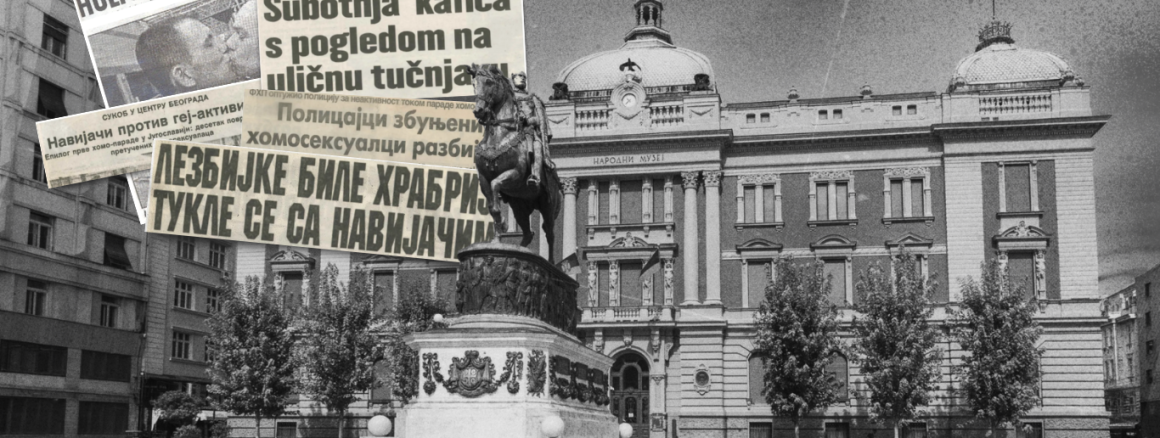
Some of the headlines that ran in the print media at the time included “Fists Cut Short the Parade,” “Homosexuals Beaten, Police Attacked”, “Saturday Coffee with a View of a Street Fight,” and “(Sport) Fans Beat Homosexuals.”
The entire event was portrayed in the media mainly as a “brawl” and a clash with police, while the Pride program itself, the organised threats, and the question of state responsibility were pushed into the background.
Yet it was precisely the state that the organisers had relied on. Back in 2001, they trusted the new democratic authorities that had come to power after the regime of Slobodan Milošević, says Agata Milan Đurić, one of the organisers of that Pride from Arkadija, the oldest organisation in Serbia working on LGBT+ rights.
The Pride was held under the slogan “There’s Room for Everyone,” and the organisers’ intent was for LGBT+ people to publicly claim space, for the first time, as equal citizens.
The plan was to gather at Republic Square, with a march, panel discussions, concerts, and a theatre performance at the Student Cultural Centre. The organisers wanted to help open up society, break down taboos, and build solidarity. All of that was overshadowed by the violence.
“With all due respect to someone I trusted enormously, Prime Minister Zoran Đinđić gave a typically diplomatic, political statement at the time, saying that the 2001 Pride was a test of tolerance for Serbian society,” Đurić says today, “instead of clearly condemning the violence against the citizens who were at Pride that day and doing everything possible to bring the perpetrators to justice.”
Violence Foretold
Most media, Đurić argues, glossed over the fact that the attack on Pride activists was organised by football fans and “neo-fascist and clerical” organisations such as “Obraz” or “Blood and Honour,” among others.
According to media reports at the time, the attackers included fans of Red Star, Partizan, and Rad, skinheads, the youth wing of the Serbian Radical Party, the Chetnik Movement, sympathisers of the Ravna Gora Movement, Svetosavlje youth, and priest Žarko Gavrilović.
“They avoided reporting that we had received many threats and that all of Belgrade was plastered with their threats. The messages were terrifying, like ‘we’re waiting for you,’ and worse things I won’t repeat. Representatives of these organisations gave violent, dehumanising statements to certain media outlets,” Đurić adds.
Arkadija’s archive has been collecting media reports on LGBT+ topics over the past three decades. Jelena Vasiljević, founder of the Rainbow Ignite archive, concludes that the dominant media narrative about the first Pride hasn’t changed.
The queer organisation Rainbow Ignite organised an event called “Žene!” (Women!) ahead of the “Oslobađanje” (Liberation) protest march held by the Queer Assembly on June 30 this year in Belgrade, marking 25 years since Serbia’s first Pride. Lepa Mlađenović, who took part in organising the first Pride, spoke at the event, and activists tried to give the media broader context about it.
“We showed footage from that period, tried to present the bigger picture and the idea behind it, but we’re still portrayed only through the lens of the violence that was experienced. It’s not just the media, civil society organisations spread that same narrative on social media too. Someone got beaten up, the police didn’t want to react, and that’s that,” Vasiljević says.
Invisibility
Vasiljević points out that after the 2001 Pride, a press conference was held at which figures from the intellectual and public life of the time spoke about what had happened and demanded an urgent response from state authorities.
Participants included writer Vladimir Arsenijević, professor Srbijanka Turajlić, playwrights Borka Pavićević and Biljana Srbljanović, and others. Yet, she notes, almost no one reported on that event.
The media landscape back then was different, she says, there were far fewer electronic media outlets and no social media platforms. Some outlets, such as Radio Television of Serbia (RTS), ignored the fact that brutal violence had occurred at the 2001 Pride, or reported on LGBT+ topics in a sensationalist and negative way.
As an example of professional reporting, she cites B92, whose director at the time, Veran Matić, publicly condemned the violence.
What It Was Like to Report
Matić says the chaos at Pride broke out before the program at Republic Square had even begun, and that they “almost immediately found themselves right in the middle of horrifying violence.”
“There were very few police officers, and you could see the fear of the violent mob on their faces. At one point they started firing pistols into the air, trying to stop the attackers. Among the crowd, priest Žarko Gavrilović stood out, his inflammatory statements, which the media published, essentially justified the violence,” Matić says.
Insajder journalist Ivana Konstantinović, who was reporting for B92 in the field at the time, says it was especially demanding for the camera operators who tried to capture the scenes.
“It was one of those moments when you genuinely don’t know what might happen next. On the street with me at the time were Mašan Lekić and Zoran Kesić, together we made a documentary about it and received an honourable mention at a festival in Košice, Slovakia. I remember a part of the documentary where we were told we were entering a certain part of the city at our own risk, that’s a terrifying moment,” Konstantinović says.
Journalist Branko Čečen, who in the newsrooms he worked in at the time pushed for professional reporting on LGBT+ rights, says that for RTS and the commercial media, coverage of the first Pride was “a period of considerable confusion,” and that the event itself did not receive adequate media coverage.
“It was covered by roughly B92 and one other television station, the rest remembered it only afterwards. The reporting on the aftermath was also problematic, on the fairly sluggish response from the prosecution and police, the small number of arrests, and the abbreviated court proceedings that came nowhere close to covering everyone responsible,” Čečen says.
New Media Spaces After the First Pride
After what Đurić calls the “revolutionary Pride” of 2001, she and Dušan Maljković were invited that September by Nebojša Spajić, then an editor at (public service) Radio 202, to host a show called “Gayming,” about LGBT+ people.
“The ‘Gayming’ show was extremely important, people all over Serbia could hear on the radio that they weren’t alone, along with positive messages from our guests about LGBT+ existence and culture. It was shocking to the Serbian public, as some media reported at the time, that drag and queer people were hosting a show devoted to LGBT+ people,” Đurić says.
Đurić says a journalist from what was then Radio Yugoslavia illegally barged into the broadcast and called for a public lynching of the hosts. After the first episode, in which Arsenijević was a guest, a group of people gathered outside Radio Belgrade, and staff inside were told not to leave the building because of a bomb threat.
“That case also went unpunished, just as it remains to the discredit of political leaders that not a single perpetrator of the Pride violence was ever legally prosecuted, even though there was clear video footage. We kept hosting the show after that. Coming into Radio Belgrade was a challenge. On Mondays, when our show aired, there was special security,” Đurić says.
Topics That Are Ignored
Nemanja Marinović, editor at Zoomer and the new queer outlet Unmuted, says the terminology used in reporting on LGBT+ people has changed and that open homophobia is less common, but the LGBT+ population is still exploited in media coverage whenever it doesn’t suit those in power.
“Tabloids serving the regime don’t currently find hate speech and violence against this community convenient, because it sends a pro-European image,” he says.
“It seems to me that the tabloid media have now largely ignored the protest organised by the Queer Assembly, even though it also supported the students’ demands, whereas after the previous Pride, which also openly supported the students, there were headlines like ‘blockader Pride’”, Marinović says.
Marinović points out that in-depth analyses or investigative pieces dealing with the situation of LGBT+ people and their everyday problems are rare.
“I’d say these kinds of topics are pushed forward by individual people trying to change something within their own outlets, while editorial policy only follows along once something stirs up public attention. You can’t report on minority issues only on that minority’s international day,” Marinović notes.
Vasiljević adds that LBT+ women in particular, who face multiple, overlapping forms of discrimination, remain “completely invisible” in the media.
“Especially if we’re talking about Roma lesbians, or lesbians with disabilities or any kind of neurodivergence. The media will always focus on a woman in a position of power, always a white woman,” Vasiljević says.
Đurić concludes that certain media outlets with integrity have helped raise public awareness and understanding that different minorities deserve to be equal to all other citizens.“Over time, media space has opened up more and more for us. It also matters for the public to get to know LGBT+ people, because once a relationship is established, once you read an interview, or watch a good documentary, there’s a good chance that a certain percentage of people will change their views and perhaps no longer hold prejudices or keep their social distance,” Đurić concludes.
_________________________________________________________________________________________________________
Author: Dejana Cvetković
The article was initially published on Vreme, and has been republished here with permission.