Not Just a Statistic: Media Responsibility in Reporting on Victims of Sexual Violence
April 22, 2026
Content warning: This article discusses sexual violence, abuse, and the treatment of victims in media coverage. Some readers may find this distressing.
“If you or someone you know were sexually assaulted, would you please stand. If you or that person you know was assaulted by someone they knew, would you please raise your hand. And if you or that person who was assaulted actually reported it, stay standing.”
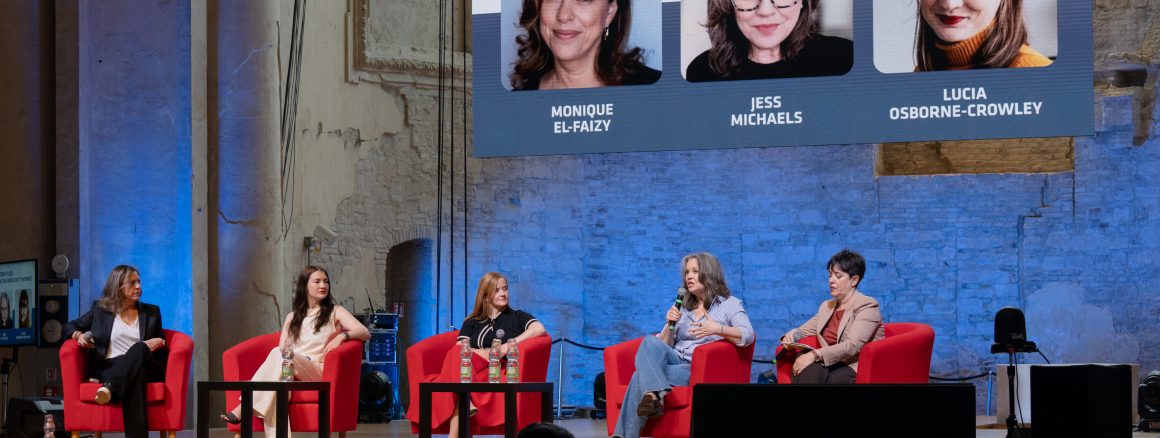
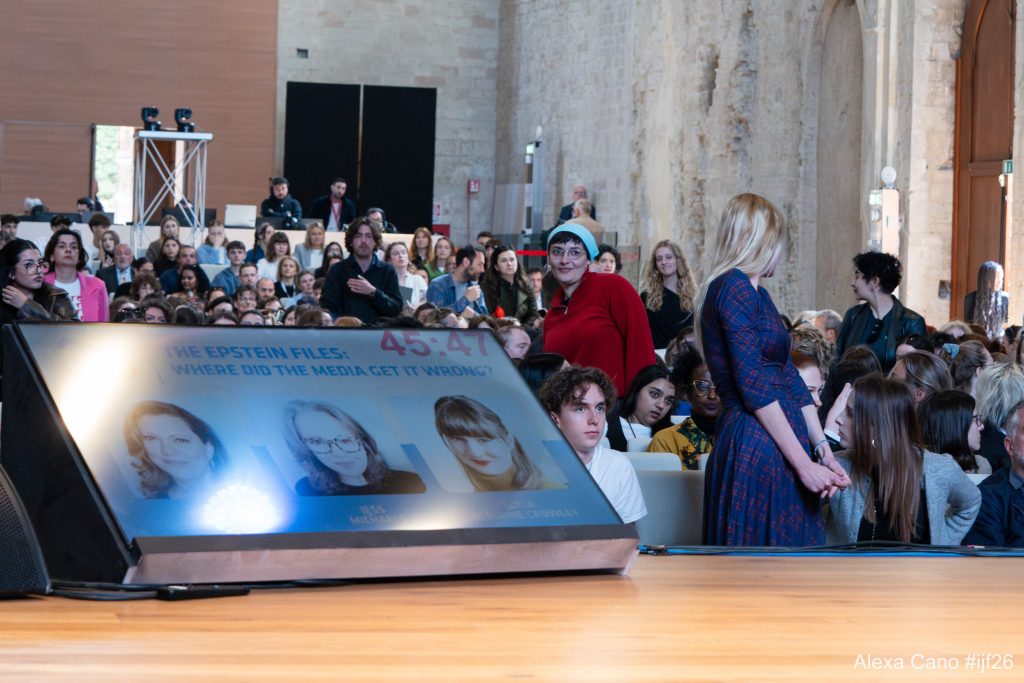
This is how Jess Michaels, an advocate for survivors of sexual assault and founder of 3Joannes Inc, and an Epstein survivor herself, began her talk on the panel at Perugia’s 20th International Journalism Festival.
Shocking or not, it would be safe to say that most of the people in the room stood up, raised their hands, and then quickly sat down. Because that is what we forget – it is not a stranger in an alley or a random person in the park late at night who on average commit acts of sexual violence.
According to the NGO RAINN (The Rape, Abuse & Incest National Network) “60% of rapes are committed by someone known to the victim whereas 2.5% ‘are committed by someone with an unknown relationship to the victim”. Despite its severity, this crime remains one of the most under-reported in the world. Victims often face aggressive interrogation and outright denial, dissuading victims to come forward.
The #MeToo movement saw one of the largest online movements and bravery of women and girls’ testimonies of sexual violence, misconduct and behaviour, drawing awareness to sexual abuse, rape culture and sexual harassment which haunt our streets, our social media, our gaming platforms and day to day life. A movement of exposure, resilience and fight for the protection of women, as well as a call for perpetrators to face the consequences of their actions.
However, as highlighted by the panellists in Perugia, #MeToo was only a starting point, not the end.
We find ourselves in 2026, as the U.S. Department of Justice begins releasing heavily redacted files that peel back the surface of one of the most powerful white men in America, and arguably the world.
The picture that emerges isn’t just of a man, but of something more disturbing altogether; an octopus whose tentacles span across continents from the most influential figures in society, from businessmen to members of the Royal Family in the United Kingdom. The documents trace Jeffrey Epstein’s web of social and financial connections. More disturbing still, they expose not just who he knew, but how he operated,revealing in black and white, his attitudes towards women and the actions that proceeded as a result.
The Epstein Files, despite being heavily redacted, have managed to expose some of the most powerful men in the world and their misogyny, hatred, acts of violence and sexual assault. Yet it remains to be seen whether any of the names mentioned will face prosecution for their actions.
It seems that despite the level of exposure and evidence against them, we are yet again in a situation of lack of institutional reaction and willingness to take these powerful white men and make them face the consequences of their actions. The web around them remains so impermeable that not even the law nor human rights and dignity have been able to break through and shatter their protective glass.
The important thing to remember is that Epstein did not act alone. He had people around him at every corner. From those people who saw what was happening and stayed silent, people who enabled it, and people who took part in it. And yet, the ones who should have been in focus from the beginning, the victims, are still denied the dignity and respect they deserve, across the media landscape, both online and offline.
Instead, we’ve seen coverage that deliberately softens the reality. Victims under 18 are described as “underage women,” a tactic shying away from the actual truth: these are children. It’s a deliberate choice, one that diminishes the severity of the crimes and helps to shield those responsible.
Headlines and articles have been seen to focus on the power, status and influence of these powerful men, reinforcing their importance and position in society while pushing the victims further into the background.
Annette Young, the moderator at Perugia’s panel discussion, drew our attention to an email between Epstein and a French businessman Olivier Colom, a former diplomat and advisor to President Nicolas Sarkozy where Epstein referred to women as “some are like shrimp, you throw away the head and keep the body”. The issue with this sentence, aside from the fact that it was written and sent between two extremely influential and powerful men, is this quote represents a certain attitude towards women which still exists in our society today.
We have all witnessed the case of Gisèle Pelicot, a French woman who was a victim of multiple rape cases orchestrated by her husband Dominique, who would repeatedly drug her and rape her alongside 51 other men while she was unconscious. This case saw justice in the court room with 47 men being found guilty of aggravated rape, two of attempted rape and two of sexual assault. And yet, Gisèle had to endure and suffer years of sexual violence and rape by one of the most trusted people in her life, her husband.
CNN recently conducted an investigation exposing a global ‘rape academy’ with group chats between men encouraging one another to drug and assault their wives. On one specific porn site, there were over 20,000 videos of so called ‘sleep’ content. The website had 62 million views in February alone. One of the users on the website even claimed to be running a business selling sleeping liquids that can be deliveredanywhere across the world.
We need to ask ourselves, why is it that when powerful, rich white men conduct acts of sexual violence and crime, we give them the platform and space to explore their backgrounds, their image, their influence,rather than paying attention to the victims of such crimes. Why is it that the mainstream media yet again has failed the victims of sexual violence by not protecting their dignity, privacy and safety.
Indeed, it goes as far as everyday users on X using Grok, X’s built-in AI system, to unblur or remove the black boxes covering the faces of the children and women photographed and included as evidence in the Epstein Files, whose faces were blurred for the protection of their privacy.
In what kind of society does it become normalised for individuals, regardless of status, to conduct acts of sexual violence and crimes with little to no accountability and consequence?
Towards the end of the panel, attention was drawn to where the media has failed Epstein victims and survivors and where we can do better. The victims of these crimes are human first and foremost, and they cannot be contacted nor respond to every single interview request. It is important we acknowledge that speaking of one of the most traumatic moments and experiences of victims can re-traumatise them.
Furthermore, the importance of protecting these victims is vital; this includes not sharing their personal information such as phone numbers and contact information without consent, to ensuring that their privacy and boundaries are respected. This can also include taking regular breaks during interviews especially when covering sensitive and triggering topics such as trauma and sexual violence. Rather that pushing for the story to come out as fast and as quick as possible, journalists should allow the interviewee to lead the interview and timeline based on their comfort, safety and pace.
Sexual violence and rape are one of the most inhumane acts of violence. As journalists, our role is to make sure we don’t get pulled into the same misogynistic, patriarchal machine that allows rape jokes, sexism, and inequality to thrive. We have to actively go against it. That means being clear about what these crimes are, making sure readers understand them, doing our part in protecting victims from their identity to their personal information and being clear to call out the crimes for what they are – crimes against children, women or men.
The media shapes how people understand society, it has an influence on how people think and view the world, and it is our role to ensure that when reporting on sensitive cases such as sexual violence, we do it responsibly and adhere to the appropriate Code of Ethics. We must remember these are not nameless victims; they are people who have feelings and emotions and who live lives. They are not headlines or case numbers. We must remember this when reporting on such cases, which should be driven by compassion, humanity and empathy rather than competition and sensationalism.
Author: Hana Kojaković
Photos: Alexa Cano #ijf26